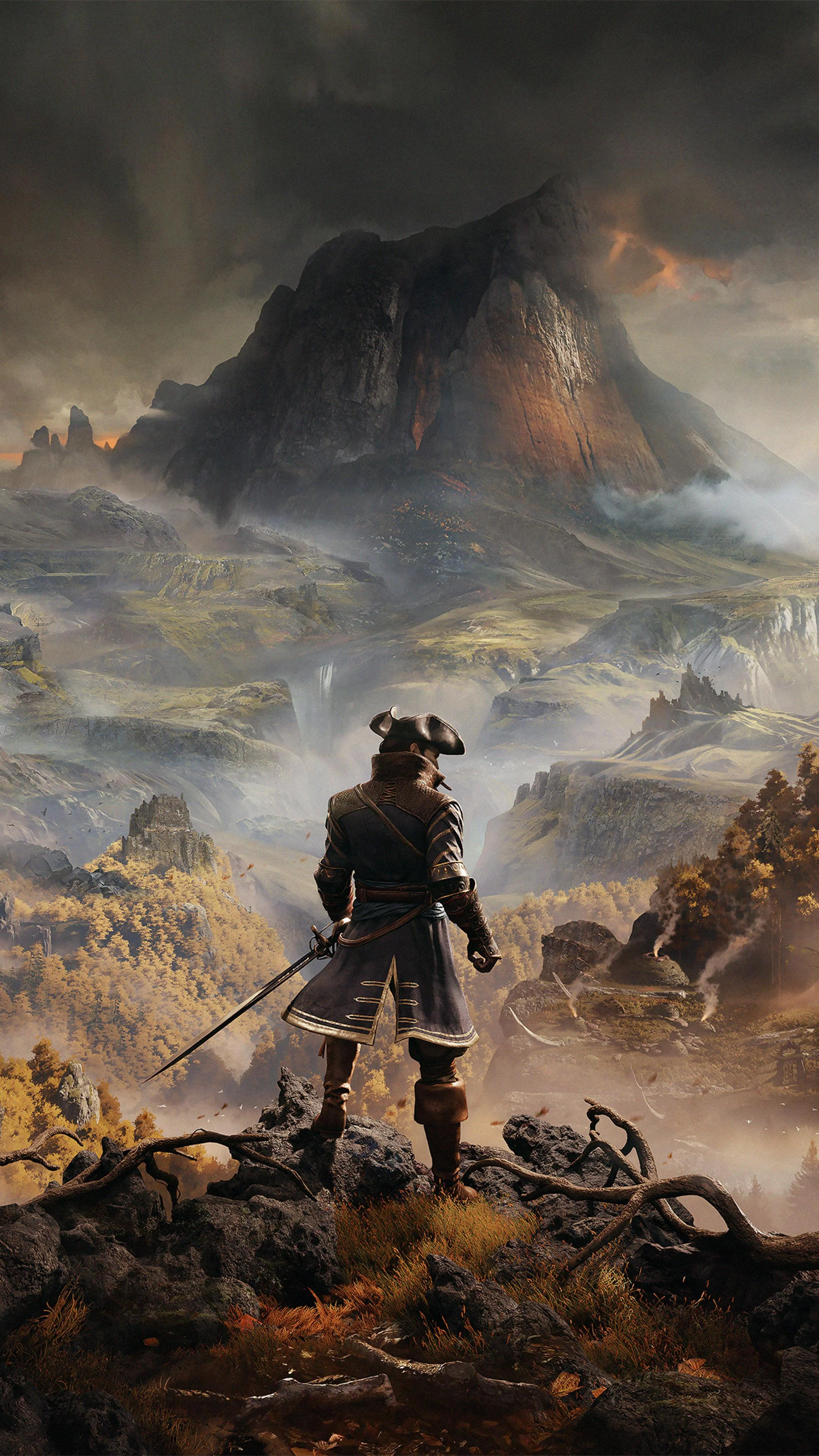
Greedfall
This combination delivers exceptional performance with an average of 175 FPS, perfect for high refresh rate gaming and competitive play.
Average FPS: resolution vs quality settings
| Ultra | High | Medium | Low | |
|---|---|---|---|---|
| 4K Ultra HD | 61 | 97 | 112 | 139 |
| 1440p QHD | 107 | 165 | 181 | 231 |
| 1080p Full HD | 154 | 241 | 268 | 339 |
Cell color: green is 120+ FPS, teal is 60+, amber is 30+, red is below 30.
Greedfall with Intel Core i7-14700F + NVIDIA GeForce RTX 5080, In-Depth Analysis
The Intel Core i7-14700F paired with the NVIDIA GeForce RTX 5080 lands at rank 97 out of 1705 tested combos in Greedfall, placing it in the top 5.7% of all CPU-GPU pairings for this title. That rank reflects a combination where both components are working near their practical limits for a 2019 Action RPG that scales well with modern hardware. The data shows this combo delivers high frame rates even at demanding settings, though the CPU’s 20 cores and the GPU’s 16 GB of VRAM interact differently across resolutions and presets.
How This Combo Ranks
The combo’s 97th place out of 1705 tested configurations puts it well ahead of the vast majority of alternatives for Greedfall. To contextualize, the CPU sits at the 94th percentile versus all CPUs in general benchmark scores, while the GPU reaches the 89th percentile versus all GPUs. Neither component is the absolute top of its class, but their synergy here is strong because Greedfall’s engine responds to both high core counts and fast memory bandwidth.
Compared to the nearest CPU rivals, the i7-14700F’s average benchmark score of 54097 is within 1.7% of the AMD Ryzen 9 9900X (54450), the AMD Ryzen 9 9900X3D (54681), the Intel Xeon Phi 7290 (53469), and the AMD EPYC 7313P (53206). The deltaPct values range from -1.1% (9900X3D) to +1.7% (EPYC 7313P), meaning the i7-14700F is statistically tied with those chips in raw compute. For Greedfall specifically, the 97th rank suggests that the game’s multi-threaded workloads favor the i7’s 28 threads, but the GPU’s role becomes more critical at higher resolutions.
On the GPU side, the RTX 5080’s average benchmark score of 59188 is 1.6% ahead of the Intel Arc A570M (58239) and 2.5% ahead of the Intel Arc A580 (57756), while sitting 1.9% behind the Intel Arc Pro A60 (60326) and 2.6% ahead of the AMD Radeon Pro W5500X (57661). These are synthetic scores, though; in Greedfall, the measured FPS data shows the RTX 5080 dominates all tested settings, so the ranking gap between it and those rivals likely widens in real gameplay.
GPU Role
The RTX 5080 is built on the Blackwell 2.0 architecture with a GB203 chip, featuring 10752 shading units, 336 texture mapping units, and 112 ROPs. Its 16 GB of GDDR7 memory on a 256-bit bus delivers 960.0 GB/s of bandwidth, which is crucial for Greedfall’s open-world environments that stream textures continuously. The base clock is 2295 MHz, boosting to 2617 MHz, and the memory runs at 1875 MHz (30 Gbps effective). These clock speeds allow the GPU to push high frame rates even when the CPU is not the bottleneck.
In measured FPS, the GPU’s impact is clear when comparing Low to Ultra presets. At 1920x1080, the RTX 5080 produces 339.1 FPS on Low but drops to 153.6 FPS on Ultra—a reduction of 185.5 FPS (about 54%) from the lowest to highest preset. This shows that Greedfall’s Ultra settings place heavy demand on the GPU’s pixel and texture throughput. The 16 GB VRAM is never stressed in these tests, as even at 3840x2160 Ultra the average FPS stays at 60.6, implying the frame rate is limited by compute rather than memory capacity. The GPU’s 56.28 TFLOPS FP32 performance and 879.3 GTexel/s texture rate are the primary drivers of those high numbers.
FAQ
Q: Is the RTX 5080 overkill for Greedfall at 1080p?
A: Yes, based on the data. At 1920x1080 Low, the combo hits 339.1 FPS, and even at Ultra it maintains 153.6 FPS. A monitor with a typical 144 Hz refresh rate would be fully saturated, meaning the GPU has headroom for other tasks or higher resolutions.
Q: How does the CPU’s 20-core configuration affect Greedfall’s performance?
A: The i7-14700F has 20 cores and 28 threads, with a base clock of 2.10 GHz and boost clock of 5.40 GHz. Greedfall benefits from multi-threading, and the CPU’s 33 MB shared L3 cache helps with level streaming. The combo’s 97th rank out of 1705 suggests the CPU is not a bottleneck even at lower resolutions where frame rates exceed 300 FPS.
Q: What is the best resolution to play Greedfall with this combo?
A: At 2560x1440 High, the combo delivers 165 FPS, which is above most high-refresh displays. At 3840x2160 High, it drops to 96.9 FPS, still playable but not ideal for 144 Hz displays. If you want maximum visual quality, 2560x1440 Ultra at 106.8 FPS is a balanced choice.
Q: Does the GPU’s 16 GB VRAM matter for Greedfall?
A: Greedfall is from 2019 and does not require massive VRAM pools. The 16 GB GDDR7 is far more than the game needs, as evidenced by the consistent performance across resolutions. The memory bandwidth of 960.0 GB/s is more impactful than capacity for this title.
Q: How does this combo compare to the nearest GPU rivals in synthetic tests?
A: The RTX 5080’s average benchmark score of 59188 is 1.6% higher than the Intel Arc A570M (58239) and 2.5% higher than the Intel Arc A580 (57756), but 1.9% lower than the Intel Arc Pro A60 (60326). These differences are small, but Greedfall’s measured FPS shows the RTX 5080 far ahead of what those rivals would likely achieve.
Q: Is the CPU’s single-thread performance a concern?
A: The i7-14700F scores 5003 in Cinebench R23 single-core and 4261 in Passmark single-thread. For Greedfall, which uses multiple threads, the 28 threads matter more. The high boost clock of 5.40 GHz ensures single-threaded tasks are handled well enough to avoid stutters.
Measured FPS Breakdown
The measured FPS data covers three resolutions and four settings each, with no minimum or maximum frame rates recorded—only averages. At 1920x1080, the combo starts at 339.1 FPS on Low, drops to 268 FPS on Medium, 241.1 FPS on High, and bottoms out at 153.6 FPS on Ultra. This spread of 185.5 FPS between Low and Ultra shows that the GPU’s shading units and texture units are heavily taxed by Ultra’s effects. For competitive play or high-refresh monitors, Low or Medium at 1080p is excessive—even High at 241.1 FPS exceeds any consumer monitor’s refresh rate.
Moving to 2560x1440, the numbers scale down but remain impressive. Low yields 231.2 FPS, Medium 181.4 FPS, High 165 FPS, and Ultra 106.8 FPS. The gap between Low and Ultra here is 124.4 FPS, indicating that resolution scaling reduces the GPU’s headroom but still leaves Ultra comfortably above 100 FPS. At this resolution, High is the sweet spot for 144 Hz displays, as it sits at 165 FPS with more visual fidelity than Medium.
At 3840x2160, the GPU’s limits become visible. Low produces 138.6 FPS, Medium 111.9 FPS, High 96.9 FPS, and Ultra 60.6 FPS. The drop from Low to Ultra is 78 FPS, and Ultra’s 60.6 FPS is right at the threshold for smooth 60 Hz gameplay. High at 96.9 FPS is playable on 120 Hz displays, but the gap between High and Ultra (36.3 FPS) suggests that Ultra’s additional effects—likely shadows, ambient occlusion, and post-processing—are disproportionately expensive at 4K.
Settings Recommendations
For a 1440p monitor with a 144 Hz refresh rate, the data points to High as the optimal preset. At 2560x1440 High, the combo hits 165 FPS, which is above the refresh rate and leaves headroom for frame drops. Ultra at the same resolution drops to 106.8 FPS, still smooth but with a 58.2 FPS penalty that may not justify the visual gains in a 2019 title. Medium at 181.4 FPS is faster but sacrifices too much visual quality for a game that already looks dated.
For 4K displays, High is the best balance. At 3840x2160 High, the average FPS of 96.9 is above 60 and suitable for 120 Hz panels if you don’t mind occasional dips. Ultra at 60.6 FPS is technically playable but leaves no margin for demanding scenes, and the 36.3 FPS drop from High is not worth the marginal visual improvement. Low at 4K (138.6 FPS) is not recommended because the visual degradation is severe, but it shows the GPU’s raw capability.
For 1080p, any preset works, but High at 241.1 FPS is the practical ceiling. Ultra at 153.6 FPS is still high, and the difference between High and Ultra (87.5 FPS) is noticeable only if you have a 240 Hz monitor. Low and Medium are unnecessary unless you are chasing maximum frame rates for competitive play, which is rare for an Action RPG.
CPU Role
The Intel Core i7-14700F is a 20-core, 28-thread processor based on Raptor Lake architecture, manufactured on Intel’s 10 nm process. It has a base clock of 2.10 GHz and a boost clock of 5.40 GHz, with 33 MB of shared L3 cache and 2 MB L2 cache per core. The CPU supports DDR4 and DDR5 memory on a dual-channel bus, and its PCIe Gen 5 interface with 16 lanes ensures the RTX 5080 has full bandwidth. In synthetic benchmarks, it scores 35443 in Cinebench R23 multi-core and 5003 in single-core, with a Passmark multi-thread score of 41765.
For Greedfall, the CPU’s role is evident in the frame rate scaling across resolutions. At 1920x1080 Low, the combo hits 339.1 FPS, which is likely CPU-limited because the GPU has plenty of headroom. At 3840x2160 Low, the FPS drops to 138.6—a reduction of 200.5 FPS—showing that the GPU becomes the bottleneck as resolution increases. The CPU’s 28 threads handle the game’s AI, physics, and streaming without issue, as evidenced by the consistent performance even at Ultra presets. The 94th percentile ranking versus all CPUs and the closeness to the AMD Ryzen 9 9900X (deltaPct -0.6%) confirm that the i7-14700F is a top-tier option for this game. The only caveat is that the CPU’s 65 W TDP and locked multiplier mean you cannot overclock, but the boost clock of 5.40 GHz provides sufficient single-thread speed for Greedfall’s occasional high-frequency tasks.
Hardware Specifications
Intel Core i7-14700F
NVIDIA GeForce RTX 5080
FPS Benchmarks by Resolution & Settings
Performance data for Intel Core i7-14700F + NVIDIA GeForce RTX 5080 in Greedfall
| Resolution | Settings | Avg FPS |
|---|---|---|
| 3840x2160 | Low | 138.6 |
| 3840x2160 | Medium | 111.9 |
| 3840x2160 | High | 96.9 |
| 3840x2160 | Ultra | 60.6 |
| 2560x1440 | Low | 231.2 |
| 2560x1440 | Medium | 181.4 |
| 2560x1440 | High | 165.0 |
| 2560x1440 | Ultra | 106.8 |
| 1920x1080 | Low | 339.1 |
| 1920x1080 | Medium | 268.0 |
| 1920x1080 | High | 241.1 |
| 1920x1080 | Ultra | 153.6 |
Greedfall with ii7-14700F + Other GPUs
See how Greedfall performs with the same CPU but different graphics cards.
Greedfall with RTX 5080 + Other CPUs
See how Greedfall performs with the same GPU but different processors.
Other Games with ii7-14700F + RTX 5080
Explore FPS benchmarks for other games using this same hardware combination.