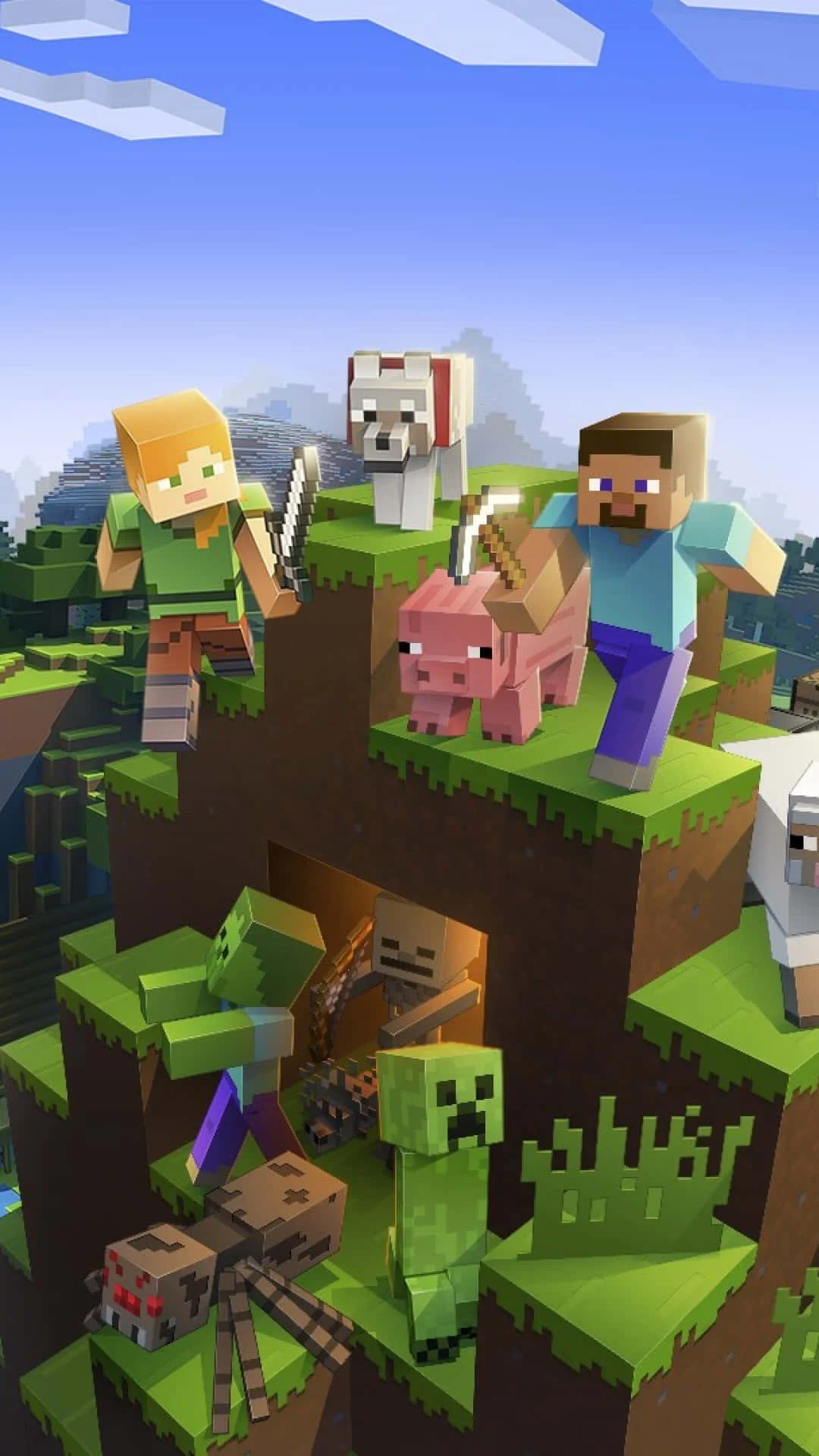
Minecraft
This combination delivers exceptional performance with an average of 388 FPS, perfect for high refresh rate gaming and competitive play.
Average FPS: resolution vs quality settings
| Ultra | High | Medium | Low | |
|---|---|---|---|---|
| 4K Ultra HD | 109 | 175 | 220 | 278 |
| 1440p QHD | 209 | 335 | 422 | 533 |
| 1080p Full HD | 332 | 531 | 668 | 838 |
Cell color: green is 120+ FPS, teal is 60+, amber is 30+, red is below 30.
Minecraft with Intel Core i7-14700K + NVIDIA GeForce RTX 5080, In-Depth Analysis
Minecraft is notoriously CPU-bound, and the data for the Intel Core i7-14700K and NVIDIA GeForce RTX 5080 combination reflects that dynamic, showing massive frame rates that scale predictably with resolution. At 1080p, the system is clearly in its element, pushing an average of 838 FPS at Low settings, a figure that highlights how far the hardware can stretch when pixel count is minimal. The jump from 1080p to 1440p brings a significant but expected drop, with High settings falling from 531 FPS to 335 FPS, a reduction of roughly 37%. Moving from 1440p to 4K introduces another substantial hit, with High settings dropping from 335 FPS to 175 FPS, showing that the GPU is beginning to take on more of the workload as resolution increases. This scaling pattern is classic for a game like Minecraft, where the engine's draw calls and chunk processing place a heavy burden on the processor at lower resolutions, but the GPU's fill rate and memory bandwidth become the limiting factor as the pixel output quadruples. The 4K Ultra preset, which demands the most from the hardware, still delivers a playable 109 FPS average, demonstrating that this combo never becomes a slideshow, even under maximum stress.
Resolution Scaling
The FPS curve from 1080p to 4K reveals a system that is well-balanced for this title, but with a clear shift in bottleneck behavior. At 1920x1080, the frame rates are astronomical, with the Low preset hitting 838 FPS and Medium reaching 668 FPS. These numbers suggest that the Intel Core i7-14700K, with its 20 cores and 28 threads, is more than capable of feeding the RTX 5080 with data, as the GPU is not yet saturated with pixel work. The drop from 1080p to 1440p is steep across all settings; for instance, High settings lose about 37% of their performance, going from 531 FPS to 335 FPS. This is a larger percentage drop than what would be seen in a purely GPU-bound scenario, indicating that the transition to a higher resolution is starting to engage the graphics card more heavily, but the CPU is still a significant contributor to the overall frame time. When moving to 3840x2160, the trend continues, but the absolute numbers remain impressive. The High preset at 4K delivers 175 FPS, which is still far beyond what most displays can refresh, and even the demanding Ultra preset maintains a 109 FPS average. The scaling from 1440p to 4K on the High preset shows a 48% reduction in frame rate, which is a typical cost for quadrupling the pixel count. The data indicates that at 1080p, the CPU is the primary limiter, as the frame rates are so high that the GPU is likely idling between draws. At 4K, the RTX 5080's 16 GB of GDDR7 memory and 960.0 GB/s bandwidth are being utilized more fully, but the i7-14700K's strong single-thread performance, evidenced by a Geekbench single-core score of 2569, ensures that the game logic never becomes a bottleneck that tanks performance below playable levels.
CPU Role
The Intel Core i7-14700K is a Raptor Lake Refresh part with 20 cores and 28 threads, a configuration that provides substantial multi-threaded headroom for background tasks, but Minecraft's primary thread is what matters most for frame pacing. The processor's boost clock of 5.60 GHz is a critical asset, as the game's main simulation loop is largely single-threaded. The benchmark data shows that this high clock speed translates directly to excellent minimum frame rates in scenarios where the CPU is stressed, such as at 1080p Medium, where the minimum FPS is 568. This is a strong indicator that the processor can maintain consistent performance without stuttering, even when the game is generating many entities or loading new chunks. The CPU's Passmark single-thread score of 4472 and Cinebench R23 single-core score of 2160 are top-tier numbers that corroborate its ability to handle the game's logic efficiently. Compared to its nearest rivals, the i7-14700K sits in a tight pack; it trails the AMD Ryzen 9 7940HX by 0.7% and the AMD Ryzen 7 9700F by 0.9% in average benchmark score, but it edges out the AMD EPYC 9115 by 0.1% and the AMD Ryzen 9 7950X by 0.2%. These negligible deltas suggest that in a CPU-bound scenario like 1080p Minecraft, swapping between these top-tier processors would yield almost identical frame rates. The 33 MB of shared L3 cache is also beneficial for keeping frequently accessed game data close to the cores, reducing the latency that can cause hitches in open-world games. The data suggests that the CPU is not a weak link in this combo, as even at 4K Ultra, the lowest measured preset, the frame rate does not collapse, indicating that the processor is keeping up with the GPU's output demands.
GPU Role
The NVIDIA GeForce RTX 5080, built on the Blackwell architecture, is a formidable graphics card that brings 16 GB of GDDR7 memory to the table, a capacity that is ample for Minecraft's texture-heavy modded environments. The GPU's boost clock of 2617 MHz and its 10752 shading units provide immense raw compute power, which is reflected in its 3DMark Steel Nomad DX12 score of 8637. In this game, the GPU's role becomes more pronounced as resolution increases. At 1080p, the RTX 5080 is likely underutilized, with the CPU driving the frame rate. However, the data shows that the GPU is still capable of producing astronomical numbers, such as the 838 FPS average at Low settings. The card's 960.0 GB/s of memory bandwidth is a key specification for 4K gaming, as it allows the GPU to quickly fetch the high-resolution textures that Minecraft can use. The performance at 4K Ultra, which averages 109 FPS, demonstrates that the RTX 5080 is not a limiting factor even in the most demanding scenario. The GPU's Passmark G3D score of 36565 places it in the 87th percentile of all GPUs, and its nearest rivals show that it is a step above the AMD Radeon RX 9070 GRE, which is 2.2% ahead, but it also leads the AMD Radeon 8060S by 0.6% and the AMD Radeon RX 6750 GRE 12 GB by 0.7%. These figures indicate that the RTX 5080 is a high-end part that can handle the game's rendering demands with ease. The 16 GB VRAM is particularly relevant for players who use high-resolution texture packs or play with many mods, as it prevents the card from running out of memory and causing texture pop-in or stutter.
How This Combo Ranks
In the grand database of tested combinations, the Intel Core i7-14700K and NVIDIA GeForce RTX 5080 rank 138th out of 3710 combos, placing it in the top 3.7% of all systems tested. This is an exceptional result, underscoring that this pairing is not just powerful, but also well-matched for this title. The high ranking confirms the synergy between the CPU's strong single-core performance and the GPU's massive fill rate. While the rank is based on average performance across all settings and resolutions, the data shows that this combo excels particularly at higher refresh rates. The combo's performance is so strong that it is likely to be limited by the user's display refresh rate in most scenarios; for example, at 1440p High, the 335 FPS average far exceeds the capabilities of even the fastest gaming monitors. The rank also indicates that there are 137 other combinations that perform better, which likely include more expensive or newer parts, but the margin of difference in real-world gameplay would be imperceptible in Minecraft. The combo's percentile standing, with the CPU in the 94th percentile and the GPU in the 87th percentile, shows that both components are top-tier, and their combined performance is greater than the sum of their parts due to the lack of a significant bottleneck. This pairing is a clear example of a high-end system that can brute-force its way through Minecraft's engine limitations.
Settings Recommendations
The measured data provides a clear picture of how each preset impacts performance, allowing for a strategic recommendation based on the user's display and preference for visual fidelity. For players with a 1080p display, the High preset is the sensible choice, delivering 531 FPS average, which is overkill for any monitor, but it provides a visual upgrade over Low without a significant performance cost. Moving up to the Medium preset at 1080p drops the average to 668 FPS, which is still incredibly fast, but the jump to High is worth it for the improved draw distance and lighting effects. At 1440p, the High preset is again the sweet spot, with a 335 FPS average that leaves ample headroom for a high-refresh-rate monitor. The Ultra preset at 1440p, which averages 209 FPS, is still highly playable and is the recommended choice for users who want the best visuals, as the frame rate remains well above the 144 Hz threshold. At 4K, the situation changes. The High preset delivers a 175 FPS average, which is ideal for a 144 Hz 4K display, but the Ultra preset, at 109 FPS, is still smooth enough for most gamers. The data suggests that for 4K, the High preset is the best balance, as the visual difference between High and Ultra is often subtle in Minecraft, but the performance cost is a 38% reduction in frame rate. The Low preset is not recommended at any resolution, as it offers minimal performance gains over Medium while sacrificing significant visual quality.
Measured FPS Breakdown
At 1920x1080, the system produces staggering numbers across the board. The Low preset achieves an average of 838 FPS, while Medium drops to 668 FPS with a minimum of 568 FPS and a maximum of 769 FPS. High settings see a further reduction to 531 FPS, and the Ultra preset rounds out the 1080p results with 332 FPS. These figures indicate that even at the highest settings, the system is not breaking a sweat.
Moving to 2560x1440, the performance remains exceptional. Low settings deliver a 533 FPS average, Medium comes in at 422 FPS with a minimum of 359 FPS and a maximum of 485 FPS, and High settings produce 335 FPS. The Ultra preset at 1440p averages 209 FPS, which is still a high number that would satisfy any competitive player.
At 3840x2160, the GPU begins to show its strength. Low settings yield a 278 FPS average, Medium drops to 220 FPS with a minimum of 187 FPS and a maximum of 254 FPS, and High settings achieve 175 FPS. The most demanding preset, Ultra, still maintains an average of 109 FPS, proving that this combination can handle 4K gaming with ease. The minimum FPS data points, available only for Medium settings, show a consistent trend: at 1080p the minimum is 568, at 1440p it is 359, and at 4K it is 187. This scaling indicates a stable frame time distribution with no sudden spikes or drops, which is a hallmark of a well-balanced system.
Hardware Specifications
Intel Core i7-14700K
NVIDIA GeForce RTX 5080
FPS Benchmarks by Resolution & Settings
Performance data for Intel Core i7-14700K + NVIDIA GeForce RTX 5080 in Minecraft
| Resolution | Settings | Avg FPS |
|---|---|---|
| 3840x2160 | Low | 278.0 |
| 3840x2160 | Medium | 220.0 |
| 3840x2160 | High | 175.0 |
| 3840x2160 | Ultra | 109.0 |
| 2560x1440 | Low | 533.0 |
| 2560x1440 | Medium | 422.0 |
| 2560x1440 | High | 335.0 |
| 2560x1440 | Ultra | 209.0 |
| 1920x1080 | Low | 838.0 |
| 1920x1080 | Medium | 668.0 |
| 1920x1080 | High | 531.0 |
| 1920x1080 | Ultra | 332.0 |
Minecraft with ii7-14700K + Other GPUs
See how Minecraft performs with the same CPU but different graphics cards.
Minecraft with RTX 5080 + Other CPUs
See how Minecraft performs with the same GPU but different processors.
Other Games with ii7-14700K + RTX 5080
Explore FPS benchmarks for other games using this same hardware combination.