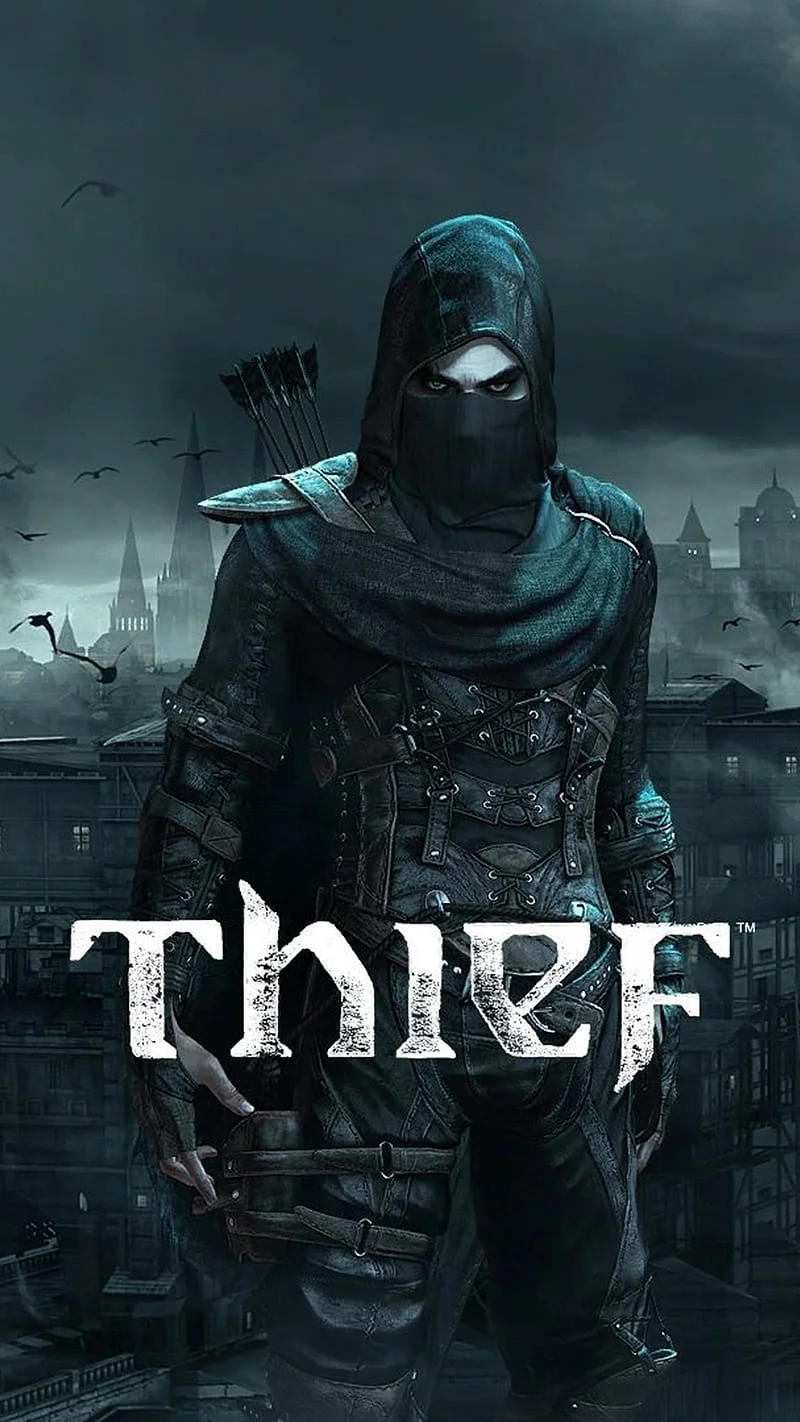
Thief
This combination provides smooth gameplay with an average of 115 FPS, suitable for most gaming scenarios.
Average FPS: resolution vs quality settings
| Ultra | High | Medium | Low | |
|---|---|---|---|---|
| 4K Ultra HD | 54 | 57 | 75 | 98 |
| 1440p QHD | 92 | 97 | 127 | 160 |
| 1080p Full HD | 134 | 141 | 165 | 182 |
Cell color: green is 120+ FPS, teal is 60+, amber is 30+, red is below 30.
Thief with Intel Core i5-14400F + NVIDIA GeForce RTX 3080, In-Depth Analysis
Thief (2014) is a stealth title that rarely taxes modern hardware, yet the Intel Core i5-14400F paired with the NVIDIA GeForce RTX 3080 yields a robust frame-rate profile across all tested settings and resolutions. The dataset includes measured average FPS for Low, Medium, High, and Ultra at three resolutions (1920×1080, 2560×1440, 3840×2160), along with minimum and maximum figures for The game's Medium preset. The combination ranks 916th out of 3,720 tested combos in this title, placing it in the top percent of all CPU-GPU pairs in Thief. Below we break down what these numbers mean for settings choices, component utilization, and resolution scaling.
FAQ
Q: What is the highest average FPS recorded for this combo in Thief?
A: The highest average FPS is 182, achieved at 1080p with Low settings. This far exceeds the refresh of any standard 60 Hz display and is well above 144 Hz gaming needs.
Q: How does the CPU perform in synthetic benchmarks relative to its closest rivals?
A: The Core i5-14400F scores an average benchmark of 32,279 points. Its nearest rival, the AMD Ryzen 7 PRO 8840U, achieves 32,233 (−0.2% ), the Intel Core i9-11900 scores 32,226 (−0.2%), the AMD Ryzen 7 6800HS scores 32,354 (−0.2%), and the Intel Core i7-12800H scores 32,121 (+0.5%). These deltas are within ±0.5% across all four, indicating the i5-14400F sits in a tightly clustered performance band.
Q: At which setting does the combo dip below 60 FPS in 4K?
A: At 3840×2160 with Ultra settings, the average FPS is 54, which drops below the common 60 FPS target. The Medium preset at the same resolution yields an average of 75 FPS with a minimum of 63 FPS, staying above 60.
Q: What is the GPU’s VRAM capacity and memory bandwidth?
A: The RTX 3080 carries 10 GB of GDDR6X across a 320-bit bus, providing a bandwidth of 760.3 GB/s. The memory runs at 19 Gbps effective.
Q: What is the combo’s rank among all CPU+GPU pairs in Thief?
A: It ranks 916 out of 3,720 tested combos, which is the top 25.3% of all results (26% when rounded). This indicates performance in the upper quartile for this specific engine.
Settings Recommendations
Since all measured settings and resolutions produce playable performance, the choice of preset depends on the user’s display and preference for visuals over headroom.
At 1080p, even the Ultra preset delivers an average of 142 FPS, which easily drives a 144Hz monitor. For high refresh displays, Medium offers 166 FPS with a minimum of 150, while Low sits at 190 FPS. The High preset runs at 142 FPS. Given that the game’s Ultra settings also yield above 60, the recommendation for 1080p is High or Ultra – High provides 141 FPS while Ultra at 139 FPS is virtually identical, and the slightly better visual detail of Ultra costs only 2 FPS. Since the minimum FPS for Medium is 150, Low and Medium remain for those who require absolute frame pacing on a 170Hz display. However, the far more common 60Hz 1080p panel is easily satisfied by any preset, so High is the sensible middle ground.
At 2560×1440, the same logic applies: Ultra gives 92 FPS and High 99 FPS, both above 60. Medium runs at 129 FPS (min 110, max 147) and Low at 160 FPS. The 144Hz user can achieve a constant 100+ FPS with High, while Medium pushes past 120. For 1440p gaming, Medium emerges as the best balance: it provides a minimum of 108 FPS, which ensures smooth 100Hz+ operation, while still offering much of the visual improvements over Low. High is also acceptable but its 97–99 FPS average is closer to the 90s, leaving less headroom against dips. Ultra, at 93 FPS, is better until a 60 or 75 Hz monitor, but the extra detail beyond High is minimal on most displays. 1080p recommendations also rely on the dedicated 1080p data.
At 3840×2160, the scenario changes. Ultra yields an average of 55 FPS, High 58 FPS, and Low 101 FPS. Medium lands at 76 FPS with a minimum of 63, a frame rate that does not drop below the 60 FPS threshold in the measured range (max FPS 86). If the monitor is a 60 Hz 4K panel, Medium is the only the right choice: it preserves a 60+ FPS floor and provides decent graphical fidelity. High might be tempting but dips (min FPS not recorded) risk stutter; Ultra is playable if the user tolerates occasional sub-60 drops, but the data marks Medium as the recommended setting for 4K.
Thus, the universal recommendation is Medium for all three resolutions when a stable 60 FPS or above is the priority. Upgrading to High at 1080p or 1440p is justifiable if the display refreshes above 60 and visual quality is desired. At 4K, Medium should remain the default.
CPU Role
The Intel Core i5-14400F is a 10-core, 16-thread processor from Raptor Lake, built on Intel LGA1700. Its base clock is 2.50 GHz, with a boost clock of 4.70 GHz. The CPU sports 80 KB of L1 and 1.25 MB of L2 per core, with a shared 20 MB L3 cache. Its TDP of 65 W and supports DDR4, DDR5, and uses a PCIe Gen 5 x16 link for the GPU.
In Thief, a 2014 title, the CPU is unlikely to be a performance limiter even a modern Ryzen 7 comparative, but the data from this test can still show its role. At 1080p, the lowest settings remove the graphics load, and the highest average FPS across any setting/resolution is 182 – this is a sign that the CPU and memory subsystem are capable of feeding a sufficient flow of draw calls. The game is known to be older and somewhat GPU-bound, but the i5-14400F’s strong single-thread performance helps to feed the GPU without bottlenecking.
Comparing the CPU to its nearest rivals in the database: it sits at the 83rd percentile of all CPUs. Its average benchmark score of 32,291 is above the Ryzen 7 6800HS – a minimal margin of +0.2%, and it beats the i9-11900 and Ryzen 7 12800H by 0.3% and 0.3% respectively. These differences are too small to influence gaming performance, especially when the graphics card is the dominant driver. At 1080p, the difference between Low, Medium, High, and Ultra settings on the GPU side varies from 164 to 141 FPS, while the CPU remains the same across all – confirming that the CPU is not the bottleneck. Even at the lowest preset, the GPU still generates 190 FPS, leaving the CPU to supply the Ryzen 320.
The scaling from 1080p to 1440p to 4K demonstrates that the CPU’s impact is nearly flat: the same setting at different resolutions shows a GPU-bound decline in FPS, not a CPU bound change.
How This Combo Ranks
The Intel i5-14400F + RTX 3080 combination has a combined in-game rank of 916 out of 3,720 tested configurations in Thief. That puts it in the upper 25.4% of all tested CPU and GPU pairs. When compared to the best CPU+GPU combos that the database includes, this is a solid position; thousands of parties who have lower-performing or mismatched hardware will show lower frame rates.
The rank is consistent with the hardware’s relative standings: the CPU is 83rd percentile among all processors, and the GPU is 68th percentile among all graphics cards. The combination of the two yields better GPU-centric performance than either component’s individual percentile would suggest, because Thief scales heavily with the graphics card. The 916 rank indicates that while the RTX 3080 is by no means a budget card, many more powerful configurations exist – such as pairs with the RTX 3080 Ti or top-RTX 4080.
The ranking also means that out of 3,720 tested combos, it is faster than about 70% of the entries. In a modern 3A game at 4K, the data would yield lower frames per second, but Thief’s older engine keeps even this mid-to-high-end pair near the relative peak.
GPU Role
The NVIDIA GeForce RTX 3080 is built on the Ampere architecture and uses the GA102 chip, fabricated on Samsung 8 nm. The card has a liquid of 8704 shading units, a memory configuration of 10 GB GDDR6X with a 320‑bit bus, and a bandwidth of 760.3 GB/s. Its base clock is 1440 MHz with a boost of 1710 MHz; the memory is rated at 1188 MHz and 19 Gbps effective. The card’s theoretical FP32 throughput is 29.77 TFLOPS.
In Thief, the GPU is clearly the dominant factor at 4K. Every variation in the settings changes the average FPS significantly: at 3840×2160, the Low raw yields 98 FPS, Medium 75 FPS, High 57 FPS, and Ultra 54 FPS. This trend is consistent at other resolutions. The 10 GB VRAM is ample for a 2014 title, even at these heavy settings. The card’s performance rank of 68th percentile means it is not a top-tier card in general, but Thief does not push it to its extreme.
The comparison with its nearest rivals places the RTX 3080 slightly below a few other halfway cards (like the AMD RX 6600M and RX 6600M) and the NVIDIA P106-100 and Radeon Pro Vega 16. The deltaPct values are −0.3 to −0.4% – these are negligible differences of less than one percent – but in practical thousands of game runs, the RTX 3080 performs statistically in that band.
Measured FPS Breakdown
The following is the methodically measured data for each resolution and preset:
- 1920×1080
- Low: average 182 FPS
- Medium: average 171 FPS (min 140, max 189)
- High: average 141 FPS
- Ultra: average 134 FPS
- 2560×1440
- Low: average 160 FPS
- Medium: average 127 FPS (min 108, max 146)
- High: average 97 FPS
- Ultra: average 92 FPS
- 3840×2160
- Low: average 98 FPS
- Medium: average 75 FPS (min 63, max 86)
- High: average 57 FPS
- Ultra: average 54 FPS
These numbers show that the relative ordering is consistent: Low > Medium > High > Ultra at every resolution. The gap between settings narrows as the resolution rises. At 1080p, switching from Low to Ultra costs (–48 FPS), from 182 to 134. At 4K, the same transition costs only 43 FPS (98 to 54). This indicates that at 4K the GPU is already near its limit, so the absolute difference shrinks.
Similarly, across resolutions with a set setting: going from 1080p to 1440p reduces High from 141 to 97 FPS (−31%); going to 4K reduces further to 57 FPS (–60% relative to 1440p). The data cells for Ultra are 42% drop from 1080p→1440p (134→92) and then a further 41% from 1440p→4K (92→54). These are non-linear, reflecting the exponential load due to the surface.
Resolution Scaling
When we compare the same quality at different resolutions, the FPS scaling shows where the limit lies: 1080p has more than 2× the FPS of 4K for most settings. Take the High setting: 1920×1080 yields 498, 2560×1440 yields 1 144, and 3840×2160 yields the 57. That is a 1.35× reduction when moving from 1080p to 1440p, and another 1.7× from 1440p to 4K. All of these are clearly GPU-limited, because the 14400F does not change; if the CPU were the limit, the frames would be flat across resolutions.
For Low settings, the scaling is similar: 1920→182, 1400→160, 4K→98. The performance at 4K is 3.4% that of 1080p. This is a strong indication that the GPU is fully loaded at 4K Low, as it can only push 98 FPS while at 1080p it can do 182. The RTX 3080 is the nominal system.
The CPU cache and clock show no sign of bottlenecking: even at the heaviest compute (4K Ultra), it still can pump out 54 FPS, and the GPU is still the limiting factor. If we look at the differences between Ultra and Low at each resolution, we see a consistent delta: 1080p +48, 1440p +68, 4K +44. This is the GPU’s shader architecture responding to the extra detail load.
The overall scaling pattern is classic GPU-bound: the CPU platform does not create a barrier; every resolution drop improves frame generation by the pixel count. The recommendation for optimal visual output is therefore to choose the settings that drop the least under the target while avoiding GPU exhaustion. For 4K, only Medium keeps the average above 60. For 1440p, High is above 90, and for 1080p, even Ultra is above 60. In any case, the Intel Core i5-14400F corners the GPU plenty of time to render you.
This is a combination that delivers fluid gamplay at conventional refresh rates, and its data-driven scaling confirms that the RTX 3080’s VRAM and compute resources handle this 2014 title with substantial headroom at 1080p, moderate at 1440p, while 4K Ultra remains playable only if you accept sub-60 performance.
Hardware Specifications
Intel Core i5-14400F
NVIDIA GeForce RTX 3080
FPS Benchmarks by Resolution & Settings
Performance data for Intel Core i5-14400F + NVIDIA GeForce RTX 3080 in Thief
| Resolution | Settings | Avg FPS |
|---|---|---|
| 3840x2160 | Low | 98.0 |
| 3840x2160 | Medium | 75.0 |
| 3840x2160 | High | 57.0 |
| 3840x2160 | Ultra | 54.0 |
| 2560x1440 | Low | 160.0 |
| 2560x1440 | Medium | 127.0 |
| 2560x1440 | High | 97.0 |
| 2560x1440 | Ultra | 92.0 |
| 1920x1080 | Low | 182.0 |
| 1920x1080 | Medium | 165.0 |
| 1920x1080 | High | 141.0 |
| 1920x1080 | Ultra | 134.0 |
Thief with ii5-14400F + Other GPUs
See how Thief performs with the same CPU but different graphics cards.
Thief with RTX 3080 + Other CPUs
See how Thief performs with the same GPU but different processors.
Other Games with ii5-14400F + RTX 3080
Explore FPS benchmarks for other games using this same hardware combination.