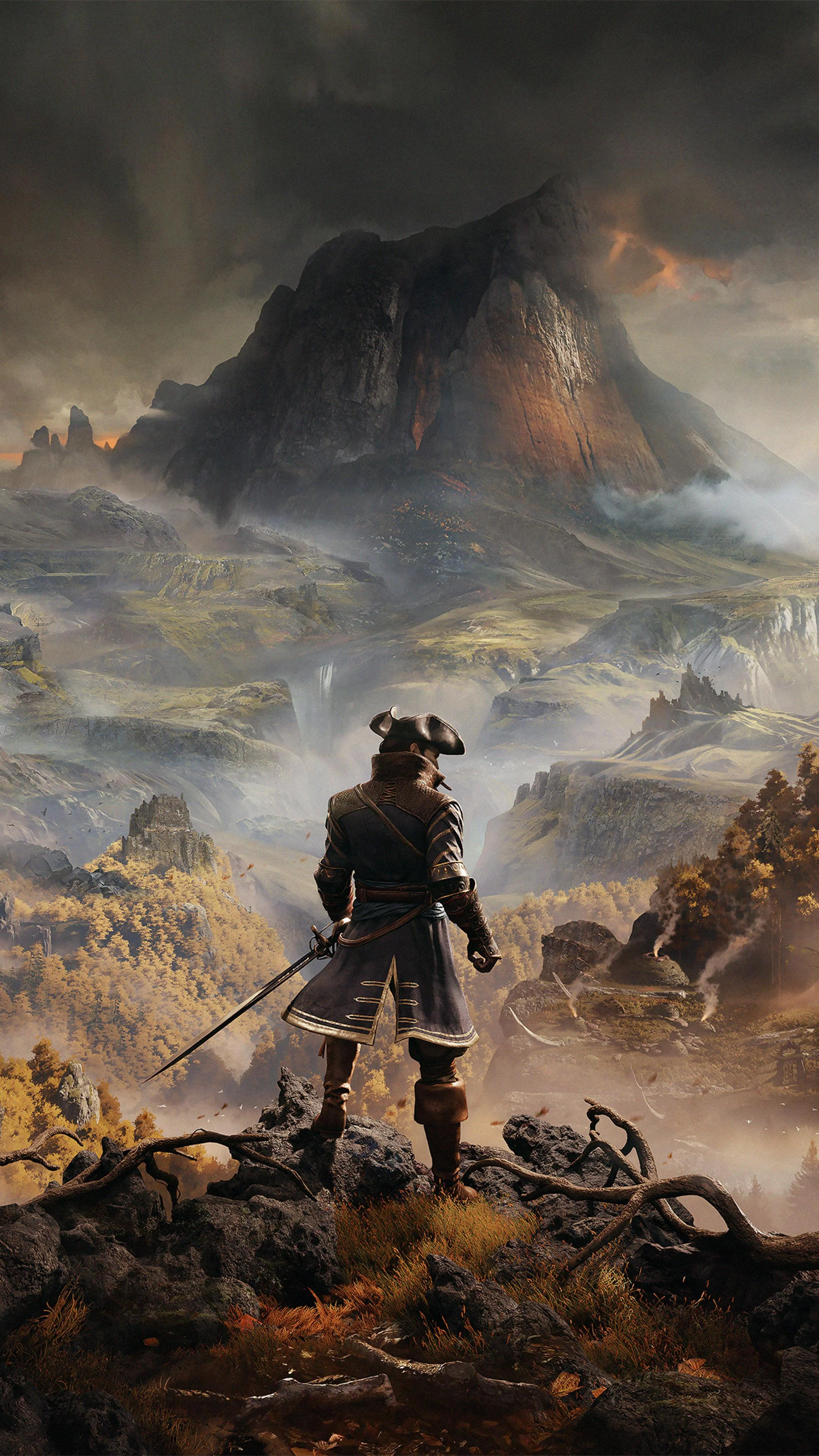
Greedfall
This combination offers playable performance with an average of 39 FPS, though you may want to lower settings for smoother gameplay.
Average FPS: resolution vs quality settings
| Ultra | High | Medium | Low | |
|---|---|---|---|---|
| 4K Ultra HD | 14 | 22 | 25 | 31 |
| 1440p QHD | 24 | 38 | 41 | 53 |
| 1080p Full HD | 35 | 54 | 60 | 76 |
Cell color: green is 120+ FPS, teal is 60+, amber is 30+, red is below 30.
Greedfall with AMD Ryzen 5 7500F + Intel Arc B370, In-Depth Analysis
Greedfall, the 2019 Action RPG from Spiders, presents a demanding workload for the AMD Ryzen 5 7500F and Intel Arc B370 combination. The measured data reveals a configuration that is consistently bound by its graphics processor, with performance scaling that dictates very specific settings choices depending on the target resolution. The benchmark results show a system that can achieve playable frame rates only when graphical demands are kept in check, and the analysis below details exactly where that line lies.
Settings Recommendations
The measured FPS data for this combination points to a clear, if unflattering, hierarchy of playable settings. At the native 1080p resolution, the most balanced experience is achieved with the Medium preset, which delivers an average of 60 FPS. This is the only settings tier at 1080p that hits the 60 FPS target, with a recorded minimum of 51 FPS and a maximum of 69 FPS, indicating that while the average is solid, there are moments of perceptible frame dips. The Low preset offers a higher average of 76 FPS, providing more headroom for smoother gameplay, but it does so at a significant visual cost. The High preset drops to an average of 54 FPS, which is a noticeable step down from the fluidity of 60 FPS and suggests the GPU is starting to struggle. The Ultra preset is not viable at this resolution, plummeting to an average of just 35 FPS.
Moving to 1440p, the situation becomes more constrained. The Low preset is the only option that provides a playable experience, with an average of 53 FPS. This is borderline, and while it is technically above the 30 FPS playability threshold, it sacrifices nearly all visual fidelity to achieve it. The Medium preset falls to 41 FPS, which is a substantial compromise on smoothness, and the High preset drops further to 38 FPS. The Ultra preset at 1440p is not recommended, as it yields an average of just 24 FPS.
At 4K, the data shows this combination is fundamentally out of its depth for anything but the most basic settings. The Low preset manages an average of 31 FPS, which is barely playable for a slower-paced Action RPG, but it is the only setting that approaches a functional frame rate. The Medium preset provides an average of 25 FPS (with a min of 21 and max of 28), which is a slideshow, and the High preset drops to 22 FPS. The Ultra preset is unplayable at 14 FPS. For the best experience per the measured rows, users should prioritize 1080p with the Medium preset as the primary target, falling back to Low at 1440p if they must increase resolution, and accepting that 4K is only viable on the Low preset.
How This Combo Ranks
The data places this specific combination of components in a very low position within the benchmark database's hierarchy for Greedfall. The combo rank is 2699 out of 2938 tested combinations, placing it in the bottom 8% of all systems tested. This ranking is a direct consequence of the GPU's performance profile, which is the limiting factor in this pairing. The Intel Arc B370's individual benchmark score places it in the 5th percentile of all GPUs, and its average score of 1184 is nearly identical to legacy parts like the ATI Mobility Radeon HD 5570 and ATI Radeon HD 5770, which are its closest rivals with scores of 1186 and 1190 respectively. This indicates that the Arc B370 is providing a level of graphical performance that is several generations old, which severely bottlenecks the otherwise capable Ryzen 5 7500F.
The CPU, in contrast, is a much stronger performer. The AMD Ryzen 5 7500F sits in the 77th percentile of all CPUs, with an average benchmark score of 24964. Its nearest rivals in the database are the Intel Core i7-11850H and the AMD Ryzen 5 8400F, which have average scores of 24935 and 25005, representing a performance difference of only 0.1% and -0.2% respectively. This shows that the processor is more than capable of handling the game's logic, but its potential is entirely untapped because the GPU cannot keep up with the rendering demands. The massive disparity between the CPU's high percentile ranking and the GPU's low percentile ranking, combined with the combo's low overall rank, confirms that this is a severely imbalanced system for Greedfall, where the graphics card is the overwhelming bottleneck.
GPU Role
The Intel Arc B370 is the definitive limiting component in this configuration. Its specifications paint a picture of a low-power, integrated-class part that is not designed for demanding gaming workloads. The chip, based on the Xe3-LPG architecture and built on a 3 nm process, has a very modest configuration with 1280 shading units, 40 TMUs, and 20 ROPs. Its compute capabilities are limited to 6.144 TFLOPS for FP32, and it has a pixel rate of 48.00 GPixel/s and a texture rate of 96.00 GTexel/s. The GPU's clock speed is specified with a base of 300 MHz and a boost of 2400 MHz, but the memory configuration is the most telling detail: it uses "System Shared" memory, meaning it relies on the system's DDR5 RAM rather than dedicated VRAM. The memory bandwidth is listed as "System Dependent," which is a significant handicap for a game like Greedfall that requires consistent bandwidth for texture streaming.
This lack of dedicated VRAM and the low bandwidth are reflected directly in the measured FPS. The performance drops are not linear with resolution; they are severe. At 1080p High, the card manages 54 FPS, but at 1440p High, it falls to 38 FPS, a 30% reduction. Moving from 1080p High to 4K High, the frame rate collapses to 22 FPS, a 59% reduction. These figures indicate that the GPU is not just struggling with pixel count but is likely also hitting memory bandwidth limits and fill-rate ceilings. The GPU's TDP is listed at 25 W, which classifies it as an integrated graphics processor (IGP). This is a part designed for efficiency in portable devices, not for sustained high-fidelity gaming. The data shows that its performance is comparable to the ATI Radeon HD 5770, a card from 2009, which underscores its inadequacy for modern titles at higher resolutions.
Measured FPS Breakdown
The measured FPS data provides a comprehensive, if bleak, picture of this combo's gaming capabilities. At 1920x1080, the results are as follows:
- Low: 76 FPS average. This is the smoothest experience available, offering a playable and responsive frame rate.
- Medium: 60 FPS average (51 min, 69 max). This is the sweet spot for a balanced visual and performance profile, hitting the standard 60 FPS target.
- High: 54 FPS average. This is a playable frame rate, but the drop from Medium suggests the GPU is working significantly harder.
- Ultra: 35 FPS average. This is not a smooth experience and indicates the settings are too demanding for the hardware.
At 2560x1440:
- Low: 53 FPS average. This is the only playable option at this resolution, hovering just above the 30 FPS minimum for playability.
- Medium: 41 FPS average (35 min, 48 max). This is a noticeable step down in smoothness and is not recommended for fast-paced action.
- High: 38 FPS average. The game is becoming increasingly stuttery and less responsive.
- Ultra: 24 FPS average. This is below the playability threshold and will result in a poor experience.
At 3840x2160:
- Low: 31 FPS average. This is on the edge of playability, suitable only for slower, more methodical gameplay.
- Medium: 25 FPS average (21 min, 28 max). This is effectively a slideshow, with frequent and significant frame drops.
- High: 22 FPS average. This is unplayable.
- Ultra: 14 FPS average. This is a near-static image and renders the game unplayable.
The data shows that the frame rate is heavily dependent on the settings preset, with a massive gap between Low and Ultra at every resolution. For instance, at 1080p, the difference between Low and Ultra is 41 FPS, which is a 54% drop in performance. This highlights the GPU's inability to handle the increased shading, lighting, and post-processing effects that come with higher presets.
Resolution Scaling
The frame rate scaling across resolutions reveals a system that is purely GPU-bound. The data shows a consistent and significant drop in performance as resolution increases. At the High settings preset, the average FPS drops from 54 at 1080p to 38 at 1440p, a 30% decrease. Moving from 1440p to 4K, the average FPS drops from 38 to 22, a 42% decrease. This pattern is consistent across all settings, indicating that the GPU is the primary constraint.
The scaling is not perfectly proportional to the pixel count. The jump from 1080p (2.07 million pixels) to 1440p (3.69 million pixels) is a 78% increase in pixels, but the FPS only drops by 30%. This suggests that at 1080p, the GPU is still somewhat limited by other factors, such as draw calls or driver overhead, but as resolution increases, the pure fill-rate and memory bandwidth limits of the GPU become the dominant bottlenecks. The drop from 1440p to 4K (8.29 million pixels) is a 125% increase in pixels, and the FPS drops by 42%, which is closer to a linear scaling of workload. This behavior is classic for a GPU that is running out of raw pixel processing power and memory bandwidth. The fact that the CPU is not the bottleneck is further proven by the fact that the frame rate scales so dramatically with resolution; if the CPU were the limit, the FPS would remain relatively constant regardless of resolution. The data strongly indicates that the Intel Arc B370 is completely saturated at 1080p and is simply unable to process the increased data at higher resolutions.
CPU Role
The AMD Ryzen 5 7500F is a powerful processor that is entirely wasted in this configuration for Greedfall. With 6 cores and 12 threads based on the Zen 4 architecture, it has a base clock of 3.70 GHz and a boost clock of 5.00 GHz. Its multi-threaded performance is strong, as evidenced by a Cinebench R23 multi-core score of 22799 and a Geekbench multi-core score of 12362. Its single-thread performance is also excellent, with a Geekbench single-core score of 2374 and a Cinebench R23 single-core score of 3218. The CPU's 32 MB of shared L3 cache and support for DDR5 memory (with a bandwidth of 83.2 GB/s) are all modern, high-end features that are more than sufficient for gaming.
However, the benchmark results for Greedfall show no sign of CPU limitation. The frame rates are consistently and exclusively tied to the GPU's performance. The massive frame rate drops associated with increasing resolution and settings are the definitive proof that the Ryzen 5 7500F is not the bottleneck. If the CPU were struggling, we would expect to see frame rates plateau at a certain level regardless of resolution, which is not the case. The CPU's performance percentile (77th) and its proximity to rivals like the Intel Core i7-13620H (average score 24911, delta 0.2%) and the Intel Core 5 210H (average score 24872, delta 0.4%) confirm that it is a high-performing part. In this specific pairing, the Ryzen 5 7500F is essentially idling, waiting for the Intel Arc B370 to feed it frames. The system's overall rank of 2699 out of 2938 combos is almost entirely a reflection of the GPU's severe deficiency, while the CPU's potential remains untapped, making this a prime example of a system where a component upgrade is necessary to unlock the processor's true gaming capabilities.
Hardware Specifications
AMD Ryzen 5 7500F
Intel Arc B370
FPS Benchmarks by Resolution & Settings
Performance data for AMD Ryzen 5 7500F + Intel Arc B370 in Greedfall
| Resolution | Settings | Avg FPS |
|---|---|---|
| 3840x2160 | Low | 31.0 |
| 3840x2160 | Medium | 25.0 |
| 3840x2160 | High | 22.0 |
| 3840x2160 | Ultra | 14.0 |
| 2560x1440 | Low | 53.0 |
| 2560x1440 | Medium | 41.0 |
| 2560x1440 | High | 38.0 |
| 2560x1440 | Ultra | 24.0 |
| 1920x1080 | Low | 76.0 |
| 1920x1080 | Medium | 60.0 |
| 1920x1080 | High | 54.0 |
| 1920x1080 | Ultra | 35.0 |
Greedfall with Ryzen 5 7500F + Other GPUs
See how Greedfall performs with the same CPU but different graphics cards.
Greedfall with Arc B370 + Other CPUs
See how Greedfall performs with the same GPU but different processors.
Other Games with Ryzen 5 7500F + Arc B370
Explore FPS benchmarks for other games using this same hardware combination.