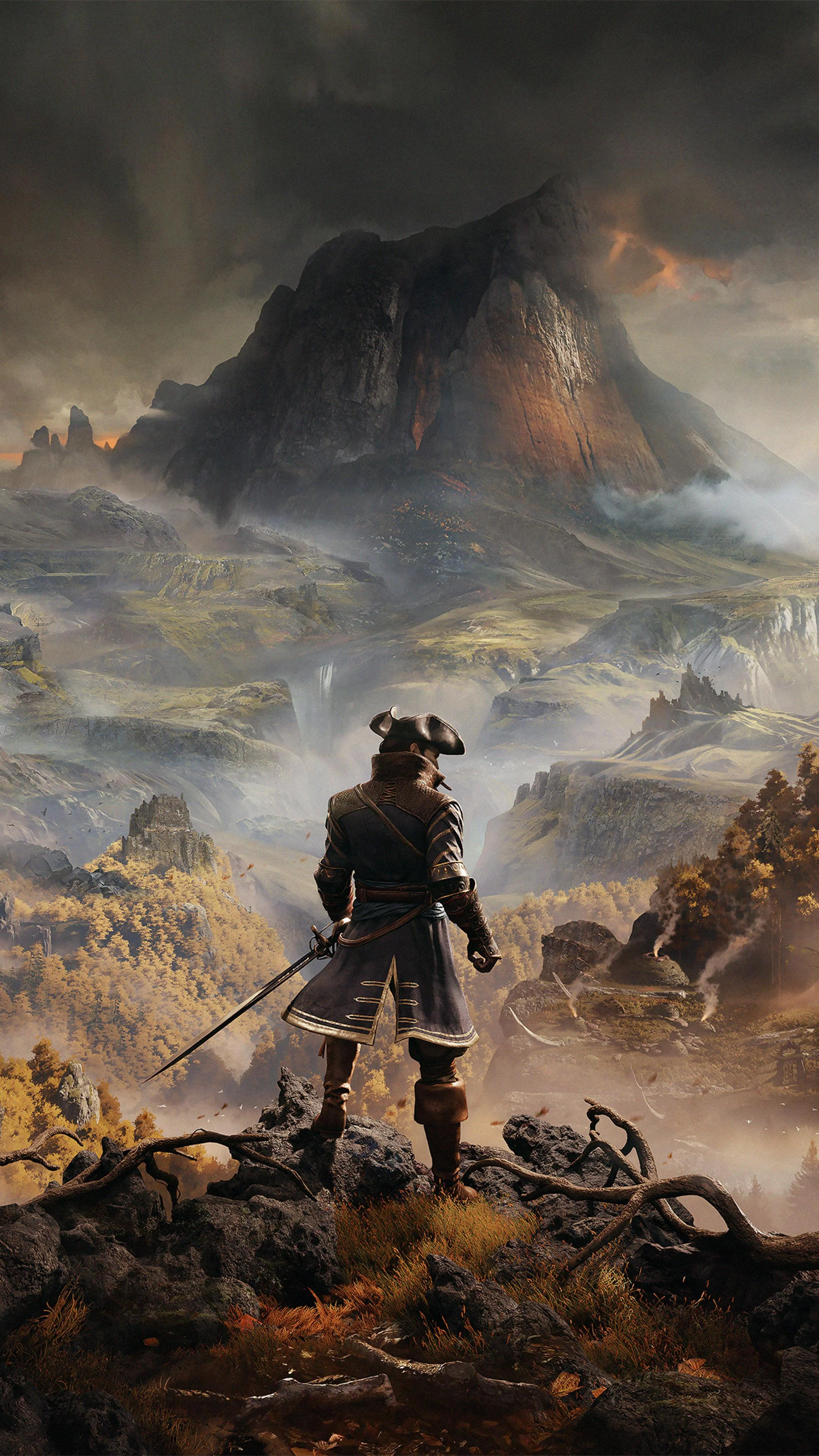
Greedfall
This combination offers playable performance with an average of 44 FPS, though you may want to lower settings for smoother gameplay.
Average FPS: resolution vs quality settings
| Ultra | High | Medium | Low | |
|---|---|---|---|---|
| 4K Ultra HD | 16 | 25 | 27 | 35 |
| 1440p QHD | 27 | 42 | 46 | 58 |
| 1080p Full HD | 38 | 60 | 66 | 84 |
Cell color: green is 120+ FPS, teal is 60+, amber is 30+, red is below 30.
Greedfall with Intel Core i5-12600KF + Intel Arc B390, In-Depth Analysis
The Intel Core i5-12600KF paired with the Intel Arc B390 delivers a playable experience in Greedfall only at 1080p with Low or Medium settings, according to the measured data. The dataset shows a clear and severe bottleneck: the Arc B390, which ranks in the 9th percentile among all GPUs, is the limiting component. Its average benchmark score of 1482 places it just 1.3% ahead of the NVIDIA GeForce GT 520MX and 2.7% ahead of the GT 710. This GPU is simply not built for high-resolution gaming, making the 12600KF’s substantial multi-core muscle largely irrelevant in this specific configuration.
Resolution Scaling
The performance drop from 1080p to 4K is steep, confirming that the Arc B390 saturates long before the CPU becomes a factor. At Medium settings, the average frame rate falls from 66 FPS at 1920x1080 to 46 FPS at 2560x1440, a 30% reduction. Pushing further to 3840x2160 yields just 27 FPS, which is a 59% decline from the 1080p result. This scaling pattern is characteristic of a GPU-limited scenario; the i5-12600KF has ample headroom, as evidenced by its 23,391 multi-core score in Cinebench R23, but it is never allowed to stretch its legs.
The low preset tells a similar story. At 1080p Low, the system achieves 84 FPS, but this drops to 58 FPS at 1440p and only 35 FPS at 4K. The 4K Low result is actually lower than the 1440p Medium score (35 FPS vs. 46 FPS), which suggests that even reducing graphical complexity cannot overcome the fundamental fill-rate limitations of the GPU. The Arc B390’s 60.00 GPixel/s pixel rate and 120.0 GTexel/s texture rate are simply insufficient for the pixel count of 4K displays.
The Ultra preset is the clearest indicator of the GPU ceiling. At 1080p Ultra, the system manages 38 FPS, but at 1440p Ultra it falls to 27 FPS, and at 4K Ultra it collapses to 16 FPS. This is a 58% drop from 1080p to 4K, mirroring the Medium preset’s scaling almost exactly. The consistency of these percentage drops—regardless of settings—proves that resolution, not graphical complexity, is the primary stressor. The CPU, with its 10 cores and 16 threads, is never the constraint; even the single-threaded score of 1016 in 3DMark and 3302 in Cinebench R23 is far beyond what a game running at 25 FPS could possibly require.
Data also shows that the gap between Low and Medium is narrow at every resolution, while the gap between Medium and High is wider. At 1080p, the jump from Low (84 FPS) to Medium (66 FPS) costs 18 FPS, while Medium to High (60 FPS) costs only 6 FPS. However, at 4K, the difference between Low (35 FPS) and Medium (27 FPS) is 8 FPS, and Medium to High (25 FPS) is only 2 FPS. This compression of frame rates at higher resolutions further underscores that the GPU is running out of memory bandwidth and shading power, not that the settings are being scaled inefficiently.
Settings Recommendations
The measured rows indicate that the Medium preset at 1920x1080 is the optimal balance for this hardware combination. It delivers 66 FPS average with a minimum of 56 FPS and a maximum of 76 FPS, making it the only preset at any resolution that stays comfortably above 60 FPS while providing a minimum frame rate that avoids stutter. Low at 1080p is faster at 84 FPS, but the visual quality trade-off is unnecessary when Medium is still fluid.
At 2560x1440, the data suggests that Low is the only viable choice. The 58 FPS average is playable, but the Medium preset drops to 46 FPS with a minimum of 39 FPS, which is borderline for an action RPG. High at 1440p produces 42 FPS, and Ultra falls to 27 FPS, both of which are too inconsistent for a game that requires precise timing in combat. For 4K, none of the presets reach a playable threshold; Low at 35 FPS is the least bad option, but the data strongly recommends avoiding 4K on this GPU entirely.
The Ultra preset is not recommended at any resolution. At 1080p, it yields 38 FPS, which is below the 40 FPS threshold that most players would consider smooth. The performance cost of Ultra over High is substantial: at 1080p, Ultra is 22 FPS slower than High (38 vs. 60), and at 1440p it is 15 FPS slower (27 vs. 42). The Arc B390’s 7.680 TFLOPS of FP32 performance is not sufficient to handle the additional post-processing and shadow effects that Ultra typically enables in Greedfall.
For players with a 1080p monitor, the recommendation is clear: Medium. For 1440p, Low is the only preset that maintains a playable frame rate without dipping into the 30s. The data shows no scenario where High or Ultra provides a better experience than Medium at the same resolution, as the average FPS gains from lowering settings are not linear. The 12600KF’s performance is irrelevant to this decision because the GPU is the sole determinant of these frame rates.
CPU Role
The Intel Core i5-12600KF is a high-performance desktop processor with 10 cores (6 performance and 4 efficiency) and 16 threads, based on the Alder Lake architecture. Its benchmark results are strong: a 23,391 multi-core score in Cinebench R23 and a 27,575 in PassMark’s multithread test. It sits in the 79th percentile among all CPUs, with an average benchmark score of 27,799, which is nearly identical to the Intel Core i9-10900K (27,872, a -0.3% delta) and the AMD Ryzen 7 5800X3D (27,896, a -0.3% delta). This places the CPU in the upper echelon of gaming processors.
However, in Greedfall, the CPU’s role is almost entirely passive. The game’s frame rates are capped by the GPU at every resolution and settings combination. At 1080p Low, the system hits 84 FPS, which is the highest score in the dataset, but even this does not stress the CPU. The 12600KF’s single-thread performance, measured at 1016 in 3DMark single-thread and 3925 in PassMark single-thread, is more than adequate for the game’s AI and physics calculations, which are typically single-threaded. The 3DMark 2-thread score of 1995 also shows that the CPU can handle the main game thread plus background tasks without issue.
The data indicates that the CPU’s 16 threads are underutilized. Greedfall is an Action RPG from 2019 that does not scale well beyond a few cores, and the measured FPS does not change in a way that correlates with CPU load. For instance, the difference between 1080p Low (84 FPS) and 1080p Ultra (38 FPS) is 46 FPS, which is a GPU-side change. The CPU’s 3DMark 16-thread score of 7956 and 4-thread score of 3806 suggest that even if the game used four threads heavily, it would not be a bottleneck. The only scenario where the CPU might matter is if the GPU were upgraded, but with the Arc B390’s 9th percentile ranking, that is not a concern here.
The 125W TDP and boost clock of 4.90 GHz are typical for this class of processor, but they do not influence the measured results. The CPU’s 20 MB of shared L3 cache and 1.25 MB per-core L2 cache are generous, yet they are not exercised differently across the resolution presets. In short, the i5-12600KF is overqualified for this pairing; the data shows that the game is entirely GPU-bound, and the CPU’s only contribution is to avoid being a limiting factor, which it does with ease.
FAQ
*Q: Can this system run Greedfall at 4K?*
A: No. The measured data shows the highest 4K average is 35 FPS on Low settings, with Medium at 27 FPS, High at 25 FPS, and Ultra at 16 FPS. None of these are playable, and the GPU’s 9th percentile ranking confirms it lacks the power for 4K.
Q: What is the best preset for smooth gameplay on a 1080p monitor?
A: Medium at 1920x1080 is the best, delivering 66 FPS average with a minimum of 56 FPS. Low is faster at 84 FPS, but Medium provides a better visual experience without dropping below 56 FPS.
Q: Is the Intel Core i5-12600KF the reason for low frame rates?
A: No. The CPU is highly capable, with a 23,391 Cinebench R23 multi-core score and a 79th percentile ranking. The frame rates are entirely limited by the Intel Arc B390 GPU, which scores 1482 in 3DMark Steel Nomad and ranks in the 9th percentile.
Q: How does the Arc B390 compare to its nearest rivals?
A: The Arc B390 has an average benchmark score of 1482, which is 1.3% higher than the NVIDIA GeForce GT 520MX (1463) and 1.5% higher than the GeForce 800M (1460). It is 2.7% ahead of the GT 710 (1443).
Q: What is the frame rate difference between Low and Ultra at 1440p?
A: At 2560x1440, Low averages 58 FPS while Ultra averages 27 FPS. That is a 31 FPS difference, or a 53% reduction, which is significant for a game that requires responsive combat.
Q: Does the GPU’s memory configuration affect performance?
A: Yes. The Arc B390 uses System Shared memory with System Dependent bandwidth. This means it relies on the system’s DDR4 or DDR5 memory, which is slower than dedicated VRAM. This likely contributes to the steep FPS drops at higher resolutions, as the shared memory bus becomes a bottleneck.
GPU Role
The Intel Arc B390 is an integrated GPU based on the Xe3-LPG architecture, fabricated on a 3 nm process. It features 1536 shading units, 48 texture mapping units, and 24 raster operations pipelines. Its clock speeds are 300 MHz base and 2500 MHz boost, and it has 12 ray tracing cores. The GPU’s theoretical performance is 7.680 TFLOPS for FP32 and 15.36 TFLOPS for FP16, with a pixel rate of 60.00 GPixel/s and a texture rate of 120.0 GTexel/s. These specifications are modest, and the GPU’s 80W TDP suggests it is designed for efficiency, not high-end gaming.
The measured FPS data confirms that the Arc B390 is the sole performance limiter in this configuration. Its 3DMark Steel Nomad DX12 score is 1482, placing it in the 9th percentile of all GPUs. The nearest rivals are all legacy NVIDIA parts: the GT 520MX (1463 score, 1.3% slower), the GeForce 800M (1460, 1.5% slower), the GT 625 OEM (1446, 2.5% slower), and the GT 710 (1443, 2.7% slower). This puts the Arc B390 in a performance tier that is roughly a decade old, which explains why it struggles with Greedfall, a game that is not particularly demanding by modern standards.
The GPU’s memory is "System Shared," meaning it has no dedicated VRAM. It uses the system’s main memory, with bandwidth listed as "System Dependent." This is a critical weakness, as the game’s textures and frame buffers must compete with the CPU for memory bandwidth. The data shows that this becomes more pronounced at higher resolutions: at 4K Medium, the average FPS is 27, but the minimum FPS is 23 and the maximum is 32, indicating inconsistent frame pacing likely due to memory contention. At 1440p Medium, the minimum is 39 and the maximum is 53, still a wide variance.
The GPU’s ray tracing cores are present (12 RT cores), but Greedfall does not support ray tracing, so they are unused. The DirectX 12 Ultimate support is also irrelevant because the game is from 2019 and likely uses DirectX 11. The Arc B390’s lack of dedicated VRAM means that even at 1080p Low, the system uses system memory for the framebuffer, but the 84 FPS result shows it can handle the load at that resolution. The data strongly indicates that this GPU is only suitable for 1080p gaming at low-to-medium settings in Greedfall, and any attempt to increase resolution or settings will result in sub-30 FPS performance.
Measured FPS Breakdown
The complete dataset provides exact frame rates for all combinations of resolution and settings. At 1920x1080, the system achieves 84 FPS on Low, 66 FPS on Medium (with a minimum of 56 and maximum of 76), 60 FPS on High, and 38 FPS on Ultra. The 1080p results are the only ones that reach or exceed 60 FPS, and even then, only Low and Medium do so.
Moving to 2560x1440, performance drops significantly. Low averages 58 FPS, Medium averages 46 FPS (min 39, max 53), High averages 42 FPS, and Ultra averages 27 FPS. None of these reach 60 FPS, and only Low is above the 50 FPS mark. The 1440p Medium result is 20 FPS slower than 1080p Medium, illustrating the resolution penalty.
At 3840x2160, the results are largely unplayable. Low averages 35 FPS, Medium averages 27 FPS (min 23, max 32), High averages 25 FPS, and Ultra averages 16 FPS. The 4K Ultra result is the lowest in the entire dataset, and even the Low preset fails to maintain 30 FPS. The gap between 1440p and 4K is stark: 1440p Low is 58 FPS, while 4K Low is 35 FPS, a 40% drop.
The data also reveals that the scaling from Medium to High is consistent across resolutions. At 1080p, the difference is 6 FPS (66 to 60); at 1440p, it is 4 FPS (46 to 42); and at 4K, it is 2 FPS (27 to 25). This suggests that the High preset adds little visual benefit over Medium for the performance cost. Conversely, the drop from High to Ultra is severe: 22 FPS at 1080p (60 to 38), 15 FPS at 1440p (42 to 27), and 9 FPS at 4K (25 to 16). The Ultra preset is clearly not optimized for this GPU’s capabilities, and the measured numbers confirm that it should be avoided entirely.
In summary, the 1080p Medium preset is the sweet spot, offering 66 FPS average. The 1080p Low preset is the backup for those prioritizing frame rate at 84 FPS. For 1440p, only Low is acceptable at 58 FPS. For 4K, no preset is acceptable, and the system should be used with a 1080p display for any semblance of smooth gameplay in Greedfall.
Hardware Specifications
Intel Core i5-12600KF
Intel Arc B390
FPS Benchmarks by Resolution & Settings
Performance data for Intel Core i5-12600KF + Intel Arc B390 in Greedfall
| Resolution | Settings | Avg FPS |
|---|---|---|
| 3840x2160 | Low | 35.0 |
| 3840x2160 | Medium | 27.0 |
| 3840x2160 | High | 25.0 |
| 3840x2160 | Ultra | 16.0 |
| 2560x1440 | Low | 58.0 |
| 2560x1440 | Medium | 46.0 |
| 2560x1440 | High | 42.0 |
| 2560x1440 | Ultra | 27.0 |
| 1920x1080 | Low | 84.0 |
| 1920x1080 | Medium | 66.0 |
| 1920x1080 | High | 60.0 |
| 1920x1080 | Ultra | 38.0 |
Greedfall with ii5-12600KF + Other GPUs
See how Greedfall performs with the same CPU but different graphics cards.
Greedfall with Arc B390 + Other CPUs
See how Greedfall performs with the same GPU but different processors.
Other Games with ii5-12600KF + Arc B390
Explore FPS benchmarks for other games using this same hardware combination.