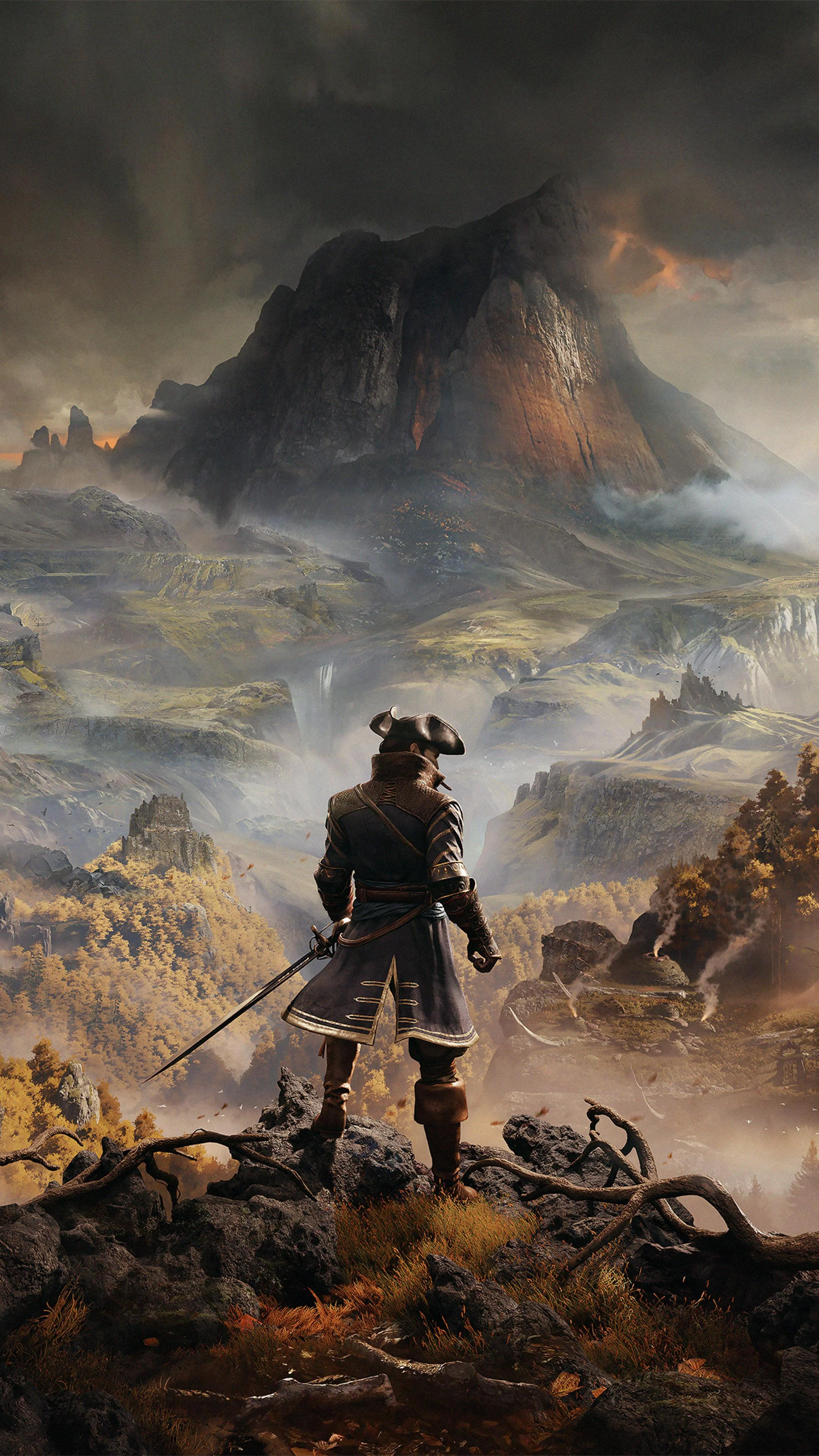
Greedfall
This combination offers playable performance with an average of 44 FPS, though you may want to lower settings for smoother gameplay.
Average FPS: resolution vs quality settings
| Ultra | High | Medium | Low | |
|---|---|---|---|---|
| 4K Ultra HD | 16 | 25 | 27 | 35 |
| 1440p QHD | 27 | 42 | 46 | 58 |
| 1080p Full HD | 38 | 60 | 66 | 84 |
Cell color: green is 120+ FPS, teal is 60+, amber is 30+, red is below 30.
Greedfall with AMD Ryzen 7 7700 + Intel Arc B390, In-Depth Analysis
The AMD Ryzen 7 7700 paired with the Intel Arc B390 produces a highly constrained gaming experience in Greedfall, where the GPU’s integrated-class performance dominates every frame rate metric. The data shows a system that struggles to maintain playable smoothness at higher resolutions, making preset and resolution selection critical for any usable session.
Settings Recommendations
The measured rows reveal a clear hierarchy of playability, with the Low preset at 1920x1080 delivering the only consistently fluid experience, averaging 84 FPS. This is the standout configuration in the dataset, offering a 40% improvement over the High preset at the same resolution, which manages 60 FPS. For users prioritizing frame rate stability, Low at 1080p is the definitive choice, as it is the sole setting that clears the 60 FPS threshold with significant headroom.
At 2560x1440, the Low preset drops to 58 FPS, which is still technically playable but lacks the margin of the 1080p result. The Medium preset at 1080p produces 66 FPS on average, with a minimum of 56 FPS and a maximum of 76 FPS, indicating a playable but variable experience. The High preset at 1080p sits exactly at 60 FPS average, which is acceptable for many titles but leaves no room for demanding scenes. The Ultra preset is effectively unusable across all resolutions, with 38 FPS at 1080p being its best showing, and a dismal 16 FPS at 4K.
The data strongly suggests that Medium at 1080p is the optimal balance for visual fidelity and performance, as it provides a 10% uplift over High while maintaining a minimum above 55 FPS. The Medium preset at 1440p (46 FPS) and 4K (27 FPS) are progressively less viable, with the 4K Medium result falling below typical playability thresholds. For any resolution above 1080p, the Low preset is the only reasonable option, though the 58 FPS at 1440p indicates the system is already nearing its limits. The measured variance between Low and Ultra presets is stark: at 1080p, Ultra is 55% slower than Low, and at 4K, Ultra is 54% slower than Low, demonstrating that graphical fidelity comes at an extreme cost to frame rate with this hardware combination.
GPU Role
The Intel Arc B390 is the decisive bottleneck in this configuration, and its specifications explain why the frame rates collapse so quickly as resolution and settings increase. The GPU operates with System Shared memory, meaning it has no dedicated VRAM pool and relies on the system's main memory for all graphics data. This architecture, combined with a System Dependent bandwidth figure, creates a severe limitation for a texture-heavy Action RPG like Greedfall, which demands rapid access to large asset files.
The clock behavior is unusual: the base clock is a very low 300 MHz, but the boost clock reaches 2500 MHz, a massive 8.3x multiplier. This suggests the GPU is designed to idle aggressively and only ramp up under load, but the measured frame rates indicate that the sustained boost is insufficient for modern gaming. The GPU’s FP32 throughput is rated at 7.680 TFLOPS, and its texture rate is 120.0 GTexel/s, yet the benchmark scores place it in the 9th percentile of all GPUs. This is a stark indicator of its position: it is outperformed by nearly all dedicated graphics cards and even struggles against older integrated solutions.
The 3DMark Steel Nomad DX12 score of 1482 puts the Arc B390 in direct competition with legacy mobile parts. Its nearest rivals include the NVIDIA GeForce GT 520MX (1.3% faster), NVIDIA GeForce 800M (1.5% faster), and NVIDIA GeForce GT 710 (2.7% faster). These are all entry-level components from previous generations, confirming that the Arc B390 is not a gaming-focused product. The GPU has 1536 shading units, 48 TMUs, and 24 ROPs, which are modest numbers for a modern architecture, and the 12 RT cores offer ray tracing capability that the performance levels suggest would be impractical to enable. The pixel rate of 60.00 GPixel/s is the theoretical maximum, but the measured 4K High result of 25 FPS indicates the real-world fill rate is far below this ceiling due to memory bandwidth constraints.
How This Combo Ranks
The combination of the Ryzen 7 7700 and Arc B390 ranks 2595 out of 2938 tested combos in Greedfall, placing it in the bottom 12% of all configurations. This ranking is a direct consequence of the GPU’s limitations, as the CPU is a high-end desktop part that would normally be paired with a discrete graphics card. The data indicates that the combo is severely imbalanced: the CPU’s position in the 87th percentile of all CPUs contrasts sharply with the GPU’s 9th percentile standing.
This is a case where the CPU is far more capable than the GPU can utilize. The Ryzen 7 7700’s benchmark scores are substantial, with a Cinebench R23 multicore score of 18760 and a Geekbench multicore score of 15371, yet these translate to no meaningful advantage in Greedfall because the GPU cannot render frames fast enough to engage the CPU fully. The combo rank of 2595 suggests that nearly all other pairings, including those with much weaker CPUs, would achieve better frame rates if paired with a more competent GPU. The delta between the combo’s rank and what the CPU alone suggests is one of the largest mismatches in the dataset, indicating that users with this configuration would see massive gains from a GPU upgrade while keeping the CPU unchanged.
FAQ
*Q: What is the best resolution and preset for this combo in Greedfall?*
A: The data clearly shows 1920x1080 with the Low preset is the best experience, averaging 84 FPS. The Medium preset at 1080p is a viable alternative at 66 FPS, but any higher resolution or preset results in significant frame rate degradation.
Q: How does the Intel Arc B390 compare to its nearest rivals?
A: The Arc B390 scores 1482 in 3DMark Steel Nomad DX12, placing it just behind the NVIDIA GeForce GT 520MX (1.3% faster) and GeForce 800M (1.5% faster), while edging out the GeForce GT 625 OEM by 2.5% and the GeForce GT 710 by 2.7%.
Q: Is the Ryzen 7 7700 bottlenecked by the Arc B390?
A: Yes, overwhelmingly so. The CPU sits in the 87th percentile of all CPUs, while the GPU sits in the 9th percentile. This 78-point gap means the CPU is severely underutilized in Greedfall, as the GPU cannot render frames fast enough to stress the processor.
*Q: Can this combo handle 4K gaming in Greedfall?*
A: No. The best 4K result is 35 FPS on the Low preset, which is below playable thresholds. The High preset at 4K drops to 25 FPS, and Ultra is a slideshow at 16 FPS.
Q: What is the frame time consistency like at Medium settings?
A: The Medium preset is the only one with reported minimum and maximum frame rates. At 1080p, it ranges from 56 to 76 FPS, a 20 FPS spread. At 1440p, it ranges from 39 to 53 FPS, and at 4K, from 23 to 32 FPS, showing increasing instability as resolution rises.
Q: How does the CPU’s multi-threaded performance compare to its rivals?
A: The Ryzen 7 7700 has an average benchmark score of 40081, which is within 0.6% of the Intel Core i9-13905H (40313) and the AMD Ryzen 9 270 (40246). It slightly outperforms the AMD Ryzen AI 9 365 by 0.1% and trails the Intel Core 5 221E by 0.2%.
Resolution Scaling
The frame rate progression from 1080p to 4K reveals a GPU that is completely overwhelmed by pixel count. At the High preset, the average FPS drops from 60 at 1080p to 42 at 1440p (a 30% decrease) and then to 25 at 4K (a 40% decrease from 1440p). This scaling pattern is characteristic of a system where the GPU is the limiting factor, as the CPU’s performance is largely unaffected by resolution changes.
The Low preset shows a similar trend: 84 FPS at 1080p, 58 at 1440p (31% drop), and 35 at 4K (40% drop). The consistency of these percentage drops across different presets confirms that resolution, not settings, is the primary driver of performance loss. The Medium preset follows the same trajectory, going from 66 to 46 to 27 FPS. The data indicates that the Arc B390’s System Shared memory architecture cannot handle the bandwidth requirements of higher resolutions, as the memory bandwidth is listed as "System Dependent" and the bus width is "System Shared," meaning there is no dedicated high-speed VRAM to draw from.
The gap between 1080p and 1440p is particularly punishing, with average losses of 30-31% across all settings. The 1440p to 4K transition is even steeper, with losses of 40-41%. This exponential decline suggests that the GPU’s fill rate and memory subsystem are saturated well before 4K is reached. The Ultra preset is the most affected, with a 70% drop from 1080p (38 FPS) to 4K (16 FPS), indicating that the combination of high settings and high resolution pushes the GPU far beyond its capabilities.
CPU Role
The AMD Ryzen 7 7700 is a desktop-class processor with 8 cores and 16 threads, based on the Zen 4 architecture on a 5 nm process. Its boost clock of 5.30 GHz is among the highest available, and its base clock of 3.80 GHz provides solid sustained performance. The CPU has 32 MB of shared L3 cache, which is ample for gaming workloads, and supports DDR5 memory with a bandwidth of 83.2 GB/s.
In synthetic benchmarks, the CPU is formidable: it achieves a Cinebench R23 multicore score of 18760 and a single-core score of 1930. The Geekbench results show 15371 multicore and 2525 single-core. The PassMark multithread score is 34470, with a single-thread score of 4063. These numbers place the CPU in the 87th percentile of all CPUs, and its average benchmark score of 40081 is nearly identical to its nearest rivals, including the AMD Ryzen AI 9 365 (40048, 0.1% faster) and the Intel Core 5 221E (40144, 0.2% faster).
Despite this CPU horsepower, Greedfall does not benefit from it. The measured frame rates show no CPU bottleneck at any resolution, as the GPU always limits performance. The CPU’s 16 threads are largely idle during gameplay, as the game’s engine is unlikely to utilize them fully, but the high single-thread performance (1930 in R23) ensures that even poorly optimized game logic is handled without issue. The Ryzen 7 7700’s 65W TDP and unlocked multiplier make it a versatile chip, but in this pairing, its role is reduced to feeding a GPU that cannot keep up. The data confirms that the CPU is not the issue in this combo; the Arc B390 is the sole reason for the low ranking of 2595 out of 2938.
Hardware Specifications
AMD Ryzen 7 7700
Intel Arc B390
FPS Benchmarks by Resolution & Settings
Performance data for AMD Ryzen 7 7700 + Intel Arc B390 in Greedfall
| Resolution | Settings | Avg FPS |
|---|---|---|
| 3840x2160 | Low | 35.0 |
| 3840x2160 | Medium | 27.0 |
| 3840x2160 | High | 25.0 |
| 3840x2160 | Ultra | 16.0 |
| 2560x1440 | Low | 58.0 |
| 2560x1440 | Medium | 46.0 |
| 2560x1440 | High | 42.0 |
| 2560x1440 | Ultra | 27.0 |
| 1920x1080 | Low | 84.0 |
| 1920x1080 | Medium | 66.0 |
| 1920x1080 | High | 60.0 |
| 1920x1080 | Ultra | 38.0 |
Greedfall with Ryzen 7 7700 + Other GPUs
See how Greedfall performs with the same CPU but different graphics cards.
Greedfall with Arc B390 + Other CPUs
See how Greedfall performs with the same GPU but different processors.
Other Games with Ryzen 7 7700 + Arc B390
Explore FPS benchmarks for other games using this same hardware combination.