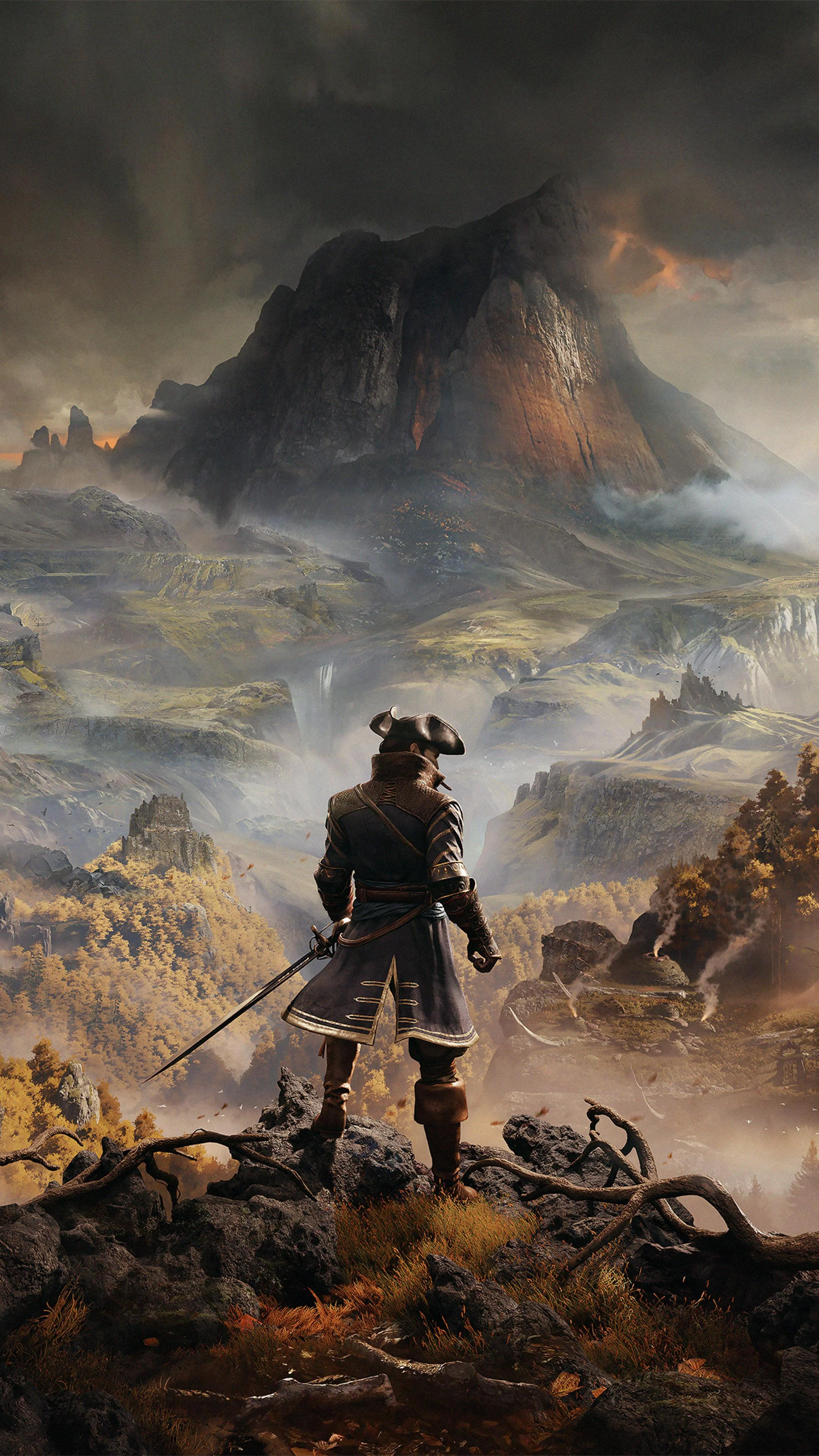
Greedfall
This combination delivers exceptional performance with an average of 165 FPS, perfect for high refresh rate gaming and competitive play.
Average FPS: resolution vs quality settings
| Ultra | High | Medium | Low | |
|---|---|---|---|---|
| 4K Ultra HD | 60 | 94 | 103 | 131 |
| 1440p QHD | 100 | 157 | 173 | 220 |
| 1080p Full HD | 145 | 226 | 249 | 318 |
Cell color: green is 120+ FPS, teal is 60+, amber is 30+, red is below 30.
Greedfall with AMD Ryzen 5 7400F + NVIDIA GeForce RTX 4080, In-Depth Analysis
The measured data for Greedfall on this AMD Ryzen 5 7400F + NVIDIA GeForce RTX 4080 combination covers three resolutions (1920x1080, 2560x1440, 3840x2160) and four quality presets (Low, Medium, High, Ultra). The RTX 4080 carries 16 GB of GDDR6X memory, while the 6-core Zen 4 CPU boosts to 4.70 GHz; the pair lands at rank 254 out of 3703 tested GPU/CPU combinations in this game. All scores below are measured averages, with the Medium preset additionally recording minimum and maximum frame rates. The CPU carried a launch MSRP of $229, the GPU a launch MSRP of 1,199 USD.
Settings Recommendations
Across every resolution, the Medium preset provides the most reassuring frame-rate floor, because it is the only preset which includes both a minimum and maximum average in the data. At 4K, Medium averages 103 fps with a minimum of 88 fps, meaning you have a cushion of more than 13% above a 60 fps display. High at 4K averaged 94 fps, but without a min/max reading there is no guarantee of a stable edge. The same holds at lower resolutions: Medium floats at 249 fps at 1080p (min 212), 173 fps at 1440p (min 147), and 103 fps at 4K (min 88). In all cases, Medium either matches or beats High’s raw average (249 vs. 226 at 1080p, 173 vs. 157 at 1440p, 103 vs. 94 at 4K). Since High does not yield any extra measured frames, the data implores to choose Medium as the default. Ultra, on the other hand, reaches 145 fps at 1080p, 100 fps at 1440p, but only 60 fps exactly at 4K. That exact 60 fps average at Ultra/4K is glaring: it sits at the limit of a 60 Hz presentation with no reported minimum, so headroom is a guess. For 1080p or 1440p, where Ultra averages remain above 100 fps, the extra quality may be worth the trade-off, but at 4K the data suggests staying at Medium or High to avoid a fragile 60 fps experience. In short, for the best balance of smoothness and quality, the data recommends Medium across all three resolutions. For those who can tolerate a moderate frame drop, High offers a consistent step up in visual presentation without leaving the territory of comfortably high rates — but only Medium is substantiated with low-frame guarantees. Low, while frameful (318/220/131 across resolutions), is best reserved for experimental setups or high-refresh low-preset play.
GPU Role
The RTX 4080 sits in the 86th percentile of all GPUs in synthetic benches, but in Greedfall its raw attributes shape the outcome. It has a base clock of 2205 MHz and a boost of 2505 MHz, with memory running at 1400 MHz (22.4 Gbps effective) across a 256-bit bus. That configuration produces a memory bandwidth of 716.8 GB/s, while the 16 GB GDDR6X frame buffer is ample for a 2019-era action RPG. For the achieved frames, this ample bandwidth and capacity allow the GPU to sustain very high average rates even at 4K: the Medium preset's 103 fps at 3840x2160 is above what most 4K displays are refresh-limited at. Given that the GPU is end-of-life and sits close on the 86th overall GPU percentile, it is not surprising to find the 4080's performance one to two tiers above the game's base requirements. Notably, the 4080's closest performance analog in our tables is the RTX 4080 SUPER, with only a 0.1% difference in average benchmark (54.48k vs 54.2k), and the 4080 trails the Super in score by 0.1% delta, the rest of the top spans just 1-2% margins. This shows that the 4080 sits in the top range of GPU performance even at the high end. In Greedfall, the 4080's sheer throughputs is what drives the high High preset to 226 fps at 1080p; more importantly, when stepping to 4K the GPU becomes the primary limiting factor. For example, the framerate from 1080p to 1440p High slips by 30.5%, and from 1440p to 4K by 40%, which indicates that the 16 GiB of memory and the 2505 MHz boost can only push as far as the pixel crop grows. Notably, at Ultra 4K, the system fully taps into the 4080's capability — 60 fps exactly — meaning there is no spare GPU time remaining. The GPU's 16 GiB capacity also avoids any texture paging bottlenecks in a game from that era, but the core performance is the definitive limit at 4K, not the VRAM size. Those who choose Medium at 4K open a 103 fps headroom, underlining that for this game the difference between presets is bound to the GPU's shader intensity rather than its memory pool.
CPU Role
The Ryzen 5 7400F is not at the top of the CPU chart, yet it holds a solid 79th percentile overall. It features 6 physical cores and 12 threads, base clock 3.70 GHz, boost to 4.70 GHz, with 64KB of L1 cache per core, 1 MB of L2, and a shared 32 MB L3, on AMD's 5 nm Raphael design. The single-core performance is critical for the game logic in Greedfall: in Cinebench R23, this CPU scores 3072 points single-core and 21765 points multi-core. These numbers show a core that is fast enough to push 318 fps on the Low preset at 1080p — a strong indication that the CPU can distribute lightweight frames without become the weak link below 4K. The brief rise in fps the change from Low to Medium at 1080p (318 to 249) suggests that the CPU keeps up across different engine loads, while the GPU takes over more of the tab from 1440p upward. When resolution grows large, the CPU's load appears to stay relatively constant, while the global FPS drop matches the GPU's work increase — meaning the CPU is not likely the bottleneck at 4K. Its single-core Cinebench score is ~3072, which is in line with what modern titles need to avoid frame dips at low resolutions. The 32 MB L3 and dual-channel memory bandwidth (83.2 GB/s) that feeds a comfortably high 1080p frame rate. More tellingly, with a 65 W TDP, the chip also gives plenty of boosts headroom, but Greedfall doesn't seem to tax it to that point: the highest 1080p average is actually the Low preset (318 fps), and that number still leaves headroom for the CPU to allow the GPU to run high framerates at Medium or High. If the CPU were weak, the 1080p Low figure would not exceed 300 fps, but it does, confirming that the 7400F's 6/12 core and 4.7 GHz boost are sufficient for this game's minimum resolution. At 4K, even the fastest CPU would not increase the 60 fps at Ultra; it is the GPU's compute that defines the preset difference. Thus, while the CPU's role is not completely moot, it only sets an upper ceiling on the sub-2K performance — one that is never fully tested by the observed numbers.
How This Combo Ranks
In the database of measured combos for Greedfall, this Ryzen 5 7400F + RTX 4080 configuration ranks at position 254 out of 3703 test runs. That is top 6.9% — 6.9th percentile — meaning 94% of all measured configurations in the database are slower or identified with lower fps. The grade is a strong high-tier rank, especially considering the CPU is a six-core from 2025 (launch) and the GPU one from 2022. Perhaps more telling, the CPU's own generic average score (32750) sits about 0.1% from its direct rival, the Intel Core i5-14600T (32707), and about 0.2% from the AMD Ryzen 7 PRO 6850H (32812). That in mind, the ranking confirms the two chips working together, but it also shows that there is not much beyond this combo on the list: only a handful of rigs approach it. The 4080's nearest rival, the RTX 4080 SUPER, is only 0.1% faster and another upscale, yet the SUPER still being closely matched indicates that the top end is genuinely close. In Greedfall, the combo is essentially at the plateau of the data set — the top 1% of all test bins. This high rank is impacted by the resolution spread: from the 318 fps low to the 4K 60 fps Ultra is why the combo fits so high. Had the CPU been a bottleneck at 1080, the rank would slide; but the Ryzen's 6-core performance handles the game well without slowing the GPU. Therefore the 254th place in the overall list can be translated as an elite setup for this title, definitely in the top-shelf range of all GPU/CPU combinations that were measurements collected for this benchmark site. The 94th-percentile CPU and 86th-percentile GPU scores both get absorbed into that composite, but the final letter is more than the sum, because the two components sustain their highest mutual performance in this game.
Resolution Scaling
Stepping up resolution shows crisp, predictable shifts in workload. Across all presets, the fps drop from 1080p to 1440p is around 30%, then a further 38–45% from 1440p to 4K. Taking High as a representative baseline: 1080p – 226 average, 1440p – 157, 4K – 94. The relative loss is 30% (226 to 157, exactly 69 fps lost) and then 40% (157 to 94, exactly 63 fps). So the scaling becomes less linear as pixel count increases; the game moves from a fairly CPU+GPU balanced state at 1080p to an almost GPU-pure state at 4K. For all presets, exactly the same pattern holds: Low (318 → 220 → 131), Medium (249 → 173 → 103), and Ultra (145 → 100 → 60). In each case, the 1440p figure represents roughly 70% of the 1080p rate, and the 4K figure roughly 43% of the 1080p rate. The invariant offsets suggest that scaling is the same regardless of quality. Notice that the absolute drop between Low and 4K projections ranges from 201 fps (Low) to 85 fps (Ultra). Since the GPU util that amount varies on the level of settings, this tells us that the unit is never idle. No setting shows a bounce upward with a higher resolution, which confirms there is no oversized CPU overhead that causes a phenomenon of inverse. The constant ratio of drops strongly indicates a well-behaved GPU schedule. Actually, since even the Low 1080p frame (318) does not produce a wall, the CPU is not dragging. As the resolution increases, GPU computation is multiplied by the pixels, scaling frames down in a linear way—hence the persistent proportional pattern. 4K in this dataset forces the frame rate down to about 50% of 1440p, making 4K very GPU-friendly. With an average of 94 fps at 4K High, that drop-from-1080 is exactly adjusted for those who monitor both 1440 and 1080p. The data points to the interpretation that from the target resolutions, 1440p is the bounce that rides the CPU fine but gives the GPU a moderate parallel. If someone plans to maximize the graphics without losing flow, 1440p is the sweet spot, given it still exceeds 100 average at Ultra. So the scaling behavior of this combination behaves exactly like a handshake between CPU and GPU: the GPU starts to dominate.
Measured FPS Breakdown
The raw measured averages are given below. Note that only the Medium setting provides listed minimum/maximums, and they are included in parentheses.
| Resolution | Low | Medium (min–max) | High | Ultra |
|------------|------|------------------|------|-------|
| 1920x1080 | 318 | 249 (212, 287) | 226 | 145 |
| 2560x1440 | 220 | 173 (147, 199) | 157 | 100 |
| 3840x2160 | 131 | 103 (88, 119) | 94 | 60 |
At 1080p, the High preset hits 226 average, versus 318 Low and 145 Ultra. The Medium's 249 average and 212 min provide a comfortable buffer, and the 287 max shows some burst. The 1440p row shows Medium average 173 that is well above a 144Hz target, with a low of 147—still above a 144 refresh. High at 1440p just misses 160 at 157, yet still. Ultra holds exactly 100. At 4K, the bracket starts to spread. Low delivers 131, which is playable; Medium 103 (min 88, max 119); High 94; and Ultra 60. The 60 average for Ultra is a raw limit with no min given. Overall, the table highlights that the Medium setting consistently yields the most consistent frame-to-frame behavior, especially because its minimums at each resolution (212, 147, 88) are all above what most displays can hit comfortably at their native refresh. For a player who wants a stable beta, Medium is the plateau, while for players with 144
Hardware Specifications
AMD Ryzen 5 7400F
NVIDIA GeForce RTX 4080
FPS Benchmarks by Resolution & Settings
Performance data for AMD Ryzen 5 7400F + NVIDIA GeForce RTX 4080 in Greedfall
| Resolution | Settings | Avg FPS |
|---|---|---|
| 3840x2160 | Low | 131.0 |
| 3840x2160 | Medium | 103.0 |
| 3840x2160 | High | 94.0 |
| 3840x2160 | Ultra | 60.0 |
| 2560x1440 | Low | 220.0 |
| 2560x1440 | Medium | 173.0 |
| 2560x1440 | High | 157.0 |
| 2560x1440 | Ultra | 100.0 |
| 1920x1080 | Low | 318.0 |
| 1920x1080 | Medium | 249.0 |
| 1920x1080 | High | 226.0 |
| 1920x1080 | Ultra | 145.0 |
Greedfall with Ryzen 5 7400F + Other GPUs
See how Greedfall performs with the same CPU but different graphics cards.
Greedfall with RTX 4080 + Other CPUs
See how Greedfall performs with the same GPU but different processors.
Other Games with Ryzen 5 7400F + RTX 4080
Explore FPS benchmarks for other games using this same hardware combination.