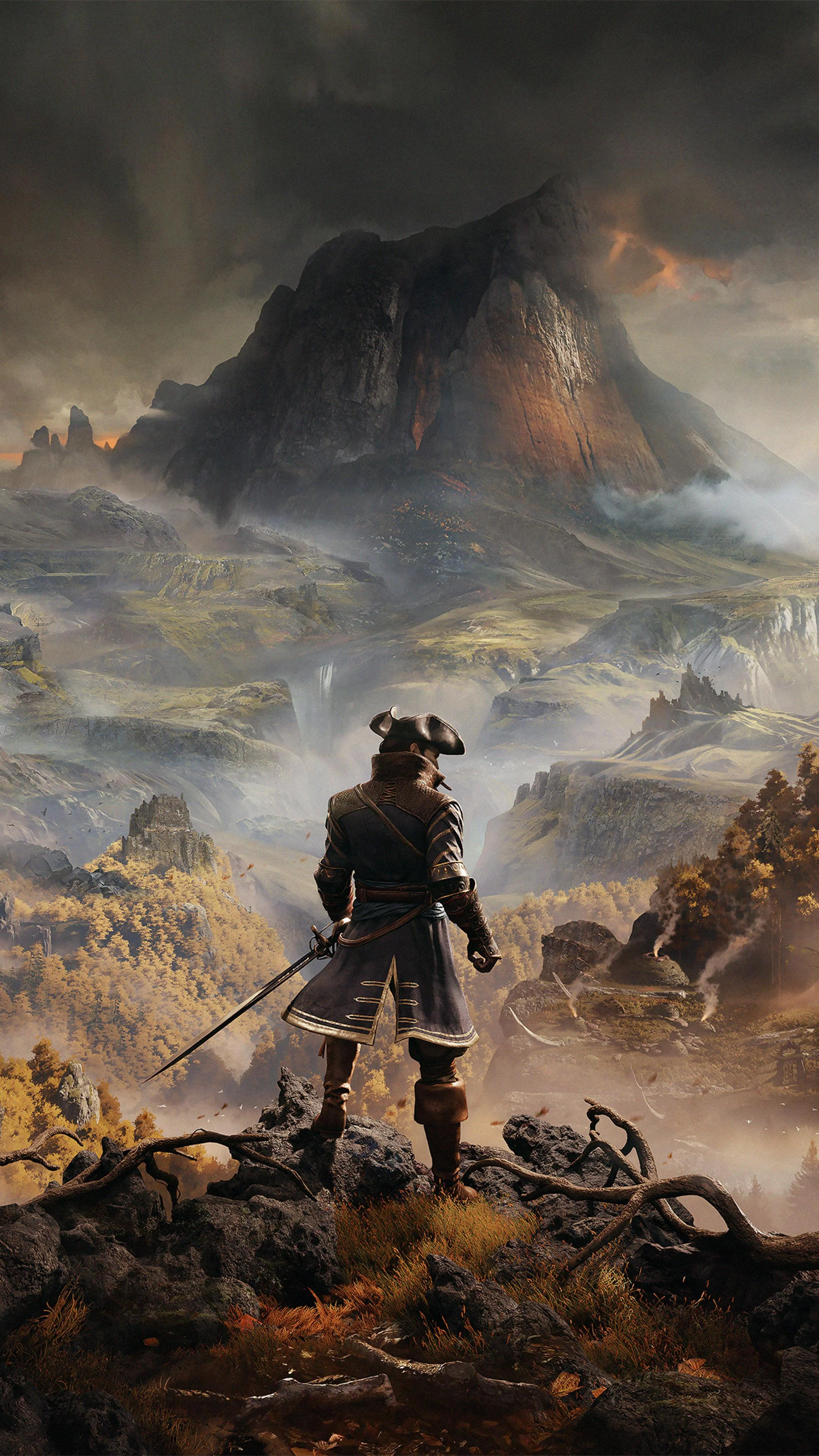
Greedfall
This combination provides smooth gameplay with an average of 72 FPS, suitable for most gaming scenarios.
Average FPS: resolution vs quality settings
| Ultra | High | Medium | Low | |
|---|---|---|---|---|
| 4K Ultra HD | 26 | 41 | 45 | 57 |
| 1440p QHD | 44 | 68 | 75 | 96 |
| 1080p Full HD | 63 | 99 | 109 | 138 |
Cell color: green is 120+ FPS, teal is 60+, amber is 30+, red is below 30.
Greedfall with Intel Core i7-13700K + NVIDIA GeForce RTX 2060, In-Depth Analysis
# Greedfall with Intel Core i7-13700K + NVIDIA GeForce RTX 2060
This combination of an Intel Core i7-13700K and NVIDIA GeForce RTX 2060 places in the 2932nd position out of 3703 tested combos for Greedfall, a result that reflects the GPU's mid-range standing rather than any CPU limitation. The RTX 2060, built on the Turing architecture with a 12 nm process from TSMC, delivers average frame rates that range from 26 FPS at 4K Ultra to 138 FPS at 1080p Low, while the i7-13700K provides ample headroom with 16 cores and 24 threads. The data shows a system where the graphics card is the primary constraint across all tested resolutions, with the CPU's substantial multi-threaded capabilities remaining largely underutilized in this Action RPG.
FAQ
Q: What is the combo's overall rank in Greedfall among all tested configurations?
A: This specific pairing ranks 2932nd out of 3703 tested combinations, placing it in the lower-middle portion of the field. The rank reflects the RTX 2060's position at the 58th percentile among all GPUs, while the i7-13700K sits at the 89th percentile among CPUs, indicating a significant imbalance between the two components.
Q: How does the RTX 2060 compare to its nearest GPU rivals in synthetic benchmarks?
A: The RTX 2060's average benchmark score is 15290, which is essentially tied with the NVIDIA GeForce GTX 580 (deltaPct 0.0) and the AMD Radeon 680M (deltaPct 0.1). It is 0.6% ahead of the NVIDIA GeForce RTX 3050 OEM and 0.8% ahead of the AMD Radeon RX 7600, showing that these cards perform within a very narrow band in aggregate testing.
Q: What is the CPU's multi-threaded performance profile relative to its rivals?
A: The i7-13700K averages a benchmark score of 46881, placing it 0.2% behind the AMD Ryzen 9 5900 and 0.3% behind the AMD Ryzen AI 9 HX PRO 375. It is 0.5% ahead of both the AMD Ryzen 9 7845HX and the Intel Xeon w3-2535, indicating near-identical overall performance among these five processors.
Q: What are the RTX 2060's memory specifications?
A: The card features 6 GB of GDDR6 memory on a 192-bit bus, delivering 336.0 GB/s of bandwidth. The memory clock runs at 1750 MHz with 14 Gbps effective speed. These specifications are typical for a mid-range Turing-era card and directly influence performance at higher resolutions.
Q: What is the best measured frame rate for this combo in Greedfall?
A: The highest average frame rate recorded is 138 FPS at 1920x1080 with Low settings. The lowest is 26 FPS at 3840x2160 with Ultra settings. The spread between these extremes is substantial, highlighting the GPU's sensitivity to both resolution and graphical preset.
How This Combo Ranks
The combo rank of 2932 out of 3703 places this system in the 79th percentile from the bottom, meaning roughly 79% of tested configurations outperform it in Greedfall. This is not a flattering position, and the cause is clear when examining the individual component percentiles. The CPU ranks in the top 11% of all processors, while the GPU ranks in the bottom 42% of all graphics cards. The system is effectively bottlenecked by the RTX 2060 in every scenario tested.
The deltaPct values from the CPU's nearest rivals show that swapping the i7-13700K for an AMD Ryzen 9 5900, AMD Ryzen AI 9 HX PRO 375, AMD Ryzen 9 7845HX, or Intel Xeon w3-2535 would change the average benchmark score by less than one percent in either direction. This suggests that the CPU choice is not the limiting factor in this combo's rank. Similarly, the GPU's nearest rivals—the GTX 580, Radeon 680M, RTX 3050 OEM, and RX 7600—all score within 0.8% of the RTX 2060 in synthetic benchmarks, meaning any of these cards would likely produce similar frame rates in Greedfall.
The rank becomes more understandable when considering that the RTX 2060 was released in January 2019, the same period as Greedfall's September 2019 launch. The card was designed for 1080p gaming at high settings in contemporary titles, not for 4K Ultra. The data confirms this: the combo achieves playable frame rates at 1080p and 1440p with medium-to-high settings, but collapses at 4K Ultra. The i7-13700K, released in late 2022, brings far more processing power than this game requires, and its high single-thread and multi-thread scores do not translate into proportional FPS gains because the GPU saturates first.
GPU Role
The NVIDIA GeForce RTX 2060 is built on the TU106 chip using a 12 nm process from TSMC, containing 10,800 million transistors on a 445 mm² die. It operates at a base clock of 1365 MHz and a boost clock of 1680 MHz, with 1920 shading units, 120 texture mapping units, and 48 raster output units. The card includes 30 RT cores and 240 tensor cores, supporting DirectX 12 Ultimate (12_2), OpenGL 4.6, and Vulkan 1.4.
Memory configuration is critical here: 6 GB of GDDR6 on a 192-bit bus provides 336.0 GB/s of bandwidth. At 4K resolution, Greedfall's texture-heavy environments can pressure this capacity, and the bandwidth figure becomes a limiting factor. The measured FPS data supports this: at 3840x2160, the average frame rate drops from 57 FPS at Low to 41 FPS at High, and further to 26 FPS at Ultra. The 6 GB capacity is sufficient for 1080p and 1440p, where the card delivers 99-138 FPS at High and Low settings respectively, but 4K Ultra exceeds what this memory subsystem can sustain.
The GPU's compute capabilities include 6.451 TFLOPS FP32 and 12.90 TFLOPS FP16 (2:1), with a pixel rate of 80.64 GPixel/s and texture rate of 201.6 GTexel/s. These figures place the card firmly in the mid-range segment of its era. The passmark G3D score of 14111 and the 3DMark Steel Nomad DX12 score of 1242 reflect its standing. The card's power draw is 160 W TDP, requiring a 450 W suggested PSU and a single 8-pin connector. The dual-slot design measures 229 mm in length, 113 mm in height, and 35 mm in width.
Settings Recommendations
Based on the measured FPS data, the optimal settings for this combo depend heavily on the target resolution. At 1920x1080, the Medium preset delivers 109 FPS average with a minimum of 92 FPS and maximum of 125 FPS. This provides a smooth experience with headroom for dips during combat or crowded scenes. The High preset at 1080p drops to 99 FPS average, which is still playable, but the margin between average and minimum narrows. The Ultra preset at 1080p yields 63 FPS, which is acceptable for a slower-paced RPG but leaves little room for frame time spikes.
At 2560x1440, the Medium preset averages 75 FPS with a minimum of 64 FPS and maximum of 87 FPS. This is the sweet spot for this resolution, offering a balance between visual fidelity and responsiveness. The High preset at 1440p drops to 68 FPS, which remains playable but approaches the threshold where input lag becomes noticeable in action sequences. The Low preset at 1440p provides 96 FPS, which is smooth but sacrifices significant visual quality.
At 3840x2160, no preset delivers a fully comfortable experience. The Low preset averages 57 FPS, which is borderline playable, while Medium drops to 45 FPS with a minimum of 38 FPS and maximum of 52 FPS. High averages 41 FPS, and Ultra falls to 26 FPS, which is unplayable for an Action RPG requiring timed dodges and parries. The recommendation is to use Medium at 1080p or 1440p, and to avoid 4K Ultra entirely. For 4K, Low settings are the only viable option, and even then, the experience will be suboptimal.
Measured FPS Breakdown
The measured data covers four resolutions and four settings presets, with 16 total data points. At 1920x1080, the Low preset achieves 138 FPS average, Medium reaches 109 FPS (min 92, max 125), High hits 99 FPS, and Ultra drops to 63 FPS. The progression from Low to Ultra shows a 54% reduction in frame rate at this resolution, indicating that the GPU's shading and memory resources are being taxed progressively.
At 2560x1440, Low averages 96 FPS, Medium averages 75 FPS (min 64, max 87), High averages 68 FPS, and Ultra averages 44 FPS. The drop from 1080p to 1440p at the same settings is approximately 30% across the board, consistent with the increase in pixel count from 2.07 million to 3.69 million. The Ultra preset at 1440p shows a 54% reduction from Low, similar to the 1080p ratio.
At 3840x2160, Low averages 57 FPS, Medium averages 45 FPS (min 38, max 52), High averages 41 FPS, and Ultra averages 26 FPS. The 4K resolution requires 8.29 million pixels, 4 times the 1080p count, and the frame rates reflect this arithmetic. The gap between 1440p and 4K at the same settings is roughly 40-45%, which is less than the theoretical 56% pixel increase, suggesting some degree of CPU involvement at lower resolutions that diminishes at 4K.
CPU Role
The Intel Core i7-13700K is a 16-core, 24-thread processor based on the Raptor Lake architecture, manufactured on Intel's 10 nm process with a die size of 257 mm². It runs at a base clock of 3.40 GHz and boosts to 5.40 GHz, with a TDP of 125 W. The cache hierarchy includes 80 KB of L1 per core, 2 MB of L2 per core, and 30 MB of shared L3 cache. It supports DDR4 and DDR5 memory in dual-channel configuration, with ECC memory support and PCIe Gen 5 with 20 lanes from the CPU.
The CPU's benchmark scores are impressive: Cinebench R23 multi-core reaches 30745, single-core 2116; Geekbench multi-core hits 19429, single-core 2529; and 3DMark max threads scores 12412. The Passmark multi-thread score of 45887 and single-thread score of 4333 further confirm its strength. The nearest rivals all score within 0.5% of this processor, meaning the i7-13700K is at the top of its class for synthetic workloads.
However, Greedfall is not a CPU-intensive title in the same way as strategy games or simulations. The game's engine, while capable of using multiple threads, does not scale linearly with core count beyond a certain point. The measured FPS data shows that at 1080p Low, the combo achieves 138 FPS, which is likely near the game's engine limit or the GPU's ceiling. The CPU's 3DMark 2-thread score of 2262 and 4-thread score of 4469 indicate that even with fewer threads active, the processor has ample headroom. The bottleneck is unequivocally the GPU, as evidenced by the fact that the i7-13700K's nearest rivals—all within 0.5% in average score—would produce identical frame rates in this game.
Resolution Scaling
The FPS scaling from 1080p to 1440p to 4K reveals the GPU-bound nature of this combo. At Low settings, the frame rates drop from 138 at 1080p to 96 at 1440p (a 30.4% reduction) and then to 57 at 4K (a 40.6% reduction from 1440p). At Medium settings, the sequence is 109, 75, and 45, representing a 31.2% and 40.0% drop respectively. At High settings, the numbers are 99, 68, and 41, showing a 31.3% and 39.7% reduction. At Ultra settings, the progression is 63, 44, and 26, with a 30.2% and 40.9% drop.
The consistency of these percentage drops across all settings is telling. If the CPU were a significant factor, the scaling would be less uniform, with smaller reductions at lower resolutions where the CPU has more influence. Instead, the near-constant 30% drop from 1080p to 1440p and 40% drop from 1440p to 4K aligns almost perfectly with the pixel count increases: 1440p has 1.78 times the pixels of 1080p (a 44% increase), and 4K has 2.25 times the pixels of 1440p (a 56% increase). The observed drops are slightly less than these theoretical values, which is typical because not all rendering work scales linearly with resolution, but the trend is clear.
This scaling pattern indicates that the RTX 2060's fill rate, memory bandwidth, and shading capacity are the limiting factors at every resolution. The CPU's role is to feed the GPU with draw calls and game logic, and the i7-13700K does this without breaking a sweat. The conclusion from the data is that this combo is GPU-limited in Greedfall at all tested settings and resolutions, and that upgrading the graphics card would yield significant FPS gains, while upgrading the CPU would yield none.
Hardware Specifications
Intel Core i7-13700K
NVIDIA GeForce RTX 2060
FPS Benchmarks by Resolution & Settings
Performance data for Intel Core i7-13700K + NVIDIA GeForce RTX 2060 in Greedfall
| Resolution | Settings | Avg FPS |
|---|---|---|
| 3840x2160 | Low | 57.0 |
| 3840x2160 | Medium | 45.0 |
| 3840x2160 | High | 41.0 |
| 3840x2160 | Ultra | 26.0 |
| 2560x1440 | Low | 96.0 |
| 2560x1440 | Medium | 75.0 |
| 2560x1440 | High | 68.0 |
| 2560x1440 | Ultra | 44.0 |
| 1920x1080 | Low | 138.0 |
| 1920x1080 | Medium | 109.0 |
| 1920x1080 | High | 99.0 |
| 1920x1080 | Ultra | 63.0 |
Greedfall with ii7-13700K + Other GPUs
See how Greedfall performs with the same CPU but different graphics cards.
Greedfall with RTX 2060 + Other CPUs
See how Greedfall performs with the same GPU but different processors.
Other Games with ii7-13700K + RTX 2060
Explore FPS benchmarks for other games using this same hardware combination.