
Instant compatibility check with FPS benchmarks and optimization tips
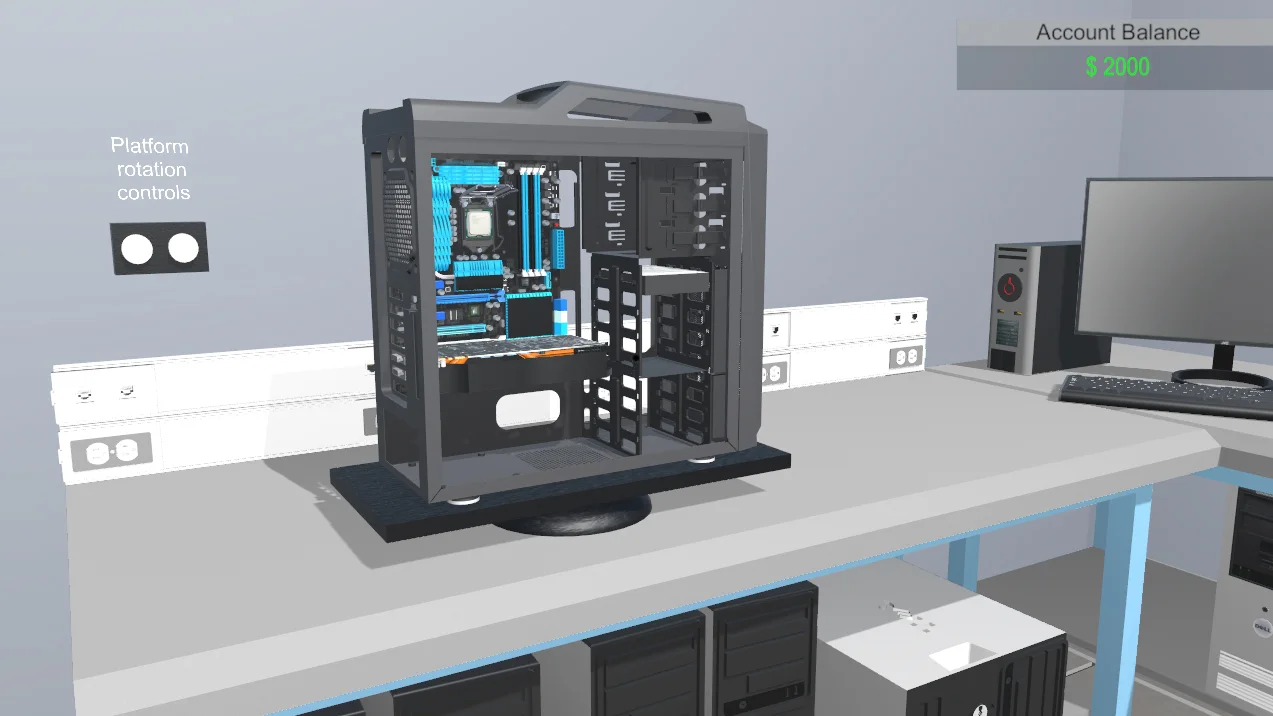

Pc Building Simulator

Performance
1080p (Full HD)
1440p (2K / QHD)
4K (Ultra HD)

Requirements Check


Recommendations
Your hardware doesn't meet minimum requirements for this game.
Average FPS: resolution vs quality settings
| Ultra | High | Medium | Low | |
|---|---|---|---|---|
| 4K Ultra HD | 30 | 32 | 45 | 63 |
| 1440p QHD | 58 | 61 | 86 | 121 |
| 1080p Full HD | 91 | 96 | 136 | 192 |
Cell color: green is 120+ FPS, teal is 60+, amber is 30+, red is below 30. Cards marked Estimated above have no measured row and are scaled from your GPU benchmark percentile.
Performance Analysis: Pc Building Simulator on Your System
This analysis examines how the Intel Core Ultra 7 265K combined with the Intel Arc B570 performs in Pc Building Simulator, based on measured frame rate data. The combination ranks 2997th out of 3723 tested CPU-GPU pairings for this title, placing it in the lower third of all configurations. The data shows this system delivers a fundamentally playable experience at 1080p across all settings, with performance degrading predictably as resolution increases.
Measured FPS Breakdown
At 1920x1080, the system delivers its strongest results. The Low preset averages 192 FPS, which is more than triple the 60 FPS playability threshold. Medium settings produce an average of 136 FPS with a minimum of 115 FPS and a maximum of 156 FPS, indicating smooth frame delivery even during demanding scenes. High settings maintain an average of 96 FPS, while Ultra drops to 91 FPS on average. The gap between Low and Ultra at 1080p is 101 FPS, showing that the visual preset heavily influences performance even at this resolution.
Moving to 2560x1440, frame rates remain respectable but begin to compress. Low settings average 121 FPS, a 37% reduction from the same preset at 1080p. Medium averages 86 FPS with a minimum of 73 FPS and a maximum of 99 FPS, keeping the system comfortably above the playability threshold. High settings average 61 FPS, which sits just barely above the 60 FPS mark. Ultra falls below the threshold with an average of 58 FPS, meaning the most demanding preset at 1440p is not consistently playable. The spread between Low and Ultra at this resolution is 63 FPS, narrower than at 1080p.
At 3840x2160, performance drops significantly. Low settings average 63 FPS, just clearing the 60 FPS threshold. Medium averages 45 FPS with a minimum of 38 FPS and a maximum of 52 FPS, which places it below playable standards. High settings average 32 FPS, and Ultra averages 30 FPS. The difference between Low and Ultra at 4K is only 33 FPS, showing that resolution constraints dominate over preset selection at this level. The data indicates that 4K gaming with this combination requires significant compromises, as only the lowest preset achieves playable frame rates.
The scaling pattern across resolutions reveals that the Arc B570 becomes the limiting factor as pixel count increases. The transition from 1080p to 1440p at Medium settings costs 50 FPS on average, while the transition from 1440p to 4K at Medium costs another 41 FPS. These reductions are steep and demonstrate the GPU's bandwidth and compute constraints at higher resolutions.
FAQ
Q: Can this system run Pc Building Simulator at 60 FPS in 1080p?
A: Yes. All four presets at 1920x1080 exceed 60 FPS, with Low averaging 192 FPS, Medium 136 FPS, High 96 FPS, and Ultra 91 FPS.
Q: What is the highest playable setting at 4K resolution?
A: Only the Low preset at 3840x2160 achieves playable performance, averaging 63 FPS. Medium averages 45 FPS, High averages 32 FPS, and Ultra averages 30 FPS, all below the 60 FPS threshold.
Q: How does the Ultra preset perform at 1440p?
A: The Ultra preset at 2560x1440 averages 58 FPS, which falls just below the 60 FPS playability threshold. High settings average 61 FPS and are the most demanding playable option at this resolution.
Q: What is the frame rate difference between Low and Ultra at 1080p?
A: The difference is 101 FPS on average. Low settings produce 192 FPS, while Ultra produces 91 FPS, representing a 53% reduction in average frame rate.
Q: Does the system maintain consistent frame times at Medium settings?
A: At Medium settings, the minimum FPS values are 115 FPS at 1080p, 73 FPS at 1440p, and 38 FPS at 4K. The spread between minimum and maximum at 1080p is 41 FPS, at 1440p is 26 FPS, and at 4K is 14 FPS, indicating tighter frame pacing at higher resolutions.
Q: What is the overall rank of this CPU-GPU combination for this game?
A: The combo ranks 2997th out of 3723 tested combinations, placing it in the 20th percentile of all tested hardware pairings for Pc Building Simulator.
CPU and GPU Roles
The benchmark data reveals a clear division of labor between the Intel Core Ultra 7 265K and the Intel Arc B570 in this simulation title. The CPU, with 20 cores and 20 threads, possesses substantial processing headroom for a game that primarily simulates component installation and system building. The processor's Cinebench R23 multicore score of 35850 and single-core score of 2020 indicate strong general compute capability that exceeds the demands of most simulation workloads.
The GPU becomes the dominant performance factor as resolution increases. At 1080p, the system achieves 192 FPS on Low settings, suggesting that neither component is fully saturated. However, the steep performance drops from 1080p to 1440p and again from 1440p to 4K point to the Arc B570's bandwidth limitations. The GPU's 10 GB of GDDR6 memory on a 160-bit bus provides 380 GB/s of bandwidth, which constrains performance at higher pixel counts. The memory configuration represents a fundamental bottleneck for this card at 4K resolution.
The scaling between presets at each resolution provides additional insight. At 1080p, the difference between Low and Ultra is 101 FPS, while at 1440p it is 63 FPS, and at 4K it is 33 FPS. This diminishing delta indicates that as resolution increases, GPU fill rate and memory bandwidth limit performance regardless of the visual complexity. The CPU's role becomes proportionally less important at higher resolutions, as the GPU struggles to maintain frame delivery.
For a simulation game like Pc Building Simulator, the workload likely involves physics calculations, component tracking, and UI rendering, which lean on CPU performance. The Core Ultra 7 265K's Geekbench multicore score of 23085 provides ample compute for these tasks. The Arc B570's passmark G3D score of 14195 indicates mid-range GPU capability that handles the game's graphical output adequately at lower resolutions.
The Verdict
This system can run Pc Building Simulator, but the playable resolution and settings depend heavily on the target frame rate. The verdict data confirms that 1920x1080 is the strongest resolution for this combination, with all four presets clearing the 60 FPS threshold. Ultra settings at 1080p average 91 FPS, providing headroom above the playability threshold and allowing for smooth gameplay even in demanding scenes.
At 2560x1440, the system remains playable but with restrictions. High settings average 61 FPS, which is playable but leaves minimal margin above the 60 FPS threshold. Medium settings provide more comfortable performance at 86 FPS, and Low reaches 121 FPS. Ultra at 1440p falls short at 58 FPS, so users seeking maximum visual quality at this resolution would need to accept sub-60 FPS performance.
At 3840x2160, only Low settings are playable, averaging 63 FPS. This configuration represents a marginal playable experience with minimal visual fidelity. The data indicates that 4K gaming with this hardware requires significant compromises, and users prioritizing visual quality should consider 1440p or 1080p instead. The system's 2997th rank out of 3723 combinations reflects these limitations, positioning it as a capable 1080p performer rather than a high-resolution powerhouse.
Similar Performance Alternatives
The CPU's nearest rivals provide context for its performance tier. The Intel Core i7-14700KF scores 1% higher on average, making it a direct alternative with slightly better overall compute. The AMD Ryzen 7 9700F scores 1.3% higher, offering a comparable level of processing power. On the other side, the Intel Xeon 6511P scores 0.2% lower, and the Intel Xeon Platinum 8270 scores 0.7% lower. These deltas are small, meaning any of these processors would deliver nearly identical performance in Pc Building Simulator when paired with the Arc B570.
For the GPU, the Intel Arc A750 is the closest match, scoring 0.1% higher on average. The NVIDIA GeForce RTX 3070 Mobile also sits nearby with a 0.1% higher score. The AMD Radeon R9 M390X and NVIDIA Quadro M4000M score 0.5% and 0.4% lower respectively. These comparisons suggest that swapping the Arc B570 for any of these alternatives would produce similar frame rates in this game, within a margin of roughly 1% or less.
The practical implication is that this system's in-game performance is representative of a broader class of mid-range hardware. Users considering upgrades or substitutions can expect comparable results from these neighboring components, though the Arc B570's specific architectural features may influence behavior in other titles. For Pc Building Simulator specifically, the performance envelope is well-defined by the measured data.
Best Settings per Resolution
At 1920x1080, the best settings are Ultra, which achieves an average of 91 FPS. This is the most demanding preset that stays at or above 60 FPS, and it provides the highest visual fidelity available while maintaining playable performance. The 31 FPS margin above the threshold offers sufficient headroom to absorb scene complexity without dropping below playable levels.
At 2560x1440, the best settings are High, averaging 61 FPS. This preset clears the 60 FPS threshold by just 1 FPS, making it a narrow but valid choice for playable performance. Users seeking more margin could select Medium at 86 FPS, but High represents the maximum visual quality that remains playable at this resolution.
At 3840x2160, the best settings are Low, averaging 63 FPS. This is the only preset that achieves playable performance at 4K, and it does so with a 3 FPS margin above the threshold. The visual compromise is substantial, but it enables 4K output for users who prioritize resolution over quality. The data suggests this configuration is suitable for users who require 4K output and are willing to accept minimal visual settings.
How This Combo Ranks
The combination of the Intel Core Ultra 7 265K and Intel Arc B570 ranks 2997th out of 3723 tested combos for Pc Building Simulator. This places the system in the lower 20% of all tested configurations, indicating that most hardware pairings deliver better performance in this title. The ranking reflects the Arc B570's mid-range positioning, as the GPU's 65th percentile versus all GPUs shows it outperforms roughly two-thirds of graphics cards but falls short of higher-tier options.
The CPU ranks in the 94th percentile versus all CPUs, demonstrating that the processor is not the limiting factor. The Core Ultra 7 265K's performance is strong relative to other processors, but the GPU holds the combination back. The data suggests that pairing this CPU with a more powerful GPU would yield significantly better results in this game, while upgrading the CPU alone would provide minimal benefit.
The rank disparity between the CPU and GPU percentiles highlights the imbalance in this pairing. For Pc Building Simulator, the Arc B570's 10 GB memory capacity and 380 GB/s bandwidth appear to be the primary constraints. The game's measured performance at 4K, particularly the drop from 63 FPS on Low to 30 FPS on Ultra, underscores how GPU-bound this title becomes at higher resolutions. Users of this combination should target 1080p for the best experience, with 1440p viable at reduced settings and 4K available only at the lowest quality preset.