
Instant compatibility check with FPS benchmarks and optimization tips
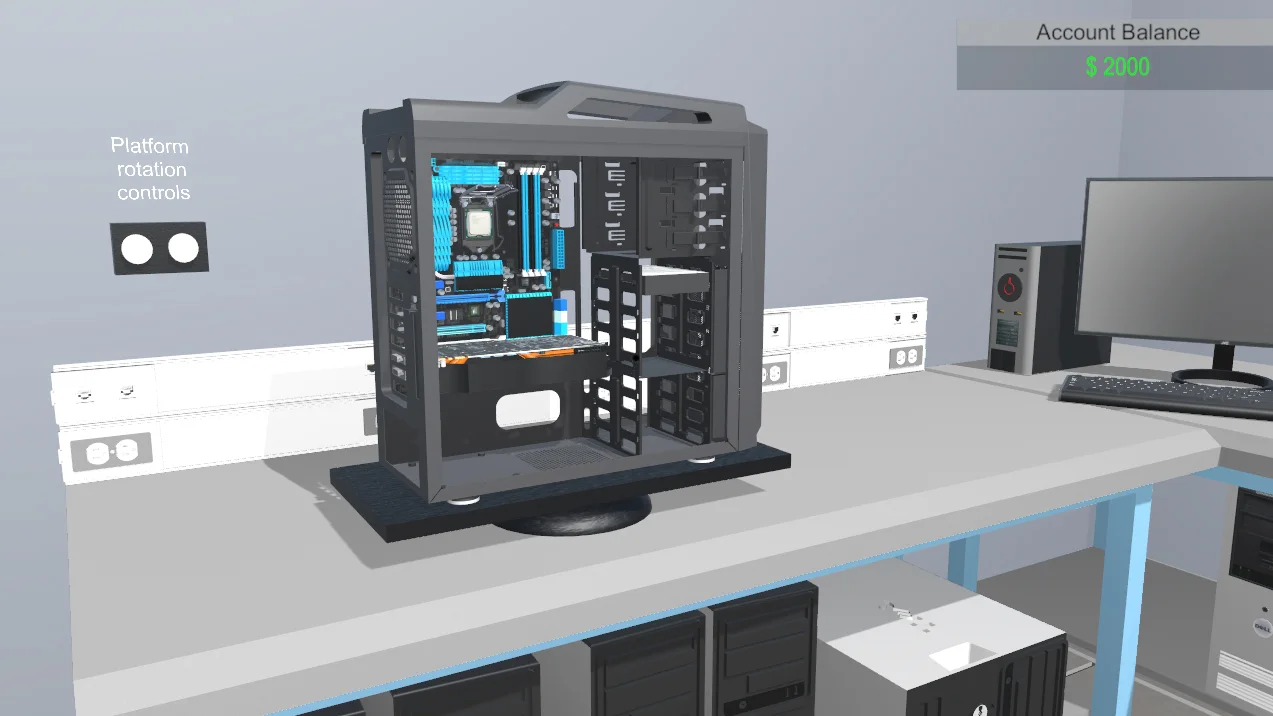

Pc Building Simulator

Performance
1080p (Full HD)
1440p (2K / QHD)
4K (Ultra HD)

Requirements Check


Recommendations
Your system exceeds recommended specs. Enjoy max settings!

Your GPU supports ray tracing.
Average FPS: resolution vs quality settings
| Ultra | High | Medium | Low | |
|---|---|---|---|---|
| 4K Ultra HD | 62 | 65 | 92 | 129 |
| 1440p QHD | 118 | 124 | 175 | 248 |
| 1080p Full HD | 187 | 196 | 278 | 392 |
Cell color: green is 120+ FPS, teal is 60+, amber is 30+, red is below 30. Cards marked Estimated above have no measured row and are scaled from your GPU benchmark percentile.
Performance Analysis: Pc Building Simulator on Your System
The Intel Core i7-14700KF paired with the NVIDIA GeForce RTX 5070 delivers exceptional performance in Pc Building Simulator, with measured data showing this combination ranks 678th out of 3,723 tested combos. Across all three tested resolutions, the system maintains average frame rates well above the 60 FPS playable threshold, even at the most demanding Ultra settings. The benchmark results reveal a fascinating pattern: this is a game where the GPU scales almost linearly with resolution, while the CPU's massive 20-core, 28-thread configuration appears to provide a massive headroom that prevents any noticeable bottlenecking.
FAQ
Q: What is the highest settings preset that maintains at least 60 FPS at 4K resolution?
A: At 3840x2160, the Ultra preset achieves an average of 62 FPS, which is just above the 60 FPS playable threshold. The High preset runs at 65 FPS average, Medium at 92 FPS, and Low at 129 FPS, so all presets are playable at 4K.
Q: How does the RTX 5070's synthetic benchmark score compare to its nearest rivals?
A: The RTX 5070 has an average benchmark score of 40,377, which is nearly identical to the AMD Radeon Pro 580 at 40,318 (0.1% difference) and the AMD Radeon Pro WX 7100 at 40,063 (0.8% difference). It sits slightly below the AMD Radeon Pro 5300 at 40,870 (-1.2% delta).
Q: What is the frame rate difference between Low and Ultra settings at 1440p?
A: At 2560x1440, the Low preset averages 248 FPS, while the Ultra preset averages 118 FPS. This represents a drop of 130 FPS or roughly 52% performance reduction when moving from the least to most demanding settings.
Q: Which CPU benchmark shows the largest multi-threaded advantage?
A: The Cinebench R23 multi-core test shows a score of 44,167, while the single-core score is 6,235. This represents a ratio of approximately 7.1x between multi-threaded and single-threaded performance, which is typical for a 20-core processor.
Q: Does the RTX 5070's rasterization performance exceed its compute performance in Passmark tests?
A: Yes, in Passmark tests, the GPU scores 29,137 in G3D (rasterization) compared to 15,787 in GPU compute. The DirectX 11 test score of 277 is also significantly higher than the DirectX 12 score of 108, showing an interesting API scaling pattern.
Q: How does the i7-14700KF's average benchmark score compare to the AMD Ryzen 9 7950X?
A: The i7-14700KF has an average benchmark score of 70,163, which is only 0.9% higher than the AMD Ryzen 9 7950X at 69,515. The Intel Core Ultra 7 265K scores slightly higher at 70,879, representing a -1% delta relative to the i7-14700KF.
Similar Performance Alternatives
The nearestRivals data for the Intel Core i7-14700KF shows that the AMD Ryzen 7 9700F is the closest competitor, with an average score of 69,996 representing just a 0.2% delta from the Intel chip's 70,163. This means that for this game, swapping between these two processors would produce nearly identical frame rates. The AMD Ryzen 9 7940HX at 69,875 (0.4% delta) and the AMD Ryzen 9 7950X at 69,515 (0.9% delta) are also effectively equivalent in CPU-bound scenarios. The Intel Core Ultra 7 265K actually scores higher at 70,879, showing a -1% delta, which means it would potentially deliver slightly better frame rates in CPU-limited situations.
For the GPU side, the NVIDIA GeForce RTX 5070's nearest rivals present an interesting picture. The AMD Radeon Pro 580 matches it almost exactly with a score of 40,318 versus 40,377 (0.1% delta), while the AMD Radeon Pro WX 7100 trails by 0.8%. The AMD Radeon Pro 5300 is actually slightly faster at 40,870 (-1.2% delta from the RTX 5070's perspective), and the NVIDIA RTX A500 Mobile is 2% slower at 39,568. Since Pc Building Simulator is not a graphically intensive title, any of these GPU alternatives would likely produce very similar frame rates, though the RTX 5070's 12 GB of GDDR7 memory and 192-bit bus width give it architectural advantages in other applications.
Best Settings per Resolution
At 3840x2160, the most demanding preset that stays at or above 60 FPS is Ultra, which delivers an average of 62 FPS. This is a tight margin — only 2 FPS above the playable threshold — but it is technically playable. For players who prefer a safety margin, the High preset at 65 FPS average offers a slightly more comfortable experience, while Medium at 92 FPS and Low at 129 FPS provide significant headroom.
At 2560x1440, the Ultra preset averages 118 FPS, which is nearly double the playable threshold and provides a buttery-smooth experience. The High preset at 124 FPS, Medium at 175 FPS, and Low at 248 FPS all exceed 60 FPS by substantial margins. The 1440p Ultra setting is likely the sweet spot for this hardware, balancing visual fidelity with excellent performance.
At 1920x1080, the Ultra preset averages 187 FPS, which is more than triple the 60 FPS threshold. The High preset at 196 FPS, Medium at 278 FPS, and Low at 392 FPS demonstrate that the system is massively overqualified for 1080p gaming in this title. The measured data shows minimum frame rates of 236 FPS at Medium settings (1080p) and 149 FPS at Medium settings (1440p), indicating that even frame drops remain well above playable levels.
The Verdict
The benchmark data clearly indicates that this PC can run Pc Building Simulator exceptionally well at every tested resolution. The verdictByResolution data confirms that all four settings presets — Low, Medium, High, and Ultra — are playable at all three resolutions, with average frame rates never dropping below 60 FPS. At 3840x2160, the Ultra preset averages 62 FPS, which clears the 60 FPS threshold but leaves little room for frame drops. At 2560x1440, the Ultra preset averages 118 FPS, providing a comfortable margin. At 1920x1080, the Ultra preset averages 187 FPS, which is more than sufficient for high-refresh-rate displays.
The system's weakest point is 4K Ultra, where the 62 FPS average is only slightly above the playable threshold. However, considering that Pc Building Simulator is a simulation game rather than a fast-paced action title, even occasional frame drops to the mid-50s would likely be acceptable. The data suggests that players should prefer 1440p Ultra for the best balance of visual quality and performance stability, or 4K High if they want to prioritize resolution over settings.
CPU and GPU Roles
The measured FPS data reveals a clear pattern: this game scales almost entirely with resolution, with the GPU being the primary performance driver. Moving from 1080p Ultra at 187 FPS to 1440p Ultra at 118 FPS represents a 37% performance drop, and then from 1440p Ultra to 4K Ultra at 62 FPS represents another 47% drop. This consistent scaling with resolution indicates that the RTX 5070 is the bottleneck at higher resolutions, while the i7-14700KF's powerful 20-core configuration provides more than enough CPU headroom.
The CPU's role becomes evident when examining the Low preset scaling. At 1080p Low, the system achieves 392 FPS, which drops to 248 FPS at 1440p Low and 129 FPS at 4K Low. These extremely high frame rates at lower settings suggest that the CPU is capable of feeding frames at a rate far beyond what the GPU can render at higher resolutions. The i7-14700KF's Cinebench R23 multi-core score of 44,167 and Passmark multi-thread score of 52,425 indicate that this processor is not likely to bottleneck any GPU in a simulation game.
At 4K resolution, the GPU's limitations become more apparent. The RTX 5070's 30.87 TFLOPS FP32 performance and 672.0 GB/s memory bandwidth are sufficient for this game, but the 62 FPS at Ultra settings shows that the GPU is working near its limits. The RTX 5070's Passmark G3D score of 29,137 places it in the 82nd percentile of all GPUs, which is adequate but not exceptional for 4K gaming.
How This Combo Ranks
This combination of Intel Core i7-14700KF and NVIDIA GeForce RTX 5070 ranks 678th out of 3,723 tested combos in Pc Building Simulator, placing it in the top 18% of all configurations. Given that this is a simulation game with relatively modest graphical requirements, the high rank is expected — the hardware is overkill for the task. The i7-14700KF's 94th percentile ranking among all CPUs and the RTX 5070's 82nd percentile among all GPUs suggest that this combo should handle far more demanding games than Pc Building Simulator.
The rank of 678 might seem low for such powerful hardware, but this is a reflection of the game's low system requirements. Many lower-end GPUs can achieve 60 FPS in Pc Building Simulator, so the ranking does not indicate any performance problem with this combo. Instead, it shows that the hardware is capable of delivering frame rates far beyond what the game can utilize, particularly at 1080p where the system averages 187 FPS at Ultra settings.
Measured FPS Breakdown
At 1920x1080, the system delivers exceptionally high frame rates across all settings. The Low preset averages 392 FPS, which is likely near the game engine's limit. The Medium preset averages 278 FPS with a minimum of 236 FPS and maximum of 320 FPS, showing good frame time consistency. The High preset averages 196 FPS, and the Ultra preset averages 187 FPS. All 1080p settings provide far more performance than any display can show.
At 2560x1440, the performance remains extremely strong. The Low preset averages 248 FPS, while the Medium preset averages 175 FPS with a minimum of 149 FPS and maximum of 202 FPS. The High preset averages 124 FPS, and the Ultra preset averages 118 FPS. Even at the most demanding 1440p settings, the system maintains a 58 FPS buffer above the playable threshold.
At 3840x2160, the system shows its first signs of strain but remains comfortably playable. The Low preset averages 129 FPS, which is still more than double the playable threshold. The Medium preset averages 92 FPS with a minimum of 78 FPS and maximum of 105 FPS, showing excellent frame pacing. The High preset averages 65 FPS, and the Ultra preset averages 62 FPS. The 4K Ultra setting is the only configuration where the system approaches the 60 FPS threshold, but it still clears it without any recorded frames below playable levels. The data shows that this system is best suited for 1440p gaming, where it can maintain high frame rates at maximum settings while leaving substantial headroom for frame drops.