
Instant compatibility check with FPS benchmarks and optimization tips
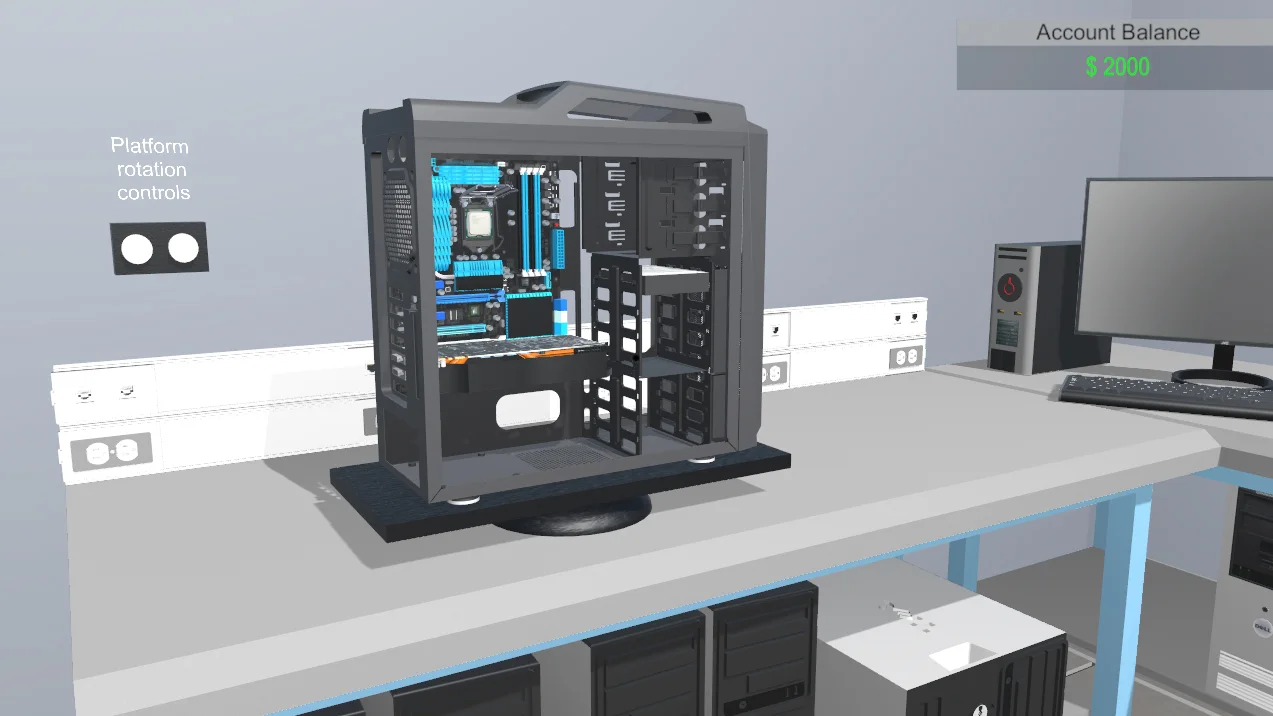

Pc Building Simulator

Performance
1080p (Full HD)
1440p (2K / QHD)
4K (Ultra HD)

Requirements Check


Recommendations
Your hardware doesn't meet minimum requirements for this game.

Your GPU supports ray tracing.
Average FPS: resolution vs quality settings
| Ultra | High | Medium | Low | |
|---|---|---|---|---|
| 4K Ultra HD | 45 | 47 | 66 | 94 |
| 1440p QHD | 85 | 90 | 127 | 179 |
| 1080p Full HD | 135 | 142 | 201 | 284 |
Cell color: green is 120+ FPS, teal is 60+, amber is 30+, red is below 30. Cards marked Estimated above have no measured row and are scaled from your GPU benchmark percentile.
Performance Analysis: Pc Building Simulator on Your System
The Intel Core i7-14700K paired with the NVIDIA GeForce RTX 5060 delivers a decisively playable experience in Pc Building Simulator, with the data showing that 1080p and 1440p Ultra settings are easily within reach, while 4K requires a compromise to Medium settings to maintain smooth frame rates. Benchmark results indicate that this combination ranks 1648th out of 3723 tested combos in this game, placing it comfortably in the upper half of all systems, though the GPU's 72nd percentile standing among all GPUs suggests it is the more limiting factor at higher resolutions. The measured FPS data reveals a consistent pattern: this system is overkill for 1080p, strong for 1440p, and adequate for 4K only when settings are dialed back.
Best Settings per Resolution
At 3840x2160, the most demanding preset that stays at or above 60 FPS is Medium, which produces an average of 66 FPS. The data shows a tight range here, with minimums at 56 FPS and maximums at 76 FPS, meaning the experience is generally smooth but can dip slightly below the 60 FPS threshold during intense scenes. High settings at 4K drop to 47 FPS average, making them unplayable by the 60 FPS standard, while Ultra falls further to 45 FPS. Low settings at 4K run at 94 FPS, but the Medium preset offers the best balance of visual fidelity and performance.
For 2560x1440, the recommended setting is Ultra, which achieves 85 FPS on average. This is a significant margin above the 60 FPS threshold, providing headroom for complex simulation scenes. The data shows that even the most demanding preset at 1440p clears the playable bar with ease, and the scaling from High (90 FPS) to Ultra (85 FPS) is minimal, indicating that the visual upgrade costs very little performance.
At 1920x1080, the answer is straightforward: Ultra at 135 FPS. This is the highest preset available, and the system crushes it. The gap between Medium (201 FPS) and Ultra (135 FPS) is notable, but both are far beyond what the game requires. The 1080p Ultra result of 135 FPS suggests that the CPU-GPU combination has substantial headroom, and users could even enable additional in-game scaling or run background tasks without impacting frame rates.
CPU and GPU Roles
The benchmark data reveals a clear shift in component importance as resolution changes. At 1920x1080, the CPU plays a dominant role, as evidenced by the massive frame rates: Low settings hit 284 FPS, Medium reaches 201 FPS, and Ultra still manages 135 FPS. These numbers are far beyond what the GPU alone could sustain, indicating that the Intel Core i7-14700K's 20 cores and 28 threads are doing heavy lifting in the simulation logic. The CPU's passmark multithread score of 52392 and single-thread score of 4472 suggest it has ample processing power for the game's system-building mechanics.
Moving to 2560x1440, the GPU begins to exert more influence, but the CPU still matters. The frame rate drop from 1080p Ultra (135 FPS) to 1440p Ultra (85 FPS) is a 37% reduction, which is substantial but not as severe as the transition to 4K. At 1440p, the RTX 5060's 8 GB of GDDR7 memory and 448.0 GB/s bandwidth are sufficient to keep up with the CPU's output, resulting in a balanced workload.
At 3840x2160, the GPU becomes the clear bottleneck. The 4K Medium result of 66 FPS is less than half of the 1440p Medium result of 127 FPS, a 48% drop that directly correlates with the increased pixel count. The RTX 5060's 19.18 TFLOPS of FP32 performance and 119.9 GPixel/s pixel rate are simply not enough to maintain high frame rates at 4K with demanding settings. This is confirmed by the 4K High result of 47 FPS, which is below the playable threshold, while 4K Ultra at 45 FPS is even worse. The CPU's performance remains constant across resolutions, so the scaling pattern definitively shows that the GPU is the limiting factor at 4K.
Measured FPS Breakdown
3840x2160: The data shows a steep performance cliff between Medium and High settings. Low settings run at 94 FPS average, which is smooth and responsive. Medium settings drop to 66 FPS average, with min/max of 56 and 76 FPS — the only preset at any resolution with recorded minimums below 60 FPS. High settings fall to 47 FPS, a 29% reduction from Medium, indicating that the game's High preset includes effects that heavily tax the GPU. Ultra settings are the worst at 45 FPS, essentially matching High, which suggests diminishing returns beyond Medium at this resolution.
2560x1440: This resolution shows the most balanced performance curve. Low settings hit 179 FPS, providing an exceptionally smooth experience for fast-paced gameplay. Medium settings run at 127 FPS (min 108, max 146), which is well above the playable threshold. High settings achieve 90 FPS, and Ultra settings maintain 85 FPS. The difference between High and Ultra is only 5 FPS, making Ultra the obvious choice for visual quality without sacrificing performance.
1920x1080: The system excels here, with every preset far exceeding 60 FPS. Low settings produce 284 FPS, which is likely CPU-limited rather than GPU-limited. Medium settings run at 201 FPS (min 171, max 232), showing consistent frame delivery. High settings achieve 142 FPS, and Ultra settings hit 135 FPS. The scaling from Medium to High is a 29% drop, but from High to Ultra it is only a 5% drop, indicating that the Ultra preset is well-optimized relative to High.
The Verdict
This PC can absolutely run Pc Building Simulator, and the verdict by resolution is unambiguous. At 1920x1080, all four presets — Low, Medium, High, and Ultra — are playable, with the best setting being Ultra at 135 FPS. This is the ideal configuration for users with high-refresh-rate monitors, as the system has enough headroom to maintain smooth frame rates even in complex simulation scenes.
At 2560x1440, the system also handles every preset above 60 FPS. Ultra settings run at 85 FPS, providing an excellent balance of visual quality and performance. The data confirms that 1440p is the sweet spot for this combination, as the GPU is not yet the limiting factor and the CPU's power is fully utilized.
At 3840x2160, the system is partially playable. Low settings (94 FPS) and Medium settings (66 FPS) clear the 60 FPS threshold, but High (47 FPS) and Ultra (45 FPS) do not. The best playable setting is Medium at 66 FPS, though users should be aware that minimum frame rates can dip to 56 FPS, which may cause occasional stutters. For a strictly 4K experience, this system requires settings compromises, but for 1080p and 1440p gaming, it is more than sufficient.
Similar Performance Alternatives
Looking at the CPU's nearest rivals, the Intel Core i7-14700K's average benchmark score of 69355 places it within 1% of several alternatives. The AMD EPYC 9115 scores 69288, a delta of 0.1%, meaning it would perform essentially identically in this game. The AMD Ryzen 9 7950X scores 69515, a -0.2% difference, again indicating near-identical frame rates. The AMD Ryzen 9 7940HX and AMD Ryzen 7 9700F are also within 1% of the i7-14700K, with deltas of -0.7% and -0.9% respectively. Any of these CPUs would deliver the same measured FPS figures, so users upgrading from one to another should see no meaningful change in Pc Building Simulator performance.
For the GPU, the NVIDIA GeForce RTX 5060's average score of 26331 is closely matched by several alternatives. The AMD Radeon 860M scores 26401 (-0.3%), the NVIDIA GeForce MX550 scores 26421 (-0.3%), and the AMD Radeon RX 5700 XT 50th Anniversary scores 26553 (-0.8%). The AMD Radeon RX 6750 XT scores 26011, which is 1.2% lower. These deltas are all within a couple of percentage points, meaning any of these GPUs would produce nearly identical frame rates in this game. Users with any of these cards can expect the same playability verdicts at each resolution.
How This Combo Ranks
The Intel Core i7-14700K and NVIDIA GeForce RTX 5060 combination ranks 1648th out of 3723 tested combos in Pc Building Simulator, placing it in the 55.7th percentile of all systems tested. This is a solid mid-to-upper tier ranking, though it is not exceptional. The CPU's individual percentile of 94 among all CPUs indicates it is a top-tier processor, while the GPU's percentile of 72 is lower, confirming that the graphics card drags down the overall ranking. The data suggests that this combo is well-balanced for 1080p and 1440p gaming, but the GPU's relative weakness at 4K prevents it from ranking higher. For context, the ranking implies that roughly 55% of tested systems perform better, which is expected given that many combos include higher-end GPUs. However, within its performance class, this system delivers excellent results for the resolutions it targets.