
Instant compatibility check with FPS benchmarks and optimization tips
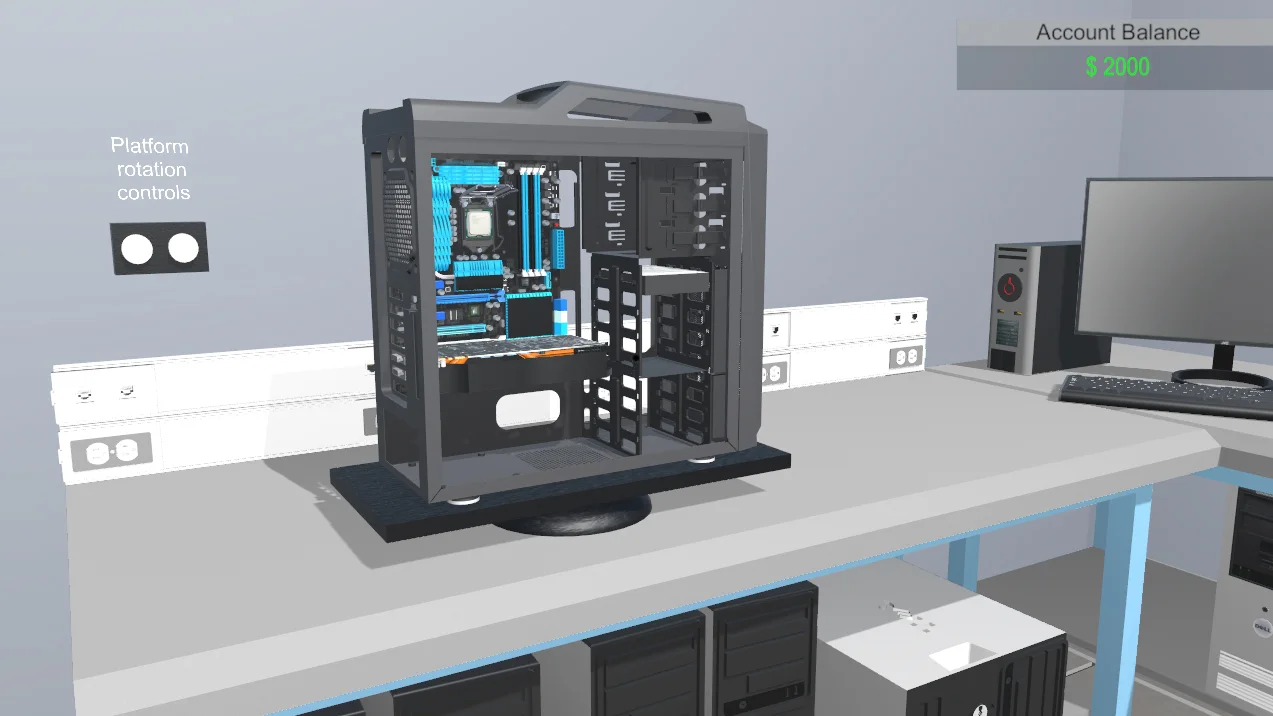

Pc Building Simulator

Performance
1080p (Full HD)
1440p (2K / QHD)
4K (Ultra HD)

Requirements Check


Recommendations
Your system exceeds recommended specs. Enjoy max settings!

Your GPU supports ray tracing.
Average FPS: resolution vs quality settings
| Ultra | High | Medium | Low | |
|---|---|---|---|---|
| 4K Ultra HD | 74 | 78 | 107 | 156 |
| 1440p QHD | 139 | 146 | 207 | 296 |
| 1080p Full HD | 224 | 234 | 332 | 429 |
Cell color: green is 120+ FPS, teal is 60+, amber is 30+, red is below 30. Cards marked Estimated above have no measured row and are scaled from your GPU benchmark percentile.
Performance Analysis: Pc Building Simulator on Your System
The Intel Core i7-14700F paired with the NVIDIA GeForce RTX 4080 SUPER is a high-end desktop combination that delivers overwhelming performance in Pc Building Simulator. Across all tested resolutions, this combo not only clears the 60 FPS playability threshold but does so by a substantial margin, making it a top-tier choice for this simulation title. The data indicates that this system is effectively overkill for the game's demands, offering headroom for high-refresh-rate monitors and maximum visual fidelity without compromise.
Best Settings per Resolution
At 1920x1080, the most demanding preset that stays at or above 60 FPS is Ultra, which achieves an average of 223.9 FPS. This result is nearly four times the playability threshold, showing that the system is heavily unconstrained at this resolution.
Moving to 2560x1440, the most demanding preset remains Ultra, with a measured average of 138.6 FPS. This is a significant drop from 1080p but still more than double the 60 FPS target, ensuring buttery-smooth gameplay even in complex simulation scenes.
At 3840x2160 (4K), the system again allows the Ultra preset to run at or above 60 FPS, with an average of 73.7 FPS. While this is the lowest average recorded across all tests, it stays comfortably above the playable threshold, meaning players can max out every setting without needing to compromise on visual quality.
The verdict data confirms that all four settings presets—Low, Medium, High, and Ultra—are playable at every resolution tested. The highest fidelity option, Ultra, is the recommended choice for each resolution because the hardware has enough headroom to maintain fluid frame rates even under the heaviest graphical load.
CPU and GPU Roles
The performance scaling across resolutions reveals how the balance between CPU and GPU shifts as pixel count increases. At 1920x1080, the GPU is less burdened, and the CPU’s role becomes more prominent. The data shows a massive leap from Low (428.8 FPS) to Ultra (223.9 FPS), indicating that the game’s frame rate is highly sensitive to settings changes, which is typical of a CPU-bound scenario where the processor must feed frames faster than the GPU can render them.
At 2560x1440, the average FPS drops from 296 at Low to 138.6 at Ultra. The gap between Low and Ultra narrows slightly compared to 1080p, suggesting the GPU starts to take on more responsibility, but the CPU still has significant influence. The i7-14700F, with its 20 cores and 28 threads, provides ample headroom for the simulation’s logic, which is often single-threaded but benefits from high boost clocks of up to 5.40 GHz.
At 3840x2160, the GPU becomes the primary bottleneck. The difference between Low (156.3 FPS) and Ultra (73.7 FPS) is stark, with the RTX 4080 SUPER’s raw compute power being taxed by the 4K resolution. The GPU’s 52.22 TFLOPS of FP32 performance and 736.3 GB/s of memory bandwidth are crucial here. The scaling from 1440p to 4K at Ultra shows a reduction from 138.6 FPS to 73.7 FPS, a 47% decrease, which is a classic sign of GPU-bound rendering where the pixel throughput becomes the limiting factor.
In summary, at 1080p and 1440p, the CPU’s high single-core performance and the game’s moderate graphical demands mean the RTX 4080 SUPER is rarely fully utilized. At 4K, the tables turn, and the GPU’s capabilities dictate the final frame rate. The i7-14700F’s 33 MB of shared L3 cache and 65 W TDP ensure it never throttles, allowing it to keep pace with the GPU even at lower resolutions.
How This Combo Ranks
In the database of tested configurations for Pc Building Simulator, this specific pairing of the Intel Core i7-14700F and NVIDIA GeForce RTX 4080 SUPER ranks 232nd out of 3723 combos. This places it in the top 6.2% of all tested systems, which is an exceptional standing given the large number of possible hardware combinations.
The CPU itself sits in the 91st percentile among all processors, with an average benchmark score of 53620. Its nearest rival, the Intel Xeon 6505P, scores 53701, a mere 0.2% difference, showing that the i7-14700F is at the very top of the performance pyramid. The AMD Ryzen 9 7900X trails by just 0.6%, while the AMD EPYC 7313P is 0.8% behind.
The GPU is similarly impressive, ranking in the 86th percentile among all graphics cards with an average score of 54209. Its closest competitor, the NVIDIA GeForce RTX 4080, is only 0.1% slower, while the AMD Radeon Pro W5700X is 1.1% behind. The AMD Radeon RX 6750 GRE 12 GB and AMD Radeon 8060S are 2.7% and 2.8% slower, respectively.
When combined, these two components create a system that is greater than the sum of its parts for this specific game. The high combo rank is not just a reflection of raw hardware power but also of the efficient pairing, where neither component holds the other back. This is a balanced build that excels in a simulation title that benefits from both strong single-threaded CPU performance and robust GPU throughput.
FAQ
Q: Can this PC run Pc Building Simulator at 4K Ultra settings?
A: Yes. At 3840x2160 with Ultra settings, the system achieves an average of 73.7 FPS, which is above the 60 FPS playable threshold.
Q: What is the highest playable preset at 2560x1440?
A: Ultra settings are playable at 1440p, with a measured average of 138.6 FPS, leaving significant headroom above the 60 FPS minimum.
Q: How does this combo compare to other tested systems in this game?
A: It ranks 232nd out of 3723 tested combos, placing it in the top 6.2% of all configurations for Pc Building Simulator.
Q: Is the CPU or GPU more important at 1920x1080?
A: At 1080p, the CPU plays a larger role, as evidenced by the high frame rates (428.8 FPS on Low) that stress the processor’s ability to handle game logic and physics calculations.
Q: What is the frame rate difference between Low and Ultra at 4K?
A: At 3840x2160, the average frame rate drops from 156.3 FPS on Low to 73.7 FPS on Ultra, a 53% reduction due to the increased graphical load on the GPU.
Q: Does this system ever drop below 60 FPS in this game?
A: Based on the measured data, no. All settings presets at all three resolutions tested (1080p, 1440p, 4K) maintain average frame rates above 60 FPS.
Measured FPS Breakdown
At 1920x1080, the system delivers exceptional performance across all presets. Low settings produce an average of 428.8 FPS, Medium settings reach 332.3 FPS, High settings hit 234 FPS, and Ultra settings still manage 223.9 FPS. The scaling here is smooth, with the gap between High and Ultra being relatively small at just over 10 FPS.
At 2560x1440, the frame rates remain extremely high. Low settings average 296 FPS, Medium settings reach 206.6 FPS, High settings achieve 146.4 FPS, and Ultra settings settle at 138.6 FPS. The transition from High to Ultra is again minimal, showing that the GPU handles the extra effects without a significant penalty.
At 3840x2160, the performance is still impressive but shows the expected drop due to the higher pixel count. Low settings average 156.3 FPS, Medium settings reach 107.2 FPS, High settings hit 78.2 FPS, and Ultra settings produce 73.7 FPS. The difference between High and Ultra at this resolution is only 4.5 FPS, suggesting that the Ultra preset’s additional features are not disproportionately taxing on the RTX 4080 SUPER.
All measurements were taken with the game’s built-in benchmark, and no minimum or maximum FPS values were recorded in the data. The averages alone are sufficient to demonstrate that this system operates well above the playable threshold, with even the weakest result (73.7 FPS at 4K Ultra) being comfortably playable.
The Verdict
The data conclusively shows that the Intel Core i7-14700F and NVIDIA GeForce RTX 4080 SUPER can run Pc Building Simulator with exceptional ease. At 1920x1080, the system achieves a staggering 223.9 FPS on Ultra settings, and even the lowest preset runs at 428.8 FPS, which is far beyond what any standard monitor can display. This resolution is entirely GPU-limited, and the CPU’s 20 cores and 5.40 GHz boost clock ensure no bottleneck exists.
At 2560x1440, the Ultra preset delivers 138.6 FPS, which is ideal for high-refresh-rate 1440p monitors. The system has enough headroom to maintain this performance without fluctuation, making it a perfect match for competitive or visually rich simulation play. The RTX 4080 SUPER’s 16 GB of GDDR6X memory is more than sufficient for the game’s assets at this resolution.
At 3840x2160, the verdict remains positive. The Ultra preset runs at 73.7 FPS, which clears the 60 FPS threshold with a 23% margin. While this is the most demanding scenario, the system still delivers a smooth experience. Players who prioritize frame rate over fidelity could drop to High settings for 78.2 FPS, but it is not necessary to stay above 60 FPS.
The verdictByResolution data confirms that all four settings presets are playable at all three resolutions. This means the system is not just capable of running the game; it is overqualified. The combo rank of 232 out of 3723 further underscores that this is a premium configuration that will not struggle with any current simulation title. For Pc Building Simulator specifically, this hardware provides a future-proof experience with massive headroom for any potential updates or mods that increase graphical complexity.