
Instant compatibility check with FPS benchmarks and optimization tips
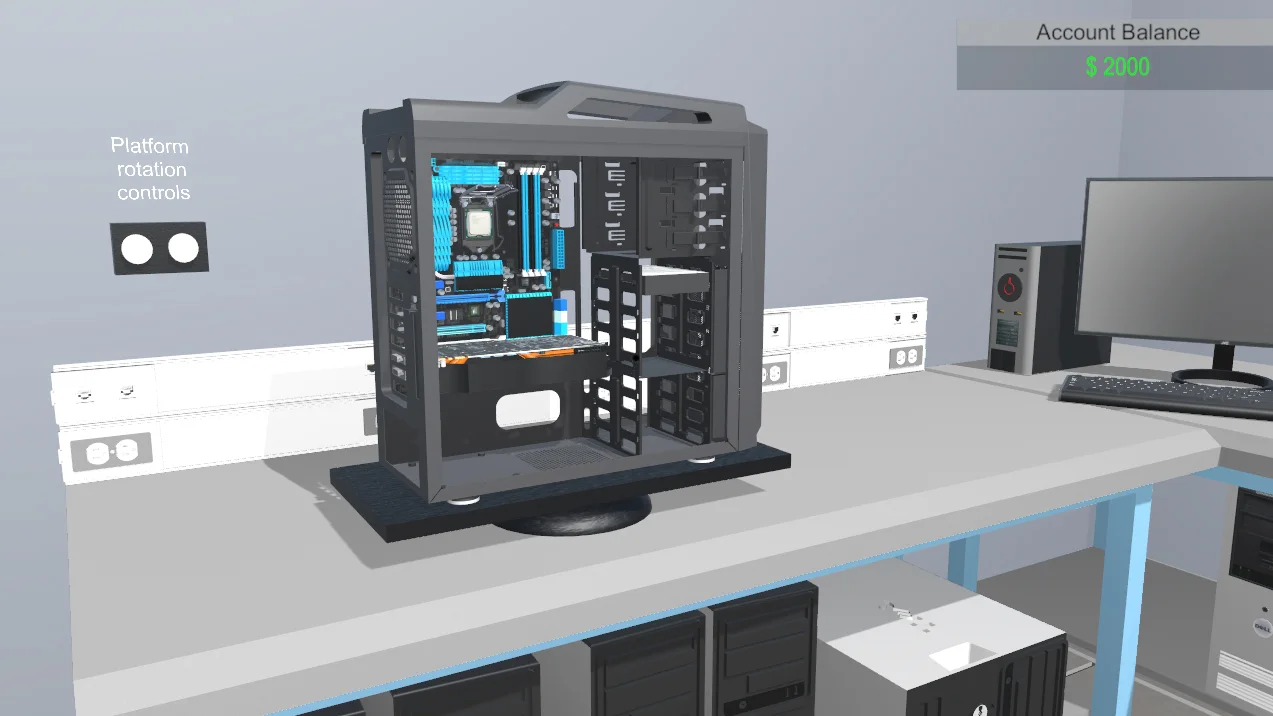

Pc Building Simulator

Performance
1080p (Full HD)
1440p (2K / QHD)
4K (Ultra HD)

Requirements Check


Recommendations
Your system exceeds recommended specs. Enjoy max settings!

Your GPU supports ray tracing.
Average FPS: resolution vs quality settings
| Ultra | High | Medium | Low | |
|---|---|---|---|---|
| 4K Ultra HD | 63 | 70 | 94 | 133 |
| 1440p QHD | 126 | 127 | 181 | 259 |
| 1080p Full HD | 193 | 204 | 289 | 410 |
Cell color: green is 120+ FPS, teal is 60+, amber is 30+, red is below 30. Cards marked Estimated above have no measured row and are scaled from your GPU benchmark percentile.
Performance Analysis: Pc Building Simulator on Your System
The pairing of Intel's Core i7-14700F with NVIDIA's GeForce RTX 4070 SUPER is a modern mid-to-high-end desktop combination, and PC Building Simulator — a simulation title released in January 2019 — represents a comparatively light workload for hardware of this caliber. The measured data in this entry confirms that expectation emphatically: every tested resolution and preset combination clears the 60 FPS playability threshold, including Ultra settings at 4K. Below, the numbers are broken down resolution by resolution, the CPU and GPU roles are weighed, and the combination's standing among tested configurations is placed in context.
Measured FPS Breakdown
All figures in this section are measured averages from the benchmark database; minimum and maximum frame rates were not captured for these runs, so the average values carry the full analytical weight.
At 1920x1080, the combination posts 409.9 FPS on Low, 288.7 FPS on Medium, 203.5 FPS on High, and 193.2 FPS on Ultra. The gap between Low and Ultra is enormous in absolute terms — more than 200 frames — but in relative terms, Ultra still delivers roughly 47% of the Low-setting result, and even the heaviest preset sits well past triple the 60 FPS threshold.
At 2560x1440, the measured averages are 258.7 FPS on Low, 181.1 FPS on Medium, 126.5 FPS on High, and 125.9 FPS on Ultra. Notice something interesting here: High and Ultra are nearly identical, separated by just 0.6 FPS. That near-convergence suggests the visual upgrades between those two presets carry almost no performance cost at this resolution for the RTX 4070 SUPER, which raises the question of why anyone would settle for High when Ultra is effectively free.
At 3840x2160, the averages drop to 133 FPS on Low, 93.5 FPS on Medium, 70 FPS on High, and 63.1 FPS on Ultra. This is where the hardware finally begins to feel the load. Ultra at 4K clears 60 FPS by only 3.1 frames, which is the tightest margin anywhere in this dataset. It is playable by the database's threshold, but it leaves little headroom for frame-time variance — and with minimum frame rates not recorded, that margin deserves some caution when extrapolating.
The scaling pattern across presets is consistent: each step up in quality costs roughly 20-35% of the frame rate at 1080p and 1440p, while the cost steepens at 4K, where dropping from Low to Ultra costs over half the average frame rate.
Best Settings per Resolution
Using the database's 60 FPS playable threshold, the most demanding preset that holds at or above 60 FPS is Ultra at every single tested resolution.
- 1920x1080 — Ultra: 193.2 FPS average, more than triple the threshold.
- 2560x1440 — Ultra: 125.9 FPS average, more than double the threshold.
- 3840x2160 — Ultra: 63.1 FPS average, clearing the threshold by 3.1 FPS.
The practical takeaway is that there is no settings compromise required anywhere in this game for this hardware. The only scenario worth monitoring is 4K Ultra, where the margin is slim; players sensitive to dips below 60 could drop one notch to 4K High (70 FPS average) and regain a modest buffer.
CPU and GPU Roles
The resolution scaling data tells a clear story about which component is doing the work. Going from 1080p Ultra to 1440p Ultra costs 67.3 FPS (193.2 down to 125.9), and going from 1440p Ultra to 4K Ultra costs another 62.8 FPS (125.9 down to 63.1). Frame rate falling steeply as resolution rises is the classic signature of a GPU-bound game — the RTX 4070 SUPER is the limiting factor at every resolution and preset tested here.
That said, the frame rate ceilings at Low settings hint at the CPU's role. At 1080p Low the system reaches 409.9 FPS, and at 1440p Low it still manages 258.7 FPS. These are frame rates at which the Core i7-14700F — a Raptor Lake Refresh chip with 20 cores, 28 threads, and a 5.40 GHz boost clock — is more than capable of feeding frames to the GPU. The simulation genre typically leans on single-thread responsiveness, and the i7-14700F's single-core credentials (a Cinebench R23 single-core score of 4958 and Geekbench single-core score of 2429) indicate the CPU is nowhere near being a bottleneck. In short: PC Building Simulator on this combination is GPU-limited at all tested settings, and the GPU in question is strong enough that it rarely matters.
FAQ
Q: Can this PC run PC Building Simulator at 4K on max settings?
A: Yes. At 3840x2160 on Ultra, the measured average is 63.1 FPS, which clears the 60 FPS playability threshold, though with limited headroom.
Q: What is the frame rate at 1080p on Ultra settings?
A: The measured average is 193.2 FPS at 1920x1080 on Ultra — more than three times the 60 FPS threshold.
Q: Is there any benefit to using High instead of Ultra at 1440p?
A: Effectively none. High measures 126.5 FPS and Ultra measures 125.9 FPS at 2560x1440 — a difference of just 0.6 FPS, so Ultra is essentially free at that resolution.
Q: Which resolution and preset combination is the riskiest for smooth play?
A: 4K Ultra at 63.1 FPS average. It is the only tested configuration that comes close to the 60 FPS line, leaving a margin of just 3.1 frames.
Q: How fast is this setup at the lightest settings?
A: At 1920x1080 on Low, the measured average reaches 409.9 FPS; at 2560x1440 on Low it is 258.7 FPS, and even at 3840x2160 on Low it holds 133 FPS.
Q: Are minimum and maximum frame rates available for these runs?
A: No. The dataset records average FPS only for each resolution and preset, so frame-time consistency cannot be assessed from this entry.
How This Combo Ranks
Within the database's tested combinations for PC Building Simulator, the Core i7-14700F + RTX 4070 SUPER pairing ranks 562 out of 3723 configurations. That places it in roughly the top 15% of tested setups for this game — a strong standing, though not at the extreme top, which is consistent with the game's modest demands: brute-forcing a light simulation title yields diminishing returns beyond a certain hardware level.
The component-level percentiles align with that placement. The i7-14700F sits in the 91st percentile versus all CPUs in the database, while the RTX 4070 SUPER sits in the 83rd percentile versus all GPUs. Since the game is GPU-bound on this system, the GPU's slightly lower percentile is the more relevant constraint on the combo's rank — yet the measured results show even that constraint is comfortably sufficient here.
The Verdict
Yes — this PC can run PC Building Simulator without qualification. The verdict data confirms that at every tested resolution (1920x1080, 2560x1440, and 3840x2160), all four presets — Low, Medium, High, and Ultra — are playable above the 60 FPS threshold.
The strongest results are at 1080p and 1440p, where Ultra delivers 193.2 FPS and 125.9 FPS respectively. At 4K, Ultra remains playable at 63.1 FPS, but the margin over the threshold is narrow enough that the database's own verdict flags it as the ceiling rather than a comfortable cruising altitude. Anyone wanting extra insurance at 4K can step down to High for a 70 FPS average. For a 2019 simulation title running on 2024-era hardware — the CPU launched in January 2024, the GPU days later — the outcome was never really in doubt, and the data bears that out.
Similar Performance Alternatives
Looking at hardware that would behave similarly starts with each component's nearest rivals in the database.
For the CPU, the i7-14700F's closest matches are the Intel Xeon 6505P (average score 53701, within 0.2% of the i7's average benchmark score of 53620), the Intel Xeon Phi 7290 (53469, 0.3% behind), the AMD Ryzen 9 7900X (53288, 0.6% behind), and the AMD EPYC 7313P (53206, 0.8% behind). Since PC Building Simulator is GPU-bound on this system, swapping in any of these comparably-scoring CPUs would be expected to leave the game's frame rates essentially unchanged — the Ryzen 9 7900X being the most consumer-relevant of the group.
For the GPU, the RTX 4070 SUPER's nearest rivals are the NVIDIA Quadro M6000 24 GB (average score 43262, 0.1% away), the GeForce RTX 5050 Mobile (43268, 0.1% away), the Quadro M6000 (43301, 0.2% away), and the GeForce RTX 4090 Mobile (43667, 1% ahead). Because the GPU is the binding constraint in this game at higher resolutions and presets, a move to the RTX 4090 Mobile — the only rival scoring measurably higher — would be the one substitution likely to nudge the tight 4K Ultra result further from the 60 FPS line. The other three sit close enough to the 4070 SUPER's average score of 43223 that the measured frame rates here should translate almost directly.