
Instant compatibility check with FPS benchmarks and optimization tips
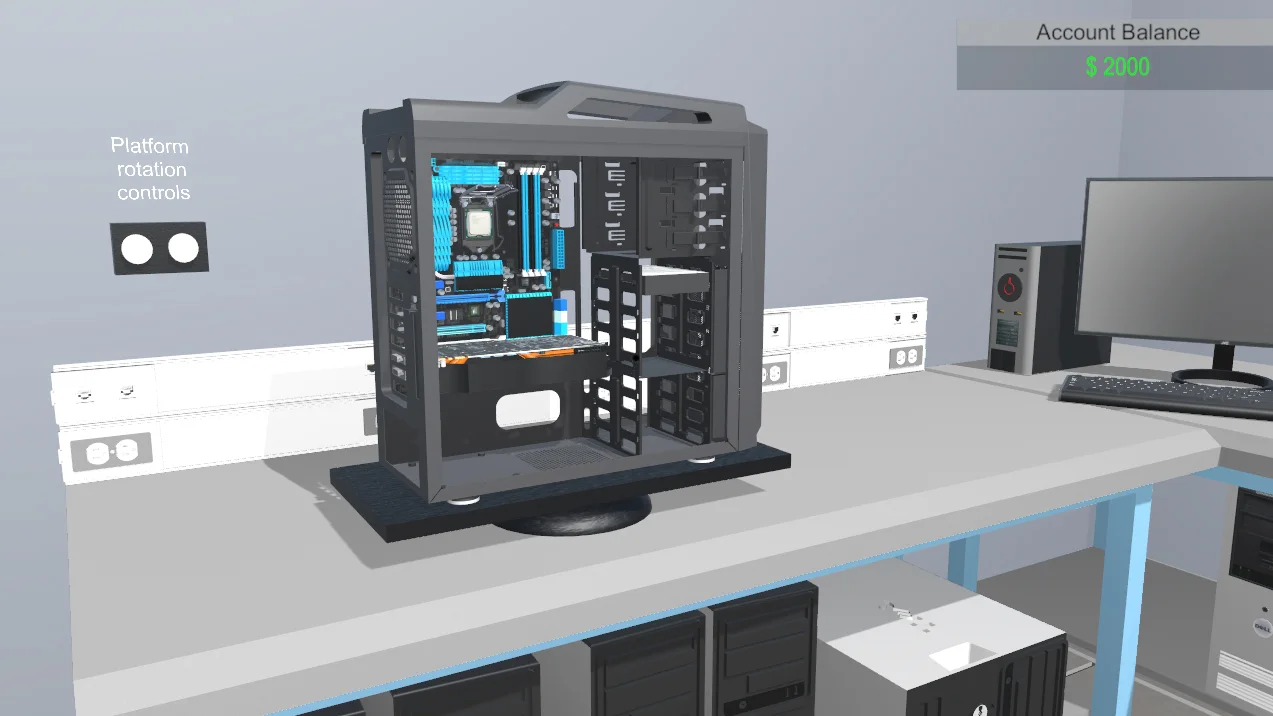

Pc Building Simulator

Performance
1080p (Full HD)
1440p (2K / QHD)
4K (Ultra HD)

Requirements Check


Recommendations
Your hardware doesn't meet minimum requirements for this game.

Your GPU supports ray tracing.
Average FPS: resolution vs quality settings
| Ultra | High | Medium | Low | |
|---|---|---|---|---|
| 4K Ultra HD | 37 | 39 | 55 | 78 |
| 1440p QHD | 71 | 75 | 106 | 149 |
| 1080p Full HD | 113 | 118 | 168 | 237 |
Cell color: green is 120+ FPS, teal is 60+, amber is 30+, red is below 30. Cards marked Estimated above have no measured row and are scaled from your GPU benchmark percentile.
Performance Analysis: Pc Building Simulator on Your System
The Intel Core i7-12700K and NVIDIA GeForce RTX 5050 combination delivers a broad range of performance in Pc Building Simulator, scaling from a fully playable 1080p experience at maximum settings to a more constrained 4K situation where only the lowest preset clears the 60 FPS threshold. The measured data shows this pairing ranks 2290th out of 3723 tested combos for this title, placing it in the lower-middle portion of the database. With a playable threshold of 60 FPS, the system demonstrates clear resolution-dependent behavior: it is fully capable at 1080p and 1440p across all presets, but at 4K it requires significant graphical compromises to maintain smooth gameplay.
Measured FPS Breakdown
At 1920x1080, the combination produces its strongest results. The Low preset delivers an average of 237 FPS, which is more than three times the playable threshold. Medium settings drop to an average of 168 FPS, with a minimum of 142 FPS and a maximum of 193 FPS, indicating consistent frame delivery even during demanding scenes. High settings maintain an average of 118 FPS, while Ultra settings still hold an average of 113 FPS. The gap between High and Ultra at 1080p is small at only 5 FPS, suggesting that the Ultra preset’s additional visual effects have a modest impact on this hardware at this resolution.
Moving to 2560x1440, the frame rates remain comfortably above 60 FPS across all four settings. Low produces an average of 149 FPS, while Medium averages 106 FPS with a minimum of 90 FPS and a maximum of 122 FPS. High settings yield 75 FPS on average, and Ultra maintains 71 FPS. The scaling from Low to Ultra at 1440p shows a total drop of 78 FPS, or roughly 52 percent, which highlights how much performance headroom exists at this resolution. Even at the most demanding preset, the average stays 11 FPS above the playable threshold, with no measured minimums dipping below the target.
At 3840x2160, the picture changes considerably. Low settings are the only preset to clear 60 FPS, averaging 78 FPS. Medium averages 55 FPS, with a minimum of 47 FPS and a maximum of 64 FPS, meaning the system spends a portion of the time below the playable threshold. High averages 39 FPS, and Ultra averages 37 FPS. The difference between High and Ultra at 4K is just 2 FPS, indicating that the GPU is heavily constrained at this resolution and the extra Ultra effects add minimal additional load. The gap between Low and Medium at 4K is 23 FPS, which is the largest single-step drop among all resolutions, underscoring the steep cost of moving from the lowest to the middle preset.
CPU and GPU Roles
The performance scaling across resolutions reveals how the balance shifts between the Intel Core i7-12700K and the NVIDIA GeForce RTX 5050. At 1920x1080, the frame rates are high enough that the CPU’s 12 cores and 20 threads are likely the primary factor in maintaining the 237 FPS Low result and the 113 FPS Ultra result. The relatively small 5 FPS drop from High to Ultra at 1080p suggests that the GPU still has headroom, and the CPU is doing the heavy lifting in keeping frame times consistent.
At 2560x1440, the GPU begins to take on more responsibility. The 78 FPS difference between Low and Ultra indicates that the RTX 5050’s rendering load is increasing, but the CPU remains sufficient to avoid bottlenecking, as evidenced by the Ultra preset still averaging 71 FPS. The minimum of 90 FPS at Medium settings shows strong frame pacing, with neither component dragging the system below comfortable levels.
At 3840x2160, the GPU becomes the clear limiting factor. The RTX 5050’s 8 GB of GDDR6 memory and 128-bit bus width, providing 320.0 GB/s of bandwidth, are pushed hard by the higher pixel count. The fact that High and Ultra both fall below 40 FPS, while Low reaches 78 FPS, points to a GPU-bound scenario where the CPU’s capabilities are largely unused. The 23 FPS drop from Low to Medium at 4K, compared to the 2 FPS drop from High to Ultra, indicates that the GPU struggles with the intermediate settings’ shading and texture demands, while the CPU’s role diminishes almost entirely at this resolution.
Similar Performance Alternatives
Looking at the nearest rivals for the CPU, the Intel Core i7-12700K sits very close to several alternatives in average benchmark score. The Intel Core i5-13600T is only 0.1 percent lower, with an average score of 35305 compared to the i7-12700K’s 35287. The Intel Core i7-12700KF is 0.2 percent lower at 35365, and the Intel Core i7-13700T is 0.3 percent lower at 35403. The Intel Core 5 213PE trails by 0.4 percent with a score of 35428. These differences are negligible in real-world gaming, meaning any of these CPUs would produce nearly identical frame rates in Pc Building Simulator when paired with the same GPU. The i7-12700K’s 84th percentile ranking among all CPUs confirms it is a strong but not exceptional processor for this workload.
For the GPU, the NVIDIA GeForce RTX 5050’s closest rivals show more variance. The AMD Radeon RX Vega M GL is 0.6 percent lower in average score, while the AMD Radeon HD 8970M is 1 percent lower. The AMD Radeon RX 5600 XT is 1.6 percent higher, and the NVIDIA RTX A4000 Mobile is 1.6 percent lower. The RTX 5050’s 66th percentile ranking among all GPUs places it in the mid-range tier. In practical terms, a system with the RTX 5050 and any of these rival GPUs would deliver broadly similar performance in this simulation game, with the RX 5600 XT being the closest competitor that might offer a marginal edge. However, the measured FPS data for this specific combo shows that the CPU and GPU work well together, and swapping in a rival component would likely shift results by only a few frames per second at each resolution.
FAQ
Q: Can this PC run Pc Building Simulator at 1080p with Ultra settings?
A: Yes. The measured average FPS at 1920x1080 with Ultra settings is 113, which is well above the 60 FPS playable threshold.
Q: What is the best preset for 1440p gaming with this combo?
A: Ultra settings at 2560x1440 produce an average of 71 FPS, clearing the 60 FPS threshold, so it is fully playable at the highest quality level.
Q: Is 4K playable with this hardware?
A: Only at Low settings. The 3840x2160 Low preset averages 78 FPS, while Medium drops to 55 FPS and High and Ultra fall to 39 and 37 FPS respectively, all below the 60 FPS target.
Q: How does the RTX 5050 compare to its nearest GPU rivals in average score?
A: The RTX 5050’s average benchmark score is 21035. The AMD Radeon RX 5600 XT is 1.6 percent higher, while the AMD Radeon RX Vega M GL is 0.6 percent lower, the AMD Radeon HD 8970M is 1 percent lower, and the NVIDIA RTX A4000 Mobile is 1.6 percent lower.
Q: Does the CPU limit performance at 4K?
A: No. At 3840x2160, the GPU is the limiting factor, as shown by the large FPS drops between presets. The CPU’s 12 cores and 20 threads are sufficient even at Low settings, where the 78 FPS average indicates no CPU bottleneck.
Q: What is the frame range at Medium settings across all resolutions?
A: At 1080p Medium, the range is 142 to 193 FPS with an average of 168. At 1440p Medium, the range is 90 to 122 FPS with an average of 106. At 4K Medium, the range is 47 to 64 FPS with an average of 55.
The Verdict
This computer can run Pc Building Simulator, but the experience depends heavily on the chosen resolution. At 1920x1080, all four presets clear 60 FPS, with Ultra averaging 113 FPS, High at 118 FPS, Medium at 168 FPS, and Low at 237 FPS. The system is fully playable at 1080p with no compromises needed. At 2560x1440, every preset also stays above the threshold, with Ultra at 71 FPS as the highest quality option that remains smooth. The 1440p experience is solid, though the margin above 60 FPS is thinner at the highest settings.
At 3840x2160, the system cannot maintain 60 FPS on Medium, High, or Ultra presets, with averages of 55, 39, and 37 FPS respectively. Only the Low preset, averaging 78 FPS, provides a playable experience. The verdict by resolution is clear: 1080p and 1440p are fully playable at all settings, while 4K requires dropping to Low quality to maintain smooth performance. The data indicates that this combo is best suited for 1080p and 1440p gaming, with 4K reserved for users willing to accept significant visual downgrades.
Best Settings per Resolution
At 1920x1080, the most demanding preset that stays at or above 60 FPS is Ultra, which achieves an average of 113 FPS. This is the optimal choice for 1080p, as it provides the highest visual quality while maintaining a comfortable margin above the playable threshold.
At 2560x1440, the best settings are also Ultra, with an average of 71 FPS. This preset clears the 60 FPS target by 11 FPS, making it the recommended option for 1440p displays. The frame rate is sufficient for smooth gameplay, though users sensitive to frame drops may prefer High settings at 75 FPS for additional headroom.
At 3840x2160, the only preset that stays at or above 60 FPS is Low, with an average of 78 FPS. This is the best setting for 4K, as all other presets fall below the threshold. The 23 FPS difference between Low and Medium at this resolution makes the choice clear: 4K users must accept Low quality to maintain playability.
How This Combo Ranks
The Intel Core i7-12700K and NVIDIA GeForce RTX 5050 combination ranks 2290th out of 3723 tested combos for Pc Building Simulator, placing it in the 61st percentile of tested systems. This ranking reflects the GPU’s mid-range position, as the CPU is a stronger performer at the 84th percentile among all CPUs. The combination is not near the top of the database, but it also avoids the bottom tier. The measured performance at 1080p and 1440p shows that this ranking understates the system’s capability for those resolutions, since the combo clears 60 FPS on all presets. The 4K results, however, drag the overall rank down, as the system struggles to maintain playable frame rates on anything above Low settings. For a simulation game like Pc Building Simulator, which is not typically frame-rate sensitive, this rank is acceptable, but users targeting 4K or high-refresh 1440p may find the GPU to be the limiting factor.