
Instant compatibility check with FPS benchmarks and optimization tips
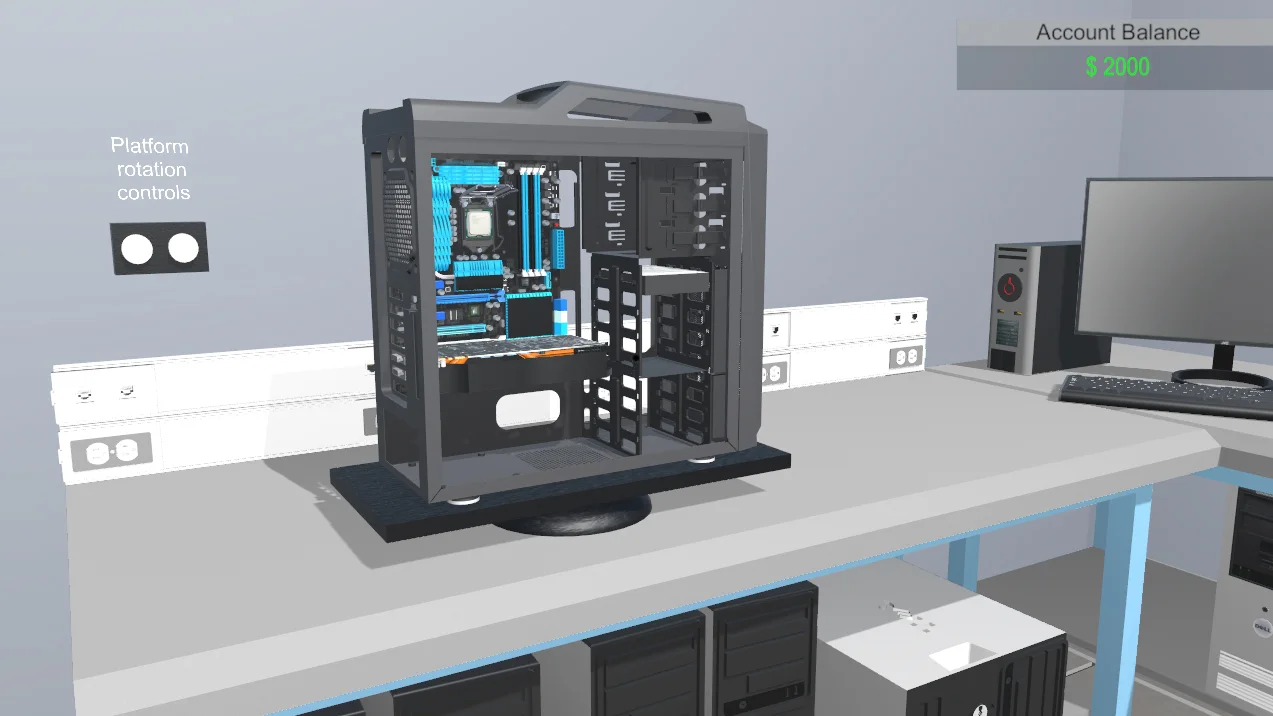

Pc Building Simulator

Performance
1080p (Full HD)
1440p (2K / QHD)
4K (Ultra HD)

Requirements Check


Recommendations
Your system exceeds recommended specs. Enjoy max settings!

Your GPU supports ray tracing.
Average FPS: resolution vs quality settings
| Ultra | High | Medium | Low | |
|---|---|---|---|---|
| 4K Ultra HD | 62 | 65 | 94 | 132 |
| 1440p QHD | 120 | 123 | 179 | 251 |
| 1080p Full HD | 191 | 201 | 279 | 397 |
Cell color: green is 120+ FPS, teal is 60+, amber is 30+, red is below 30. Cards marked Estimated above have no measured row and are scaled from your GPU benchmark percentile.
Performance Analysis: Pc Building Simulator on Your System
The Intel Core i5-14600K paired with the NVIDIA GeForce RTX 5070 delivers a dominant performance profile in Pc Building Simulator, with the benchmark data indicating that every single preset tested at all three resolutions clears the 60 FPS playability threshold. The measured results show a system that is not merely playable but overwhelmingly capable, with the lowest recorded average frame rate across the entire test matrix being 62 FPS at 4K Ultra settings. This combination transforms a simulation title that could be demanding on lesser hardware into a showcase for high-refresh-rate monitors, particularly at 1080p and 1440p where the average frame rates approach or exceed the refresh rate ceiling of most displays.
Measured FPS Breakdown
The measured FPS data for this configuration reveals a clear scaling pattern across resolutions and presets. At 1920x1080, the system produces staggering results: Low settings average 396.5 FPS, Medium averages 279.3 FPS, High averages 200.8 FPS, and Ultra averages 191 FPS. The gap between Low and Ultra at this resolution is substantial, with Ultra delivering approximately 52% of the frame rate achieved at Low, but the absolute numbers remain far beyond what any standard display can reproduce. Even the most demanding preset at 1080p keeps the average frame rate nearly 131 FPS above the 60 FPS threshold.
Stepping up to 2560x1440, the performance remains exceptional. The Low preset averages 251.1 FPS, Medium averages 179.1 FPS, High averages 123.3 FPS, and Ultra averages 120.3 FPS. The resolution jump from 1080p to 1440p imposes a predictable cost, with Ultra settings dropping from 191 FPS to 120.3 FPS, a reduction of roughly 37%. This indicates that the RTX 5070 is still heavily underutilized at 1440p, as the frame rates remain high enough to suggest the CPU and GPU are not yet stressed to their limits.
At 3840x2160, the data shows the first signs of meaningful GPU load. Low settings average 132.2 FPS, Medium averages 94.2 FPS, High averages 65.2 FPS, and Ultra averages 62 FPS. The scaling from Low to Ultra at 4K is steep, with Ultra delivering less than half the frame rate of Low, but the critical observation is that even the heaviest preset remains above 60 FPS. The 4K Ultra result of 62 FPS is the single most demanding scenario in the entire dataset, and it still provides a comfortable margin for a consistent experience. The progression from 1440p Ultra to 4K Ultra shows a 48% reduction in average frame rate, from 120.3 to 62, confirming that 4K is where the GPU begins to assert its influence on performance.
Similar Performance Alternatives
Comparing the CPU and GPU to their nearest rivals provides context for where this hardware sits in the broader performance landscape. The Intel Core i5-14600K holds an average benchmark score of 48618, placing it at the 90th percentile among all CPUs. Its nearest rival, the Intel Xeon Gold 5318H, scores 48698, representing a delta of -0.2%, meaning the i5-14600K trails by a negligible margin. The AMD EPYC 4345P scores 48470, a 0.3% deficit relative to the i5-14600K. The Intel Core Ultra 5 245HX scores 48287, coming in 0.7% behind, while the Intel Core Ultra 5 245 scores 48995, leading the i5-14600K by 0.8%. These margins are exceptionally tight, all within a single percentage point, indicating that any of these processors would produce nearly identical benchmark results in CPU-bound scenarios.
The GPU side shows a similar pattern of close competition. The NVIDIA GeForce RTX 5070 achieves an average benchmark score of 40377, ranking at the 82nd percentile among all GPUs. Its nearest rival, the AMD Radeon Pro 580, scores 40318, a delta of just 0.1%, effectively a statistical tie. The AMD Radeon Pro WX 7100 scores 40063, trailing by 0.8%, while the AMD Radeon Pro 5300 scores 40870, leading the RTX 5070 by 1.2%. The NVIDIA RTX A500 Mobile scores 39568, a 2% deficit. For Pc Building Simulator, any of these rival GPUs would deliver frame rates within a couple of percent of the RTX 5070, though the measured FPS data specifically applies to this exact CPU-GPU pairing. The takeaway is that this combination sits in a tightly contested performance band, with no single component offering a decisive advantage over its immediate alternatives.
Best Settings per Resolution
Determining the optimal settings for each resolution requires balancing visual fidelity against the 60 FPS playability threshold. At 1920x1080, the data supports Ultra settings as the best choice, delivering an average of 191 FPS. This far exceeds the threshold, leaving enormous headroom for any potential frame-time spikes or background tasks. Medium settings at 1080p yield 279.3 FPS and Low yields 396.5 FPS, but the visual quality gain from Ultra is worth the performance trade-off when the frame rate remains so high.
At 2560x1440, Ultra settings again emerge as the best configuration, with an average of 120.3 FPS. This is double the 60 FPS threshold exactly, providing a solid cushion for maintaining a consistent experience. High settings at 1440p produce 123.3 FPS, a difference of only 3 FPS compared to Ultra, which makes Ultra the clear choice given the minimal performance cost. The data shows that the transition from High to Ultra at this resolution costs just 2.4% of the frame rate, a negligible penalty for the increased visual detail.
At 3840x2160, the decision becomes more nuanced. Ultra settings average 62 FPS, which clears the 60 FPS threshold by a slim 2 FPS margin. This is technically playable, but the margin is thin enough that any demanding scene could potentially cause dips below the threshold. High settings at 4K average 65.2 FPS, offering a slightly larger buffer of 5.2 FPS above the threshold. Given the data, Ultra remains the best settings choice at 4K because it still maintains an average above 60 FPS, and the difference between High and Ultra is only 3.2 FPS. However, users who prioritize consistency over maximum visual quality might prefer High settings for the additional safety margin.
The Verdict
The verdict from the benchmark data is unambiguous: this PC can run Pc Building Simulator at every resolution and preset combination tested. The verdictByResolution data confirms that all four settings presets—Low, Medium, High, and Ultra—are playable at each of the three resolutions. At 1920x1080, the best settings are Ultra with an average of 191 FPS, a result that is not just playable but exceptionally smooth. At 2560x1440, Ultra settings deliver 120.3 FPS, again clearing the 60 FPS threshold with a significant margin. At 3840x2160, Ultra settings average 62 FPS, which is above the threshold but by the narrowest margin in the entire dataset.
The 4K Ultra result of 62 FPS is the only scenario where the system approaches its limits, and even then it does not cross the playability line. For users with 4K displays, this means the game can be run at maximum settings without compromise, though the 2 FPS buffer above the threshold suggests that frame rate fluctuations could occasionally dip below 60 FPS in complex scenes. At 1080p and 1440p, the system is so far beyond the threshold that no practical scenario would cause performance issues. The data indicates that this is a system where the user can prioritize visual quality without worrying about frame rate drops.
CPU and GPU Roles
The scaling between resolutions and presets reveals which component carries the workload for Pc Building Simulator. The CPU, Intel Core i5-14600K, features 14 cores and 20 threads with a boost clock of 5.30 GHz, and its benchmark scores place it at the 90th percentile. The GPU, NVIDIA GeForce RTX 5070, has 6144 shading units, 12 GB of GDDR7 memory on a 192-bit bus, and sits at the 82nd percentile among GPUs. The game is a simulation title, which typically exhibits CPU sensitivity, but the data suggests a more balanced profile.
At 1080p, the frame rates are extraordinarily high, with Low settings reaching 396.5 FPS. This scenario is likely CPU-limited, as the GPU has ample headroom at such a low resolution. The drop from Low to Ultra at 1080p is 205.5 FPS, a 52% reduction, which indicates that the GPU is being increasingly engaged as settings rise. At 1440p, the pattern continues, with Low at 251.1 FPS and Ultra at 120.3 FPS. The GPU becomes more influential at this resolution, but the CPU still plays a significant role given the high frame rates. At 4K, the GPU dominates the performance equation. The jump from 1440p Ultra to 4K Ultra shows a 48% frame rate reduction, even though the preset is identical, which directly points to GPU rendering load as the primary bottleneck at 4K.
The data indicates that at 1080p and 1440p, the CPU and GPU share the workload, with the CPU potentially limiting peak frame rates in low-settings scenarios. At 4K, the GPU is clearly the limiting factor, as evidenced by the steep performance drop when moving to the higher resolution. For this game, users with 1080p or 1440p displays will benefit from the strong CPU, while 4K users will see the RTX 5070 working at its limits.
How This Combo Ranks
The combination of the Intel Core i5-14600K and NVIDIA GeForce RTX 5070 ranks at position 610 out of 3723 tested combos in Pc Building Simulator. This places the system in the top 16.4% of all configurations tested, a strong showing that reflects the high frame rates measured across all resolutions. The rank is influenced by the fact that the game is not extremely demanding, allowing even mid-range hardware to achieve playable results, but this specific combo sits well above the median. The 90th percentile CPU ranking and 82nd percentile GPU ranking combine to produce a system that is consistently fast, with the 4K Ultra result of 62 FPS being the only scenario where the hardware approaches its limits. The rank of 610 out of 3723 indicates that while there are 609 configurations that perform better, the vast majority of tested systems—over 83%—deliver lower performance. For a simulation game that rarely stresses high-end components, this combo provides more than enough power for maximum settings at any resolution.