
Instant compatibility check with FPS benchmarks and optimization tips
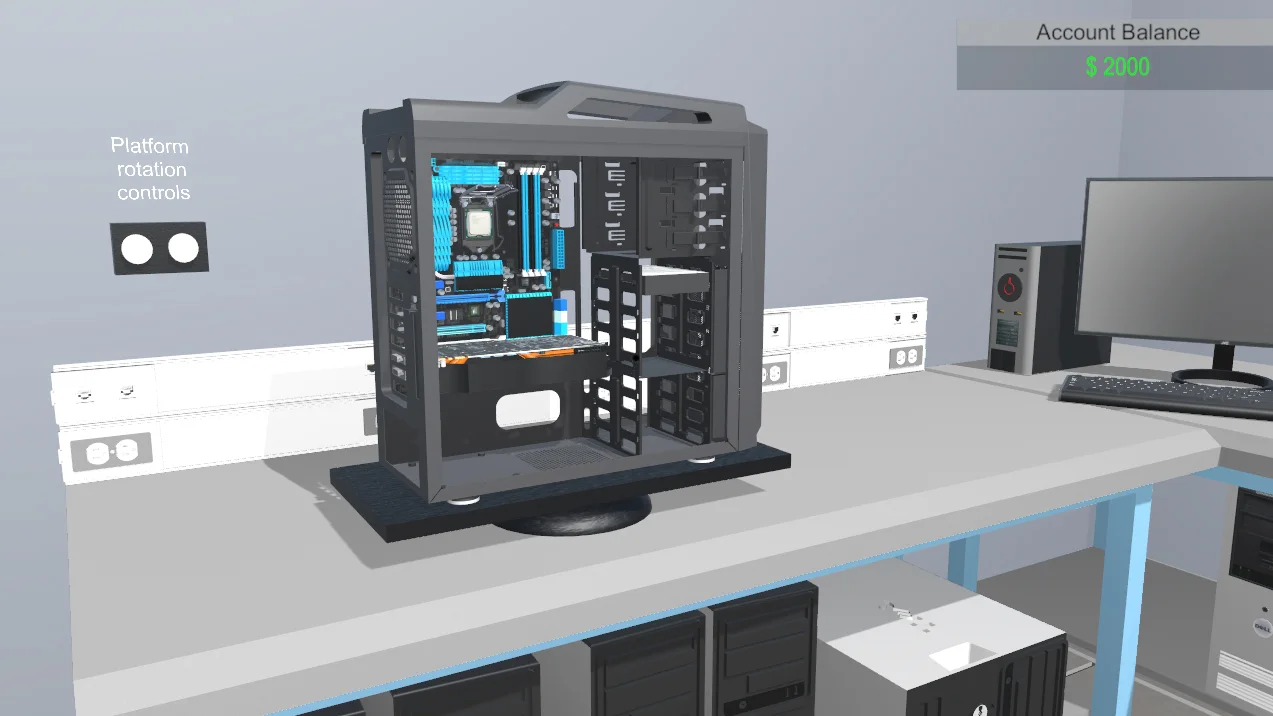

Pc Building Simulator

Performance
1080p (Full HD)
1440p (2K / QHD)
4K (Ultra HD)

Requirements Check


Recommendations
Your system exceeds recommended specs. Enjoy max settings!

Your GPU supports ray tracing.
Average FPS: resolution vs quality settings
| Ultra | High | Medium | Low | |
|---|---|---|---|---|
| 4K Ultra HD | 58 | 61 | 86 | 121 |
| 1440p QHD | 110 | 116 | 164 | 232 |
| 1080p Full HD | 175 | 184 | 260 | 367 |
Cell color: green is 120+ FPS, teal is 60+, amber is 30+, red is below 30. Cards marked Estimated above have no measured row and are scaled from your GPU benchmark percentile.
Performance Analysis: Pc Building Simulator on Your System
Pc Building Simulator, a simulation title released in January 2019, places modest demands on hardware, but the measured FPS data for the AMD Ryzen 7 9700F paired with the NVIDIA GeForce RTX 4070 reveals where the limits lie. The playable threshold is 60 FPS, and the benchmark results show this combination handles most settings with headroom, though 4K Ultra pushes the GPU past its comfort zone. The CPU, a Zen 5 Granite Ridge part with 8 cores and 16 threads, sits at the 94th percentile among all CPUs, while the GPU, an Ada Lovelace AD104, is at the 81st percentile among GPUs. The combo ranks 806th out of 3723 tested combinations.
Measured FPS Breakdown
The measured FPS data covers three resolutions and four quality presets, with only the Medium preset at each resolution reporting minimum and maximum frame times. At 3840x2160 (4K), the average frame rates are 121 FPS on Low, 86 FPS on Medium, 61 FPS on High, and 58 FPS on Ultra. The Medium preset shows a minimum of 73 FPS and a maximum of 99 FPS, indicating some frame-time variance but no dips below the playable threshold. The High preset averages 61 FPS, exactly clearing the 60 FPS bar, while Ultra falls short by 2 FPS. The gap between Low and Ultra is substantial—the Low preset delivers more than double the frame rate of Ultra—highlighting how much graphical quality impacts performance at this resolution.
At 2560x1440 (QHD), the same pattern emerges with higher headroom. Low averages 232 FPS, Medium 164 FPS (with a minimum of 140 and maximum of 189), High 116 FPS, and Ultra 110 FPS. Even at Ultra, the average is nearly twice the 60 FPS threshold, and the minimum recorded frame rate on Medium (140 FPS) suggests that even the most demanding settings would rarely dip below 100 FPS in real gameplay. The step from High to Ultra costs only 6 FPS on average, making Ultra the clear choice for visual fidelity at this resolution.
At 1920x1080 (Full HD), the system is far from stressed. Low averages 367 FPS, Medium 260 FPS (with a minimum of 221 and maximum of 299), High 184 FPS, and Ultra 175 FPS. The minimum on Medium (221 FPS) is still more than three times the playable threshold, and the Ultra preset averages 175 FPS, leaving enormous headroom for high-refresh-rate monitors. The scaling from 1080p to 1440p to 4K shows a consistent drop: at Ultra, the averages are 175, 110, and 58 FPS respectively, a reduction of roughly 37% and 67% from the 1080p figure. This steep decline points to the GPU becoming the primary bottleneck as resolution increases.
Best Settings per Resolution
The verdict data identifies the most demanding preset that maintains an average of at least 60 FPS at each resolution. For 3840x2160, the best settings are High, which averages 61 FPS. Ultra falls to 58 FPS, just below the threshold, so High is the maximum quality that keeps the game playable. Medium and Low also clear 60 FPS, but High offers the best visual balance without sacrificing smoothness. At 2560x1440, the best settings are Ultra, with an average of 110 FPS—nearly double the threshold. All four presets at this resolution exceed 60 FPS, so players can max out the game without concern. Similarly, at 1920x1080, Ultra is the best setting, delivering 175 FPS on average. The data shows that this combo is fully capable of running the game at maximum quality at 1080p and 1440p, while 4K requires a step down from Ultra to High.
Similar Performance Alternatives
The CPU's nearest rivals, based on average benchmark scores, are all within 1% of the Ryzen 7 9700F's score of 69,996. The AMD Ryzen 9 7940HX scores 69,875, a 0.2% difference; the Intel Core i7-14700KF scores 70,163, 0.2% lower than the 9700F; the AMD Ryzen 9 7950X scores 69,515, 0.7% lower; and the Intel Core i7-14700K scores 69,355, 0.9% lower. These deltas are negligible, meaning any of these processors would produce nearly identical frame rates in Pc Building Simulator, which appears to be lightly threaded. The GPU's nearest rivals are similarly close. The NVIDIA Tesla P4 scores 37,628, 0.1% higher than the RTX 4070's 37,648; the AMD Radeon RX Vega 56 scores 37,507, 0.4% higher; the NVIDIA GeForce RTX 4080 Mobile scores 38,135, 1.3% lower; and the AMD Radeon PRO W6400 scores 37,157, 1.3% higher. The RTX 4070's average benchmark score of 37,648 places it in the 81st percentile of all GPUs, and the close margins to these alternatives suggest that swapping to any of them would yield almost indistinguishable performance in this simulation. The only meaningful difference might arise in the RTX 4080 Mobile's 1.3% lower score, but even that would translate to a frame-rate difference of a few percent at most.
FAQ
Q: Can this combo run Pc Building Simulator at 4K with Ultra settings?
A: No. The measured average FPS at 3840x2160 Ultra is 58 FPS, which falls below the 60 FPS playable threshold. The best playable setting at 4K is High, which averages 61 FPS.
Q: What is the highest quality setting that maintains 60 FPS at 2560x1440?
A: Ultra is the best setting at 1440p, with an average of 110 FPS. All four presets (Low, Medium, High, Ultra) exceed 60 FPS at this resolution, so you can max out the game without issue.
Q: How does the Ryzen 7 9700F compare to the Intel Core i7-14700KF in benchmark scores?
A: The Ryzen 7 9700F has an average benchmark score of 69,996, while the i7-14700KF scores 70,163. The deltaPct is -0.2%, meaning the 9700F is 0.2% lower than the Intel part. This is a negligible difference for gaming.
Q: Which component is more likely to limit performance at 4K?
A: The data shows a steep FPS drop as resolution increases—from 175 FPS at 1080p Ultra to 110 FPS at 1440p Ultra to 58 FPS at 4K Ultra. This scaling indicates the GPU becomes the bottleneck at higher resolutions. The CPU, with its 94th percentile ranking and 8-core/16-thread design, is less stressed.
Q: What is the combo's rank among all tested systems for this game?
A: The combination ranks 806th out of 3723 tested combos, placing it in the upper portion of the database. It outperforms the majority of tested systems.
Q: Are there any settings where the minimum FPS drops below 60?
A: The only recorded minimum FPS values are for the Medium preset at each resolution: 73 FPS at 4K, 140 FPS at 1440p, and 221 FPS at 1080p. All exceed 60 FPS. No minimum data is available for other presets, but the averages suggest no sub-60 dips except at 4K Ultra, which averages 58 FPS.
CPU and GPU Roles
The division of labor between the Ryzen 7 9700F and the RTX 4070 becomes clear when examining frame rates across resolutions and presets. At 1080p, the system is heavily CPU-bound—or perhaps not even bound at all, as the Low preset hits 367 FPS and Ultra still manages 175 FPS. The CPU's single-thread score of 4,691 and multithread score of 36,470 indicate strong headroom for a simulation game that likely uses a few threads. The GPU, with its 12 GB of GDDR6X memory and 5,888 shading units, is more than adequate for 1080p. Moving to 1440p, the FPS drops by roughly 37% across presets (e.g., 175 to 110 at Ultra), suggesting the GPU is starting to take on more work, but the CPU still keeps pace. At 4K, the Ultra preset falls below 60 FPS, and even High barely clears it at 61 FPS. The 4K Low preset still delivers 121 FPS, showing that the CPU is not the limiting factor—the GPU's fill rate and memory bandwidth are the constraints. The CPU's nearest rivals are all within 1% of its average score, and the GPU's nearest rivals are within 1.3%, so the performance profile is well balanced. However, the fact that 4K Ultra fails to hit 60 FPS while 1440p Ultra has 110 FPS indicates that the RTX 4070 is the component that determines the ceiling at high resolutions.
How This Combo Ranks
In the database of 3,723 tested combinations for Pc Building Simulator, this pairing of the Ryzen 7 9700F and RTX 4070 holds the 806th position. That places it in the top quarter of all tested systems, a strong showing for a mid-range to high-end desktop configuration. The CPU's 94th percentile ranking among all CPUs and the GPU's 81st percentile among all GPUs contribute to this result. The rank suggests that while many systems outperform it—likely those with more powerful GPUs like the RTX 4080 or 4090—the 9700F + 4070 combo delivers well-above-average performance for this game. The close proximity of the CPU's nearest rivals (all within 1% in average score) and the GPU's nearest rivals (within 1.3%) means that slight hardware variations would shift the rank only marginally. The 806th position out of 3,723 is a concrete indicator that this system is comfortably in the upper echelon for Pc Building Simulator.
The Verdict
Can this PC run Pc Building Simulator? Yes, with clear caveats. At 1920x1080, every preset runs above 60 FPS, with Ultra averaging 175 FPS—more than enough for smooth gameplay on any monitor. At 2560x1440, all presets also exceed 60 FPS, and Ultra delivers 110 FPS, making it the optimal resolution for maxing out the game. At 3840x2160, the system can handle Low (121 FPS), Medium (86 FPS), and High (61 FPS), but Ultra falls to 58 FPS, just below the playable threshold. The best playable setting at 4K is High, which averages 61 FPS. For players who prioritize 4K, dropping from Ultra to High is a minor visual compromise that keeps the experience fluid. The data confirms that this combination is fully capable of running Pc Building Simulator at high frame rates across the most common resolutions, with the only limitation being 4K Ultra. Given the game's simulation nature and relatively modest graphics demands, this system offers a smooth and responsive experience in virtually all scenarios.