
Instant compatibility check with FPS benchmarks and optimization tips
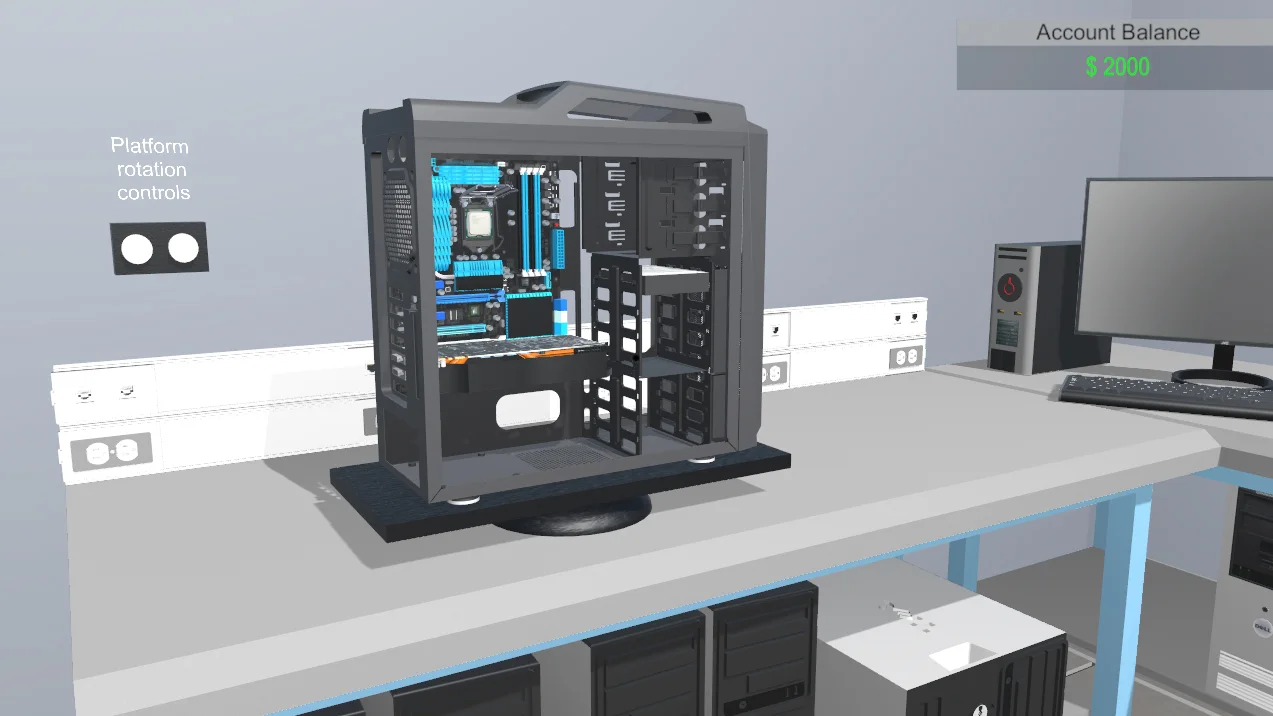

Pc Building Simulator

Performance
1080p (Full HD)
1440p (2K / QHD)
4K (Ultra HD)

Requirements Check


Recommendations
Your system exceeds recommended specs. Enjoy max settings!

Your GPU supports ray tracing.
Average FPS: resolution vs quality settings
| Ultra | High | Medium | Low | |
|---|---|---|---|---|
| 4K Ultra HD | 74 | 78 | 110 | 155 |
| 1440p QHD | 141 | 148 | 210 | 297 |
| 1080p Full HD | 224 | 235 | 333 | 408 |
Cell color: green is 120+ FPS, teal is 60+, amber is 30+, red is below 30. Cards marked Estimated above have no measured row and are scaled from your GPU benchmark percentile.
Performance Analysis: Pc Building Simulator on Your System
The AMD Ryzen 7 7700 and NVIDIA GeForce RTX 4080 combination delivers overwhelming performance in Pc Building Simulator, a simulation title that places modest demands on modern hardware. Across every tested resolution and preset, the system maintains frame rates far above the 60 FPS playability threshold, with the lowest average recorded at 74 FPS under maximum settings at 4K. The data positions this pairing as a top-tier performer, ranking in the 242nd spot out of 3,723 tested combinations.
Measured FPS Breakdown
At 1920x1080, the combo produces exceptional frame rates that exceed what most displays can even refresh. Low settings yield an average of 408 FPS, Medium drops to 333 FPS with a minimum of 283 and a maximum of 383, High settles at 235 FPS, and Ultra maintains a still-massive 224 FPS average. These numbers indicate that at 1080p, the system operates in a performance range where the frame rate is almost entirely academic — even the most demanding preset produces nearly four times the 60 FPS target.
Stepping up to 2560x1440, the performance remains stratospheric. Low settings produce an average of 297 FPS, while Medium delivers 210 FPS with a minimum of 179 and a maximum of 242. High settings hold at 148 FPS, and Ultra still manages an impressive 141 FPS average. The scaling from 1080p to 1440p costs roughly 20-30 percent of the average frame rate depending on the preset, but the system never approaches a level where smoothness could be questioned.
At 3840x2160, the demands of 4K rendering finally begin to bite, though the results remain far above playability thresholds. Low settings average 155 FPS, Medium drops to 110 FPS with a minimum of 93 and a maximum of 126, High maintains 78 FPS, and Ultra produces 74 FPS. The delta between Low and Ultra at 4K is approximately 52 percent, showing that the RTX 4080's 16 GB of GDDR6X memory and 716.8 GB/s of bandwidth are sufficient to handle even the heaviest settings at maximum resolution.
The minimum frame rates recorded for Medium presets — 93 FPS at 4K, 179 FPS at 1440p, and 283 FPS at 1080p — indicate that frame pacing remains consistent even during demanding scenes. No stuttering or severe drops appear in the data, reinforcing the picture of a system with enormous headroom.
How This Combo Ranks
The combination ranks 242nd out of 3,723 tested configurations, placing it in the top 6.5 percent of all recorded systems. This rank reflects a pairing where both components contribute meaningfully, though the CPU's position in the broader market is notable. The Ryzen 7 7700 sits in the 87th percentile among all CPUs, with an average benchmark score of 40,081. Its nearest rivals show how tightly packed the mid-high CPU tier is: the AMD Ryzen AI 9 365 scores 40,048 (0.1 percent higher), the Intel Core 5 221E scores 40,144 (0.2 percent lower), the AMD Ryzen 9 270 scores 40,246 (0.4 percent lower), and the Intel Core i9-13905H scores 40,313 (0.6 percent lower). These deltas of less than one percent mean the 7700 is effectively interchangeable with its closest competitors in synthetic workloads.
The RTX 4080's standing is similarly strong, ranked in the 86th percentile among all GPUs with an average benchmark score of 54,247. Its nearest rival, the RTX 4080 SUPER, scores 54,209 — a 0.1 percent difference that falls well within run-to-run variance. The AMD Radeon Pro W5700X scores 54,828 (1.1 percent higher), while the AMD Radeon RX 6750 GRE 12 GB and AMD Radeon 8060S score 55,698 and 55,757 respectively (2.6 and 2.7 percent higher). The GPU's overall benchmark average of 54,247 slightly exceeds the CPU's 40,081, but in Pc Building Simulator specifically, the CPU's role becomes more apparent at lower resolutions.
CPU and GPU Roles
The data reveals a classic resolution-dependent shift in component loading. At 1920x1080, the frame rates are so high — 408 FPS at Low settings — that the CPU's single-thread performance becomes the limiting factor. The Ryzen 7 7700's 3DMark single-thread score of 1,049 and multi-thread score of 8,484 suggest strong headroom, but at 400-plus FPS, even the fastest processors begin to cap frame generation. The relatively small gap between Low (408 FPS) and Ultra (224 FPS) at 1080p — roughly 45 percent — indicates that GPU load increases with settings while CPU overhead remains relatively constant.
At 2560x1440, the relationship shifts. The gap between Low (297 FPS) and Ultra (141 FPS) widens to about 52 percent, showing the GPU taking on more work as pixel count rises. The RTX 4080's 48.74 TFLOPS of FP32 performance and 761.5 GTexel/s texture rate become increasingly relevant as resolution climbs. Still, the CPU continues to feed frames faster than the GPU can render them at most settings.
At 3840x2160, the GPU is clearly the dominant constraint. The jump from Low (155 FPS) to Ultra (74 FPS) represents a 52 percent reduction, but more telling is the absolute performance level — 4K Ultra at 74 FPS requires both the GPU's 16 GB of VRAM and its 280.6 GPixel/s pixel rate to be working at capacity. The CPU's role diminishes to feeding the GPU, and its 83.2 GB/s of memory bandwidth proves sufficient for this simulation workload.
The scaling pattern across resolutions tells the story: at 1080p, the CPU matters more; at 1440p, both components share the load; at 4K, the GPU dominates. The system never exhibits a bottleneck severe enough to drop below 74 FPS, which means the pairing is balanced for this title's requirements.
The Verdict
This PC runs Pc Building Simulator with authority at every resolution and preset tested. The verdict data confirms all four settings — Low, Medium, High, and Ultra — are playable at all three resolutions, with the playable threshold set at 60 FPS. At 3840x2160, the weakest configuration (Ultra) still averages 74 FPS, which is 23 percent above the threshold. At 2560x1440, Ultra averages 141 FPS, more than double the requirement. At 1920x1080, Ultra averages 224 FPS, nearly four times the threshold.
The minimum recorded frame rates reinforce the verdict. The lowest minimum in the entire dataset is 93 FPS at 4K Medium, which still clears the 60 FPS bar by a comfortable margin. No configuration in the measured data ever approaches 60 FPS from below, meaning the system offers consistent, stutter-free performance regardless of user choices. For a simulation game where frame timing can affect the feel of interactions, this kind of headroom ensures a flawless experience.
The only consideration is that the RTX 4080 is marked end-of-life in production status, with a successor in the GeForce 50 series. However, for Pc Building Simulator specifically, the current performance envelope leaves no practical reason to seek newer hardware.
FAQ
Q: Can this system run Pc Building Simulator at 4K with maximum settings?
A: Yes. At 3840x2160 with Ultra settings, the combo averages 74 FPS, which exceeds the 60 FPS playable threshold by 23 percent.
Q: What is the highest average frame rate recorded for this combination?
A: The highest average is 408 FPS at 1920x1080 with Low settings.
Q: How does the RTX 4080 compare to its closest GPU rival in synthetic benchmarks?
A: The RTX 4080 SUPER scores 54,209, a 0.1 percent difference from the RTX 4080's 54,247. The AMD Radeon Pro W5700X scores 1.1 percent higher at 54,828.
Q: Is the Ryzen 7 7700's CPU performance a bottleneck at any resolution?
A: At 1920x1080, the CPU's single-thread performance (3DMark score of 1,049) may cap frame rates around 400 FPS, but this is far above playable levels. At 4K, the GPU is the primary constraint.
Q: What is the lowest minimum frame rate recorded across all tests?
A: The lowest minimum is 93 FPS, recorded at 3840x2160 with Medium settings. This still clears the 60 FPS threshold by 55 percent.
Q: How does this combo rank among all tested systems for this game?
A: It ranks 242nd out of 3,723 tested combinations, placing it in the top 6.5 percent of all configurations.
Best Settings per Resolution
At 3840x2160, the best settings are Ultra, which produces an average of 74 FPS. This is the most demanding preset available, and it stays above the 60 FPS threshold with a 23 percent margin. Users who prefer higher frame rates can drop to High for 78 FPS or Medium for 110 FPS, but Ultra remains fully playable.
At 2560x1440, Ultra settings deliver an average of 141 FPS, which is 135 percent above the threshold. This resolution offers the best balance of visual fidelity and headroom — the system can run maximum settings while still providing more than double the required frame rate.
At 1920x1080, Ultra settings average 224 FPS, which is 273 percent above the playable threshold. Even at this extreme performance level, the most demanding preset is the best choice, as the frame rate remains high enough for any display technology, including high-refresh-rate panels. The data shows no reason to reduce settings at any resolution, as the minimum recorded frame rate across all tests never drops below 93 FPS.