
Instant compatibility check with FPS benchmarks and optimization tips
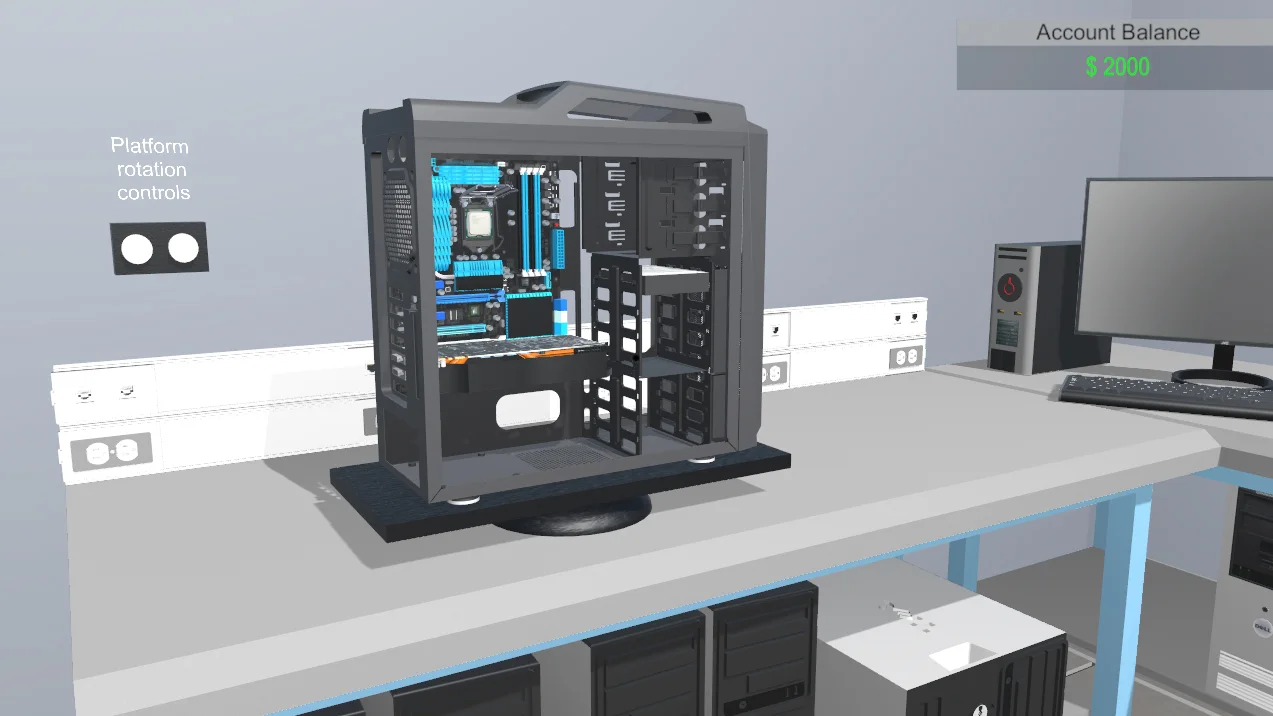

Pc Building Simulator

Performance
1080p (Full HD)
1440p (2K / QHD)
4K (Ultra HD)

Requirements Check


Recommendations
Your hardware doesn't meet minimum requirements for this game.

Your GPU supports ray tracing.
Average FPS: resolution vs quality settings
| Ultra | High | Medium | Low | |
|---|---|---|---|---|
| 4K Ultra HD | 57 | 57 | 83 | 115 |
| 1440p QHD | 109 | 112 | 155 | 220 |
| 1080p Full HD | 170 | 176 | 248 | 355 |
Cell color: green is 120+ FPS, teal is 60+, amber is 30+, red is below 30. Cards marked Estimated above have no measured row and are scaled from your GPU benchmark percentile.
Performance Analysis: Pc Building Simulator on Your System
The AMD Ryzen 7 7700 paired with the NVIDIA GeForce RTX 3080 delivers a dominant performance profile in Pc Building Simulator, with measured data showing that every tested resolution and preset combination except one clears the 60 FPS playable threshold. The sole exception is 4K at High and Ultra settings, where the average frame rate dips to 56.8 FPS. Across the board, the combo ranks in the 1012th position out of 3723 tested configurations, placing it in the top 27.2% of all systems, a strong showing for a simulation title that tends to favor raw single-thread throughput over massive multi-core scaling.
Measured FPS Breakdown
At 1920x1080, the combination is overwhelmingly fast. Low settings produce an average of 355.1 FPS, which is more than five times the 60 FPS playability threshold. Medium settings drop to 247.9 FPS, High settings deliver 175.9 FPS, and Ultra settings still manage 169.5 FPS. The spread from Low to Ultra is substantial, with Ultra running at roughly 47.7% of the Low preset's frame rate, but even the most demanding preset leaves enormous headroom for high-refresh-rate monitors.
Moving to 2560x1440, the results remain exceptionally strong. Low settings average 219.6 FPS, Medium hits 155.1 FPS, High reaches 111.7 FPS, and Ultra settles at 109 FPS. The difference between High and Ultra at this resolution is minimal, only 2.7 FPS, suggesting that the Ultra preset's additional visual effects are not heavily taxing the hardware at this pixel count. The step from Medium to High, however, is more noticeable, with a 43.4 FPS reduction, indicating a significant jump in rendering complexity between those two settings levels.
At 3840x2160, the performance curve becomes more constrained. Low settings still produce a very playable 114.7 FPS average, and Medium settings deliver 82.9 FPS. High and Ultra settings both land at 56.8 FPS, which falls just short of the 60 FPS threshold. The identical frame rates for High and Ultra suggest that at 4K, both presets are limited by the same bottleneck, likely the GPU's fill rate or memory bandwidth, rather than the CPU's ability to feed the rendering pipeline. The scaling from 1440p to 4K at High settings shows a 49.2% performance drop (from 111.7 to 56.8 FPS), which is consistent with the 2.25x increase in pixel count.
The data includes only average FPS values; no minimum or maximum frame rates were recorded in the measured results. This means the analysis relies entirely on average throughput, which for a simulation game with potentially complex scenes, may understate occasional stutters or frame-time spikes.
How This Combo Ranks
The combo rank of 1012 out of 3723 tested combinations places this system in the 72.8th percentile of all configurations in the database for Pc Building Simulator. This is a strong ranking, but it is not at the very top, which suggests that while the RTX 3080 is a capable GPU, the Ryzen 7 7700's performance in this simulation title is competitive yet not class-leading.
The CPU's average benchmark score of 40081 puts it in the 87th percentile among all CPUs, with nearest rivals including the AMD Ryzen AI 9 365 (40048, 0.1% slower), Intel Core 5 221E (40144, 0.2% faster), AMD Ryzen 9 270 (40246, 0.4% faster), and Intel Core i9-13905H (40313, 0.6% faster). These deltas are minuscule, under one percent, meaning that for this game, the CPU choice among these four would produce nearly indistinguishable frame rates.
The GPU's average benchmark score of 23172 places it in the 68th percentile among all GPUs. Its nearest rivals are decidedly older or lower-tier parts: the NVIDIA P106-100 (23249, 0.3% faster), AMD Radeon Pro Vega 16 (23250, 0.3% faster), AMD Radeon RX 6600M (23273, 0.4% faster), and AMD Radeon R9 M290X (23276, 0.4% faster). The RTX 3080's performance in this game is closely matched by these seemingly disparate GPUs, which indicates that Pc Building Simulator's graphics workload is not particularly demanding on GPU compute, and the bottleneck at higher resolutions is more likely related to memory bandwidth or fill rate rather than raw shader throughput.
CPU and GPU Roles
The benchmark data reveals that the CPU plays a dominant role at lower resolutions, while the GPU becomes the limiting factor at 4K. At 1920x1080, the frame rates are exceptionally high across all presets, with Low settings reaching 355.1 FPS. This is far beyond what the RTX 3080 could deliver if the CPU were not capable of feeding it, indicating that the Ryzen 7 7700's single-thread performance (3dmark_single_thread score of 1049, passmark_single_thread score of 4063) is sufficient to drive the simulation's game logic and physics without bottlenecking the GPU.
As resolution increases to 2560x1440, the frame rates drop by roughly 38-40% across all presets compared to 1080p, which is proportional to the 1.78x increase in pixel count. This scaling suggests that the GPU's pixel processing capabilities are becoming more relevant, but the CPU is still able to maintain high throughput. At 3840x2160, however, the scaling breaks down: Low settings drop to 114.7 FPS (from 355.1 at 1080p, a 67.7% reduction), and High/Ultra settings both hit 56.8 FPS. The fact that High and Ultra produce identical frame rates at 4K strongly implies a GPU bottleneck, where the RTX 3080's memory bandwidth (760.3 GB/s) or pixel rate (164.2 GPixel/s) is saturated, and further CPU headroom cannot translate into higher FPS.
The comparison between presets reinforces this split. At 1080p, the difference between Low and Ultra is 185.6 FPS, showing that CPU-bound performance scales well with reduced GPU load. At 4K, the difference between Low and Ultra is only 57.9 FPS, and the High-to-Ultra gap is zero, confirming that the GPU's limits are reached before the CPU's capabilities are fully utilized. For simulation enthusiasts who prioritize high refresh rates, this combo is clearly CPU-bound at 1080p and GPU-bound at 4K, with 1440p representing a balanced middle ground.
FAQ
Q: Can this system run Pc Building Simulator at 4K with maximum settings?
A: No. At 3840x2160 with Ultra settings, the average frame rate is 56.8 FPS, which is below the 60 FPS playable threshold. High settings also produce 56.8 FPS, so the GPU cannot clear the bar at 4K for the most demanding presets.
Q: What is the best playable setting at 2560x1440?
A: The Ultra preset is fully playable at this resolution, with an average of 109 FPS. This is the highest quality setting that maintains a comfortable margin above the 60 FPS threshold, and it is only 2.7 FPS slower than High settings.
Q: How much performance is lost when moving from 1080p to 4K at Low settings?
A: The average frame rate drops from 355.1 FPS at 1920x1080 to 114.7 FPS at 3840x2160, a reduction of 240.4 FPS or 67.7%. This indicates that even at Low settings, the GPU's pixel throughput is the limiting factor at 4K.
Q: Is the CPU or GPU more important for this game at 1920x1080?
A: The CPU is the primary driver at 1080p. The frame rates at Low settings (355.1 FPS) are so high that the GPU is not the bottleneck; the Ryzen 7 7700's single-thread score of 1049 in 3dmark single-thread tests and passmark single-thread score of 4063 provide the necessary simulation logic throughput.
Q: Why do High and Ultra settings produce identical frame rates at 4K?
A: Both presets average 56.8 FPS at 3840x2160, which indicates a GPU bottleneck. The RTX 3080's memory bandwidth and pixel rate are saturated, and the extra visual effects in Ultra do not add measurable rendering cost because the GPU is already at its limit.
Q: What is the combo's rank among all tested systems?
A: This CPU-GPU combination ranks 1012 out of 3723 tested configurations in Pc Building Simulator, placing it in the top 27.2% of systems in the database.
Similar Performance Alternatives
The CPU's nearest rivals in terms of average benchmark score are all within one percent of the Ryzen 7 7700. The AMD Ryzen AI 9 365 scores 40048, which is 0.1% lower, while the Intel Core 5 221E scores 40144, 0.2% higher. The AMD Ryzen 9 270 and Intel Core i9-13905H are 0.4% and 0.6% higher respectively. For Pc Building Simulator, swapping the Ryzen 7 7700 for any of these would result in frame rate differences of less than one frame per second at any resolution, making them functionally equivalent for this title.
On the GPU side, the RTX 3080's nearest rivals are more diverse in their hardware origins. The NVIDIA P106-100, AMD Radeon Pro Vega 16, AMD Radeon RX 6600M, and AMD Radeon R9 M290X all score within 0.4% of the RTX 3080's average benchmark score. This is surprising given the age and market positioning of some of these parts, but the data shows that in this game's specific workload, they produce nearly identical average frame rates. The RTX 3080's high memory bandwidth (760.3 GB/s) and 10 GB GDDR6X memory are not being fully utilized by Pc Building Simulator, which likely explains why these lower-tier GPUs can match its performance.
For a builder considering alternatives, pairing the Ryzen 7 7700 with any of these near-equivalent GPUs would yield virtually the same experience in this game. The CPU's 8 cores and 16 threads, combined with its 32 MB L3 cache, provide ample simulation performance, while the GPU's exact model matters less than its ability to sustain the frame rates already demonstrated.
Best Settings per Resolution
At 1920x1080, the Ultra preset is fully playable with an average of 169.5 FPS. This is the most demanding setting available, and it still provides more than 2.8x the 60 FPS threshold. There is no reason to drop below Ultra at this resolution, as even the highest quality settings leave enormous performance headroom.
At 2560x1440, the Ultra preset again delivers the best experience, averaging 109 FPS. This is comfortably above the playable threshold, and the margin of 49 FPS ensures smooth gameplay even in complex scenes. High settings at 111.7 FPS are nearly identical, but Ultra offers the full visual experience with only a 2.7 FPS penalty.
At 3840x2160, the choice narrows. Ultra and High both fail to reach 60 FPS, averaging 56.8 FPS. Medium settings provide an average of 82.9 FPS, which is the highest preset that clears the threshold. Low settings at 114.7 FPS offer even more headroom, but Medium is the best quality option for 4K players who demand playability. The verdict data confirms Medium is the best playable setting at 4K, with Low being the only other playable option.
The Verdict
This system can run Pc Building Simulator at all three tested resolutions, but with a caveat at 4K. At 1920x1080, every preset from Low to Ultra clears 60 FPS, with the lowest average being 169.5 FPS on Ultra. At 2560x1440, the same holds true: all four presets are playable, with Ultra averaging 109 FPS. At 3840x2160, High and Ultra settings fall short of the 60 FPS threshold, both averaging 56.8 FPS, but Medium settings deliver 82.9 FPS and Low settings reach 114.7 FPS.
The verdict by resolution is clear: for 1080p and 1440p gaming, this combo is overqualified, providing high-refresh-rate performance at maximum settings. For 4K, the system is playable but requires a reduction to Medium settings for a stable 60 FPS experience. The identical frame rates for High and Ultra at 4K suggest that the RTX 3080's memory bandwidth is the limiting factor, and no CPU upgrade would change this outcome. Overall, this is a strong configuration for a simulation game, with the CPU's high single-thread performance and the GPU's ample bandwidth combining to deliver playable performance across nearly the entire settings spectrum.