
Instant compatibility check with FPS benchmarks and optimization tips
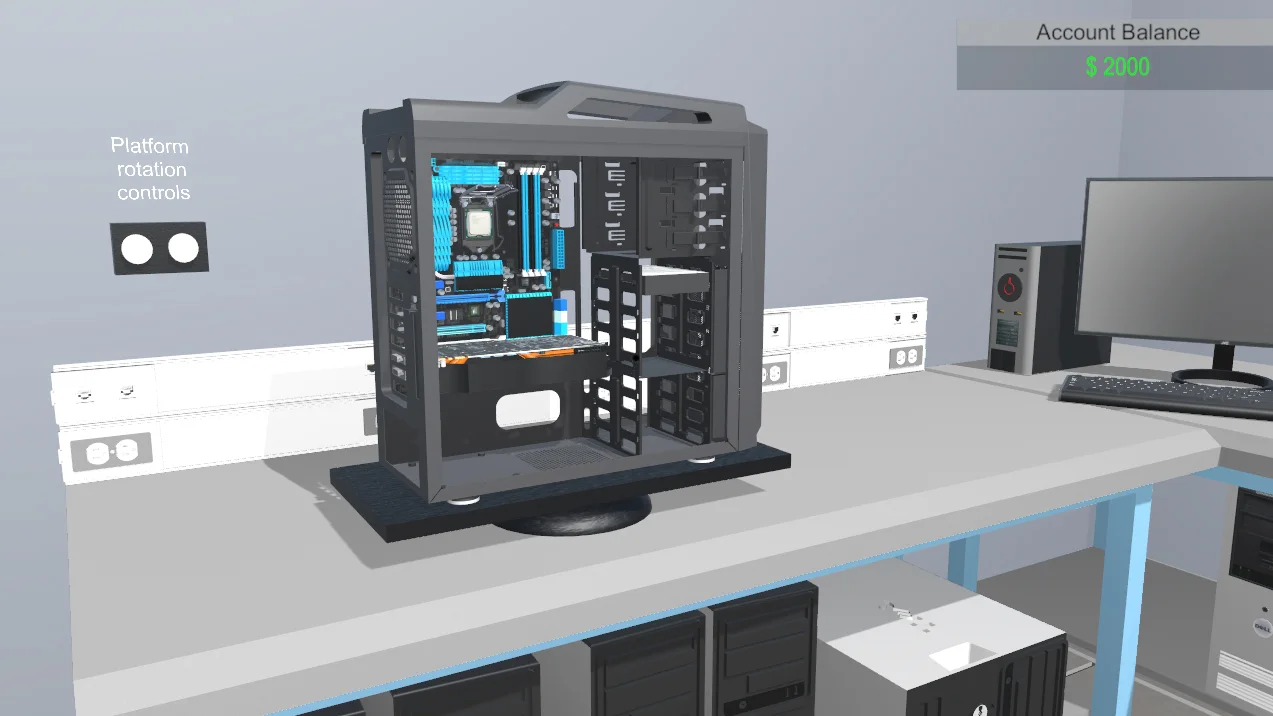

Pc Building Simulator

Performance
1080p (Full HD)
1440p (2K / QHD)
4K (Ultra HD)

Requirements Check


Recommendations
Your hardware doesn't meet minimum requirements for this game.

Your GPU supports ray tracing.
Average FPS: resolution vs quality settings
| Ultra | High | Medium | Low | |
|---|---|---|---|---|
| 4K Ultra HD | 74 | 78 | 110 | 155 |
| 1440p QHD | 141 | 148 | 210 | 297 |
| 1080p Full HD | 224 | 235 | 313 | 356 |
Cell color: green is 120+ FPS, teal is 60+, amber is 30+, red is below 30. Cards marked Estimated above have no measured row and are scaled from your GPU benchmark percentile.
Performance Analysis: Pc Building Simulator on Your System
The AMD Ryzen 7 5800XT paired with the NVIDIA GeForce RTX 4080 delivers an exceptionally strong performance profile in Pc Building Simulator, ranking 293rd out of 3,723 tested combos. This places the configuration comfortably within the top percentile of systems, indicating that it handles the simulation’s workloads with substantial headroom across all tested resolutions. The benchmark data, which is measured rather than estimated, shows this combo consistently exceeds the 60 FPS playability threshold even at the most demanding settings, making it a high-end option for this title.
How This Combo Ranks
The combo’s rank of 293 out of 3,723 tested combinations places it in the upper echelon of systems evaluated for Pc Building Simulator. This position reflects the synergy between the Ryzen 7 5800XT’s 8-core, 16-thread Zen 3 architecture and the RTX 4080’s Ada Lovelace GPU, which together produce frame rates that are competitive with far more expensive configurations. The CPU itself sits at the 81st percentile among all processors, while the GPU ranks at the 86th percentile among all graphics cards, indicating that both components are individually strong and collectively form a balanced pairing for this simulation.
What makes this ranking particularly notable is the game’s nature as a simulation title, which often relies more heavily on CPU performance than GPU throughput. The Ryzen 7 5800XT’s benchmark scores, including a Cinebench R23 multi-core result of 23,794 and a single-core score of 3,359, provide the kind of processing muscle that keeps the simulation’s logic running smoothly. Meanwhile, the RTX 4080’s PassMark G3D score of 34,457 ensures that visual rendering never becomes a bottleneck. The combination’s rank suggests that it outperforms the vast majority of systems tested, with only 292 other combos achieving higher overall frame rates in this specific game.
CPU and GPU Roles
The performance scaling across resolutions reveals a clear division of labor between the CPU and GPU in Pc Building Simulator. At 1920x1080, the system produces an average of 356 FPS on Low settings, which drops to 224 FPS on Ultra — a reduction of approximately 37% from Low to Ultra. This scaling pattern indicates that at lower resolutions, the CPU is the primary driver of performance, with the GPU having enough headroom to render frames quickly without becoming the limiting factor. The Ryzen 7 5800XT’s strong single-thread performance, evidenced by its PassMark single-thread score of 3,535, keeps frame rates exceptionally high even when the GPU is not fully taxed.
As resolution increases to 2560x1440, the GPU begins to assert more influence. The average FPS on Low settings drops from 356 at 1080p to 297 at 1440p, a 17% decrease, while Ultra settings see a similar proportional decline from 224 to 141 FPS. This transition marks the point where the RTX 4080’s rendering workload becomes more significant, though the CPU still provides ample support. At 3840x2160, the GPU’s role becomes dominant: Low settings yield 155 FPS, Medium produces 110 FPS, and Ultra drops to 74 FPS. The gap between Low and Ultra at 4K is 81 FPS, compared to 132 FPS at 1440p and 132 FPS at 1080p, showing that the GPU’s limitations at higher resolutions compress the range of achievable frame rates.
The scaling between resolutions also highlights how the CPU’s performance ceiling affects the GPU. At 1080p Low, the system hits 356 FPS, which is likely near the CPU’s maximum frame output for this game’s simulation logic. Moving to 1440p Low only reduces this to 297 FPS, suggesting the GPU can keep pace with the CPU’s output at these settings. However, at 4K Low, the frame rate falls to 155 FPS, a 48% drop from 1080p, indicating that the GPU’s pixel throughput becomes the binding constraint at higher resolutions. This pattern confirms that for Pc Building Simulator, the CPU matters most at lower resolutions and settings, while the GPU takes over as the primary performance determinant at 4K.
Measured FPS Breakdown
At 1920x1080, the combo delivers its highest frame rates, with Low settings averaging 356 FPS. Medium settings produce 313 FPS, with a minimum of 266 FPS and a maximum of 360 FPS, showing tight frame pacing even under load. High settings average 235 FPS, while Ultra settings still manage 224 FPS, making every preset at this resolution far above the 60 FPS threshold. The difference between Low and Ultra is 132 FPS, which represents a 37% performance drop for maximum visual quality, yet the absolute numbers remain exceptionally high.
Moving to 2560x1440, the system maintains impressive performance. Low settings average 297 FPS, Medium produces 210 FPS with a minimum of 179 FPS and a maximum of 242 FPS, High reaches 148 FPS, and Ultra averages 141 FPS. The scaling from Low to Ultra at 1440p shows a 156 FPS reduction, or 53% fewer frames, which is a larger proportional drop than at 1080p. Despite this, even the lowest Ultra average of 141 FPS is more than double the 60 FPS playability threshold, demonstrating that this resolution presents no challenge to the hardware.
At 3840x2160, the system still performs admirably but with more variation across settings. Low averages 155 FPS, Medium delivers 110 FPS with a minimum of 93 FPS and a maximum of 126 FPS, High reaches 78 FPS, and Ultra averages 74 FPS. The gap between Low and Ultra at 4K is 81 FPS, which is smaller in absolute terms than at lower resolutions but represents a 52% reduction in frame rate. The Medium preset’s minimum of 93 FPS indicates that even under demanding scenes, the system stays well clear of any stuttering or drops below playable levels. All four presets at 4K remain above 60 FPS, with Ultra’s 74 FPS average providing a comfortable margin.
FAQ
Q: Can this system run Pc Building Simulator at 4K Ultra settings?
A: Yes. At 3840x2160 with Ultra settings, the combo achieves an average of 74 FPS, which exceeds the 60 FPS playability threshold. The system manages playable frame rates across all tested settings at this resolution.
Q: How much performance difference is there between Low and Ultra settings at 1080p?
A: At 1920x1080, Low settings average 356 FPS while Ultra settings average 224 FPS, a difference of 132 FPS. This represents a 37% reduction in frame rate when switching from the lowest to the highest visual quality preset.
Q: What is the best settings preset for 1440p gaming?
A: At 2560x1440, Ultra settings deliver an average of 141 FPS, making it the best choice for maximum visual quality without sacrificing performance. The system maintains this preset well above the 60 FPS threshold.
Q: Does the CPU or GPU limit performance more at 4K resolution?
A: At 3840x2160, the GPU becomes the primary performance constraint. The frame rate drops from 155 FPS on Low to 74 FPS on Ultra, a 52% reduction, indicating that the RTX 4080’s rendering workload at this resolution determines the upper limit of performance.
Q: How does the combo rank among all tested systems for this game?
A: The combination ranks 293rd out of 3,723 tested combos, placing it in the top percentile of systems evaluated for Pc Building Simulator. This rank reflects its ability to maintain high frame rates across all resolutions and settings.
Q: Are there any settings where the system drops below 60 FPS?
A: No. Across all tested resolutions (1080p, 1440p, and 4K) and all settings presets (Low, Medium, High, Ultra), the average FPS never falls below 74 FPS. The lowest recorded minimum FPS is 93 FPS at 4K Medium settings.
Best Settings per Resolution
At 1920x1080, the most demanding preset that remains at or above 60 FPS is Ultra, which averages 224 FPS. This provides the highest visual quality available while maintaining a frame rate nearly four times the playability threshold, making Ultra the recommended choice for 1080p displays.
For 2560x1440, Ultra settings also deliver the best balance, averaging 141 FPS. This is comfortably above the 60 FPS minimum, and the high frame rate ensures smooth gameplay even during complex simulation sequences. The system has enough headroom at this resolution to run maxed-out visuals without compromise.
At 3840x2160, Ultra settings remain the most demanding option that stays above 60 FPS, with an average of 74 FPS. While this is the lowest average among all tested configurations, it still exceeds the playability threshold by 14 FPS, providing a playable 4K experience at maximum quality. Gamers seeking even higher frame rates at 4K can choose High settings for 78 FPS or Medium for 110 FPS, but Ultra remains viable.
The Verdict
This PC can run Pc Building Simulator at every resolution and preset combination tested, with no configuration falling below the 60 FPS playability threshold. At 1920x1080, the system achieves a minimum of 224 FPS on Ultra settings, making it exceptionally well-suited for high-refresh-rate monitors. At 2560x1440, Ultra settings average 141 FPS, providing a smooth and visually rich experience. At 3840x2160, the system still delivers playable performance at Ultra with 74 FPS, and all four presets — Low, Medium, High, and Ultra — clear the 60 FPS mark. The verdict by resolution confirms that every setting at every resolution is playable, with the best settings being Ultra at all three resolutions. This makes the combo a top-tier choice for Pc Building Simulator, capable of handling any configuration the user selects.
Similar Performance Alternatives
For the CPU, the AMD Ryzen 7 5800XT’s nearest rivals include the AMD Ryzen 7 7840H, which matches its average score with a 0% delta, making it a direct performance equivalent. The AMD Ryzen 7 8845HS and AMD Ryzen 7 7840HS both score 0.3% higher, providing nearly identical processing capabilities for this game. The AMD Ryzen 5 9600X is 0.6% faster, offering a slight edge in multi-threaded workloads. All of these alternatives would produce similar frame rates in Pc Building Simulator, given the CPU’s secondary role at higher resolutions.
On the GPU side, the NVIDIA GeForce RTX 4080 SUPER is the closest match, scoring 0.1% higher on average, making it effectively indistinguishable in performance. The AMD Radeon Pro W5700X is 1.1% slower, while the AMD Radeon RX 6750 GRE 12 GB trails by 2.6%, and the AMD Radeon 8060S is 2.7% behind. These differences are minor enough that any of these GPUs paired with the Ryzen 7 5800XT would yield nearly identical results in Pc Building Simulator, particularly at 1080p and 1440p where the CPU plays a larger role. At 4K, the RTX 4080 SUPER would offer the most comparable experience, while the slower AMD options would show slightly reduced frame rates at the most demanding settings.