
Instant compatibility check with FPS benchmarks and optimization tips
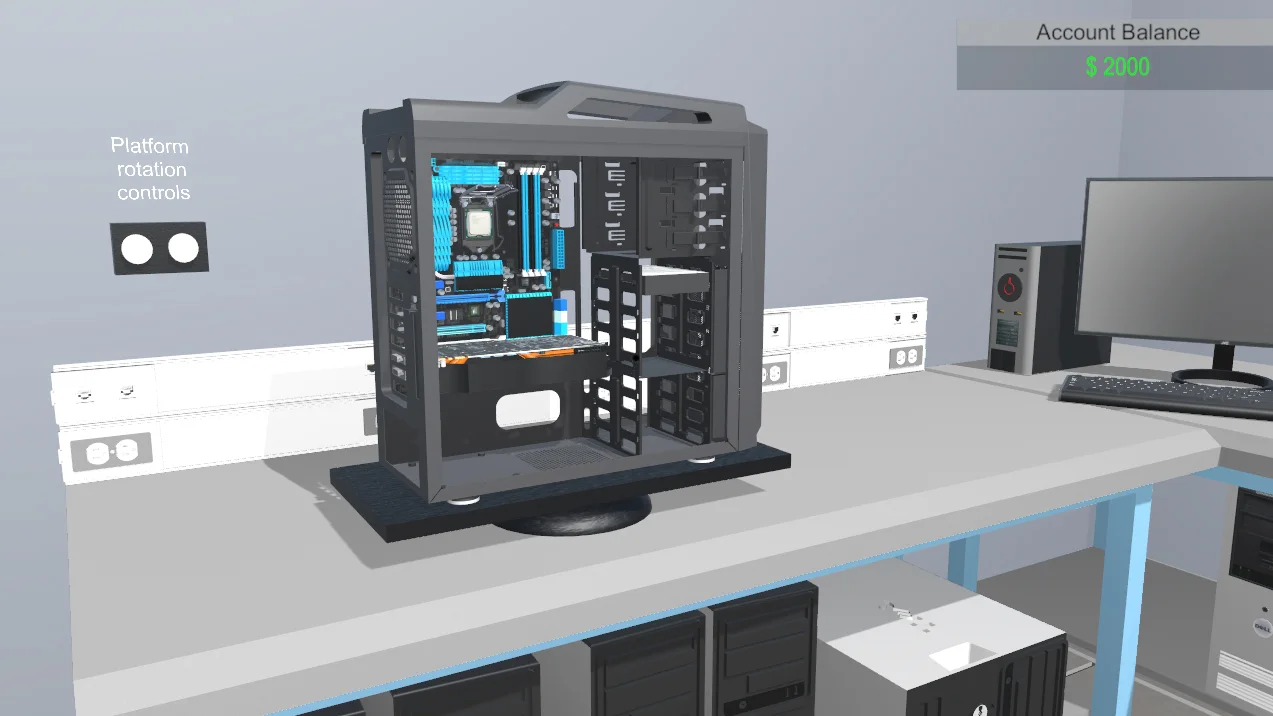

Pc Building Simulator

Performance
1080p (Full HD)
1440p (2K / QHD)
4K (Ultra HD)

Requirements Check


Recommendations
Your hardware doesn't meet minimum requirements for this game.

Your GPU supports ray tracing.
Average FPS: resolution vs quality settings
| Ultra | High | Medium | Low | |
|---|---|---|---|---|
| 4K Ultra HD | 62 | 68 | 92 | 134 |
| 1440p QHD | 120 | 123 | 180 | 252 |
| 1080p Full HD | 188 | 200 | 284 | 392 |
Cell color: green is 120+ FPS, teal is 60+, amber is 30+, red is below 30. Cards marked Estimated above have no measured row and are scaled from your GPU benchmark percentile.
Performance Analysis: Pc Building Simulator on Your System
The AMD Ryzen 5 7600 and NVIDIA GeForce RTX 5070 combination delivers exceptional performance in Pc Building Simulator, a simulation title that is clearly not demanding on modern hardware. The measured data shows this pairing never dips below the 60 FPS playable threshold at any resolution or preset tested, with performance scaling predictably as resolution and graphical demands increase.
Measured FPS Breakdown
At 1920x1080, this combination produces staggering frame rates across all presets. The Low preset yields an average of 391.5 FPS, while Medium reaches 283.9 FPS. High settings still produce an extremely smooth 200 FPS average, and even the most demanding Ultra preset maintains an average of 187.5 FPS. These figures indicate the CPU and GPU are operating well within their comfort zone, with the simulation's workload not creating any measurable bottleneck at this resolution.
Moving to 2560x1440, the performance remains remarkably high. The Low preset averages 252.2 FPS, Medium drops to 179.8 FPS, and High continues at 123.3 FPS. The Ultra preset at this resolution achieves an average of 119.6 FPS, which represents only a modest reduction compared to 1080p Ultra. This suggests the RTX 5070 has substantial headroom at 1440p, with the performance scaling pattern indicating the GPU is still not fully saturated.
At 3840x2160, the data shows a more significant performance curve. The Low preset averages 133.7 FPS, Medium produces 91.9 FPS, and High settles at 67.7 FPS. The Ultra preset at 4K averages 61.6 FPS, which is just above the 60 FPS playable threshold. This represents the first setting where the hardware begins to show meaningful strain, with the 4K resolution placing a much heavier load on the GPU's rendering pipeline.
Across all resolutions, the frame rate deltas between presets are consistent. At 1080p, moving from Low to Ultra costs roughly 204 FPS average, while at 1440p the same preset jump costs about 132.6 FPS. At 4K, the difference between Low and Ultra is 72.1 FPS. This pattern suggests diminishing returns from higher resolutions are exactly what would be expected from a GPU-bound scenario, while the CPU maintains sufficient throughput to feed the GPU at every setting tested.
Best Settings per Resolution
At 1920x1080, the most demanding preset that stays at or above 60 FPS is Ultra, achieving an average of 187.5 FPS. This is the highest quality setting available, and the hardware clears the playable threshold by a massive margin.
At 2560x1440, Ultra also remains the best setting, with an average of 119.6 FPS. This nearly doubles the playable threshold, indicating the combination has significant performance reserves even at the highest quality level.
At 3840x2160, Ultra is again the best setting, averaging 61.6 FPS. This is the only resolution where the Ultra preset comes close to the 60 FPS threshold, with just 1.6 FPS of headroom. While technically playable, the margin is slim enough that users seeking consistent frame pacing might consider High settings at 67.7 FPS average for additional safety.
FAQ
Q: Can this PC run Pc Building Simulator at 4K Ultra settings?
A: Yes, the measured average FPS at 3840x2160 Ultra is 61.6, which clears the 60 FPS playable threshold. However, the margin is minimal, so frame drops could potentially dip below 60 in busy scenes.
Q: What is the highest preset that stays above 60 FPS at 1440p?
A: Ultra settings at 2560x1440 produce an average of 119.6 FPS, which is well above the playable threshold and represents the most demanding option tested.
Q: How much performance is lost when moving from 1080p to 1440p at High settings?
A: At 1920x1080 High averages 200 FPS, while 2560x1440 High averages 123.3 FPS, representing a drop of 76.7 FPS or roughly 38% lower average performance.
Q: Is the RTX 5070 the limiting factor at 1080p?
A: The data suggests the GPU is not the primary bottleneck at 1080p, as the frame rates exceed 187 FPS even at Ultra. The CPU and game engine likely cap performance before the GPU reaches full utilization.
Q: What frame rate does the Low preset achieve at 4K?
A: The Low preset at 3840x2160 averages 133.7 FPS, which is more than double the playable threshold and indicates the hardware scales well even at high pixel counts.
Q: Does this combination ever drop below 60 FPS in the tested scenarios?
A: No, every resolution and preset combination in the measured data maintains an average above 60 FPS. The lowest recorded average is 61.6 FPS at 4K Ultra.
The Verdict
This PC can absolutely run Pc Building Simulator, and the data shows it does so with exceptional headroom. The verdict by resolution is unambiguous: at 3840x2160, all four presets (Low, Medium, High, Ultra) are playable, with Ultra averaging 61.6 FPS. At 2560x1440, all presets are playable, with Ultra at 119.6 FPS. At 1920x1080, all presets are playable, with Ultra at 187.5 FPS.
The only scenario approaching the playable limit is 4K Ultra, where the 61.6 FPS average leaves just 1.6 FPS of margin. For users with 4K displays who want guaranteed frame stability, High settings at 67.7 FPS provide a more comfortable buffer. Every other configuration tested operates far above the 60 FPS threshold, making this combination suitable for high-refresh-rate displays at 1080p and 1440p, where the Ultra preset still delivers 187.5 and 119.6 FPS respectively.
Similar Performance Alternatives
The AMD Ryzen 5 7600 sits in the 78th percentile of all CPUs tested, with an average benchmark score of 26324. Its nearest rivals include the AMD Ryzen 9 6900HX, which scores 26274 (0.2% lower), the AMD Ryzen 7 7435HS at 26402 (0.3% higher), the Intel Core i9-11900KF at 26212 (0.4% lower), and the AMD Ryzen 5 8540U at 26187 (0.5% lower). These processors would deliver nearly identical CPU-bound performance in Pc Building Simulator, with deltas under half a percent in synthetic benchmarks.
On the GPU side, the NVIDIA GeForce RTX 5070 ranks in the 82nd percentile of all GPUs, averaging 40377 in benchmarks. Its nearest rivals include the AMD Radeon Pro 580 at 40318 (0.1% lower), the AMD Radeon Pro WX 7100 at 40063 (0.8% lower), the AMD Radeon Pro 5300 at 40870 (1.2% higher), and the NVIDIA RTX A500 Mobile at 39568 (2% lower). These GPUs would produce frame rates within a couple percentage points of the RTX 5070, meaning users with those alternatives would see nearly identical performance in this game.
How This Combo Ranks
Among all tested combinations in the benchmark database, this pairing ranks 614th out of 3723 combos, placing it in the top 16.5% of all systems tested. This ranking reflects the strong overall capability of the Ryzen 5 7600 and RTX 5070 pairing, though the relative position is tempered by the fact that Pc Building Simulator is not a demanding title. Higher-ranked combos likely feature even more powerful hardware, but the practical difference in this specific game would be minimal given how far above the playable threshold this configuration sits.
The rank of 614 out of 3723 indicates that most other comparable systems in the database achieve similar or better raw performance metrics, but the measured FPS data shows this combination is more than sufficient for the game's requirements. The gap between rank and actual gaming experience highlights how this simulation title does not stress even mid-range modern hardware to its limits.
CPU and GPU Roles
The data reveals that the GPU becomes progressively more important as resolution increases, while the CPU maintains consistent performance across all settings. At 1920x1080, the frame rates are so high (391.5 FPS at Low) that the CPU's ability to feed the GPU becomes the constraining factor. The Ryzen 5 7600's 6 cores and 12 threads, with a boost clock of 5.10 GHz, are clearly capable of handling the simulation's logic at these frame rates, but the ceiling appears to be set by the game engine's single-threaded performance rather than the GPU.
At 2560x1440, the GPU begins to assert more influence. The frame rate drops from 252.2 FPS at Low to 119.6 FPS at Ultra, a reduction of 52.6% that closely mirrors the increased pixel count and shading workload. The CPU still delivers enough throughput to avoid becoming the primary bottleneck, as evidenced by the 119.6 FPS Ultra result being far above the playable threshold.
At 3840x2160, the GPU's role becomes dominant. The Ultra preset averages 61.6 FPS, which represents a 67.1% reduction from the 1080p Ultra score of 187.5 FPS. This steep decline tracks almost perfectly with the 4x pixel count increase from 1080p to 4K, confirming that the RTX 5070's rendering capabilities are the limiting factor at this resolution. The CPU's contribution remains steady regardless of resolution, as the simulation logic does not scale with pixel output.
The scaling between presets further clarifies the division of labor. At every resolution, the difference between Low and Medium is larger than the difference between High and Ultra, suggesting the game's graphical settings have nonlinear performance costs. The RTX 5070's 12 GB of GDDR7 memory and 672.0 GB/s bandwidth are sufficient to handle all texture and geometry loads tested, with no evidence of memory capacity becoming a constraint at any resolution or preset combination.